

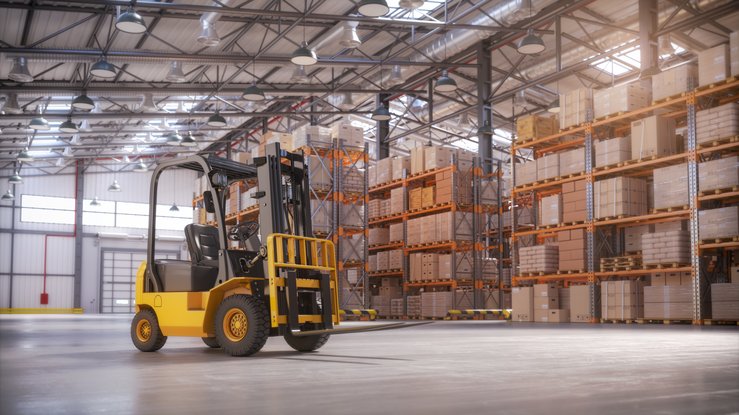
Delaware is a small state and it is more useful to say so than to pretend otherwise. There is real distribution here — there is not a great deal of it.
But it punches above its size in exactly one direction, and it is the direction that decides how a distributor here is priced. The Port of Wilmington is a specialized refrigerated import gateway: one of the country’s principal entry points for fresh fruit, including produce from Chile and Central America, and the bananas and tropical fruit that supply the mid-Atlantic. A striking share of the state’s storage capacity exists to keep fruit cold between a ship and a grocery shelf — and when a distributor owns that fruit, the whole insurance conversation tilts.
There is no published price for it. An insurance carrier builds the number from your operation. Here is what moves it.
Temperature is the loss cause
Most distribution businesses insure against something happening to their goods. A perishable importer insures against nothing happening at all — for a few hours, in the wrong room.
A refrigeration breakdown. A power interruption. A failed unit on a long haul. Any one of them can spoil an entire consignment of product you paid for, with no fire, no impact, no water, and not a scratch on the pallet. The goods look fine and are worth nothing. Because you own that stock, it is not a third-party claim; it is a hole in your balance sheet.
That is a stock throughput and spoilage conversation, not a property one, and it is priced on things that are entirely within your control: refrigeration maintenance, temperature monitoring, alarm response, standby power, and what your written plan says happens at two in the morning when a compressor stops. In a Delaware perishable book, that file moves the number more than any other single thing you can show an underwriter.
The season fills the cold rooms
This is what sizes the limit, and it is the routine mistake that costs the most.
Owners answer the inventory question with a comfortable annual average. Underwriters are asking: what is the maximum value of owned product concentrated in one place on one day? Because a loss does not wait for a convenient month.
Fruit does not arrive on a smooth curve. It arrives on a growing season, in a vessel, and the cold rooms fill hard when it does. The peak sits well above the average, and it lands in exactly the weeks a distributor can least afford an outage. A limit set to the quiet season is a limit that fails in the busy one — say the peak out loud, and let the placement answer for it.
The importer is the first U.S. seller
Here is the driver distributors are most surprised by, because it has nothing to do with the building or the trucks.
You sit in the chain of distribution, and a products-liability claim over something that causes injury can follow that chain to a seller — not only to the party that made or grew it. You did not plant it. You bought it and you sold it, and that is enough to be named. Anyone importing here should assume they are the first U.S. seller and sit in the chain accordingly: when the actual grower or maker is beyond the practical reach of a claim in this country, the importer is the realistic target.
For food that is not an abstract exposure — an ingestion profile carries a severity picture a hard good does not. General liability answers this through what the standard form calls the products-completed-operations hazard, and sizing that limit against what you actually import is most of the work on the submission.
Importing also lengthens the span your inventory is exposed for, which raises the question importers most often answer by accident:
When does the risk of loss actually pass to you?
A produce importer that takes title at origin owns the fruit on the water, at the terminal, in the cold room, and out to the grocery buyer. No single-location property policy follows that route. Stock throughput does — one marine-family form, supplier to customer. And a statewide foreign-trade zone, operated through the state itself with offices in Dover and Wilmington, gives a Delaware importer a straightforward path to duty-deferred and bonded storage without needing to be inside a port fence.
Water, wind, and the power going out
Commercial property does a bounded job for a distributor: the building, the racking, and the owned inventory while it sits in a scheduled location, plus the business income lost when that location goes down. It stops at the walls.
Delaware is flat, low, and coastal, and water is the story. Tidal and riverine flooding along the Delaware River and Bay, and surge and nor’easter flooding down the Atlantic side, are the perils that reach a dock door — which is exactly the height at which inventory sits. Flood is its own placement and belongs early in the conversation. Tropical systems bring wind onto large roof planes.
Freeze matters more here than the state’s mild reputation suggests, and for a specific reason: so much of Delaware’s storage capacity is refrigerated that a power interruption in a cold building is a stock loss, not an inconvenience. Hail and tornado exposure is modest; seismic is nil.
The middle tier is genuinely load-bearing
If you distribute beverages, Delaware is a license state with a conventional three-tier structure administered by the Office of Alcoholic Beverage Control Commissioner. A wholesaler license lets the holder buy from licensed suppliers or manufacturers and sell and deliver to licensed retail establishments, and out-of-state producers and importers that want their product on a Delaware shelf take a supplier license and must route it through a licensed Delaware wholesaler.
So the private middle tier here is not ceremonial — it is the road in. And the insurance consequence is direct: the inventory in that warehouse is genuinely yours at every step, which is exactly why it prices as a stock-throughput exposure and not a bailment. The compliance obligations of a licensed middle tier are a real operating cost sitting alongside the premium.
The fleet and the cold-room crew
A distribution business moves its own product, mostly up and down I-95 and out across the peninsula. Commercial auto prices the fleet on unit count, radius, what is hauled, and above all who drives — and a refrigerated trailer adds a cargo failure mode a dry van does not have. One note on language this trade cannot avoid: your insurance carrier is the company that writes your policy, which is an entirely different thing from a motor carrier or a freight carrier hauling goods for hire.
Workers compensation is a private-market line here. The exposure is the ordinary one — powered-industrial-truck traffic, dock work, racking and pallet handling, lifting strain — with a cold-room overlay that is disproportionate for the state’s size, because so much of what lands at Wilmington has to be handled cold. Cold-room work adds slip exposure and cold stress a dry warehouse never carries, and a distributor has route drivers on top of the warehouse crew.
Two ways to lose the same pallet
<text x="350" y="32" text-anchor="middle" font-family="Inter, sans-serif" font-size="15" font-weight="600" fill="#0F4C5C">The same pallet, lost two different ways</text>

<rect x="50" y="56" width="240" height="76" rx="8" fill="#ffffff" stroke="#C3DEDE"/>
<text x="170" y="82" text-anchor="middle" font-family="Inter, sans-serif" font-size="13" font-weight="600" fill="#0F4C5C">impact</text>
<text x="170" y="102" text-anchor="middle" font-family="Inter, sans-serif" font-size="11" fill="#3F5B64">fire, water, a collision</text>
<text x="170" y="120" text-anchor="middle" font-family="Inter, sans-serif" font-size="11" fill="#3F5B64">the damage is visible</text>

<rect x="410" y="56" width="240" height="76" rx="8" fill="#E2F4F3" stroke="#0F4C5C" stroke-width="2"/>
<text x="530" y="82" text-anchor="middle" font-family="Inter, sans-serif" font-size="13" font-weight="600" fill="#0F4C5C">temperature</text>
<text x="530" y="102" text-anchor="middle" font-family="Inter, sans-serif" font-size="11" fill="#3F5B64">a breakdown, an outage</text>
<text x="530" y="120" text-anchor="middle" font-family="Inter, sans-serif" font-size="11" fill="#3F5B64">nothing looks damaged</text>

<path d="M170 132 L170 168 L350 168 L350 196" stroke="#0F4C5C" stroke-width="2" fill="none"/>
<path d="M530 132 L530 168 L350 168" stroke="#0F4C5C" stroke-width="2" fill="none" stroke-dasharray="6 4"/>

<rect x="200" y="196" width="300" height="60" rx="8" fill="#ffffff" stroke="#0F4C5C" stroke-width="2"/>
<text x="350" y="222" text-anchor="middle" font-family="Inter, sans-serif" font-size="13" font-weight="600" fill="#0F4C5C">a total loss of goods you own</text>
<text x="350" y="242" text-anchor="middle" font-family="Inter, sans-serif" font-size="11" fill="#3F5B64">on your balance sheet, either way</text>

<rect x="40" y="274" width="620" height="54" rx="9" fill="#C8935A" stroke="#0F4C5C"/>
<text x="350" y="298" text-anchor="middle" font-family="Inter, sans-serif" font-size="14" font-weight="600" fill="#1A1A1A">Only one of these leaves a mark on the building.</text>
<text x="350" y="318" text-anchor="middle" font-family="Inter, sans-serif" font-size="14" font-weight="600" fill="#1A1A1A">Both of them cost you the whole consignment.</text>The honest summary
Delaware’s distributors are priced on perishable inventory, on how much of it is in the cold room at peak, on how well the cold holds when the power does not, and on what happens if the thing they sold makes somebody ill. The state is small; the exposure is not.
If you want the coverage mechanics rather than the cost drivers, stock throughput is the line this guide orbits, the Delaware distributor and wholesaler insurance page goes deeper on the exposures, and our wholesaling businesses pillar covers the operating shape. And if the goods in your building belong to your customers rather than to you, none of this is your program — you want the warehouse cost guide instead.