
Coverage line
Warehouse Legal Liability Insurance
The bailee line for a public, 3PL, contract, bonded, or cold-storage warehouse — coverage for loss to the customers’ goods you hold, the freight that is not yours but is your responsibility while it sits under your roof, and the exposure general liability’s care, custody, or control exclusion carves out by design.
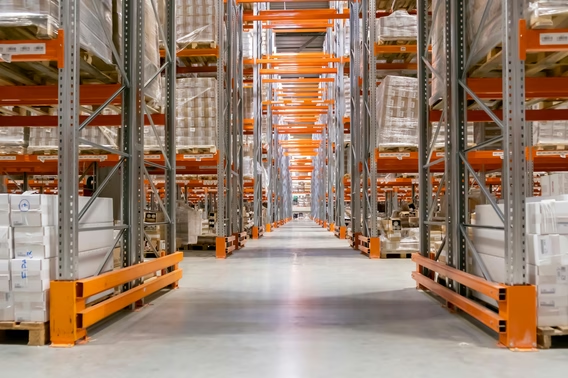

Warehouse legal liability is the coverage that answers for the one thing a warehouse handles more of than anything else: other people’s goods. The moment you take a customer’s freight into your building, you become a bailee — you hold property that belongs to someone else, and the law treats you as responsible for that property while it is in your care. This line exists to answer a loss to those goods that you are on the hook for, and it is the signature coverage of a business built on storing and shipping freight that is not its own.
It is also the line owners most often assume is already handled somewhere else, and it is not. Your general liability policy answers for the harm you cause other people and their property around your operation; your commercial property policy answers for your own building and equipment; neither one pays for damage to the customers’ goods sitting on your racks. That is a deliberate carve-out, not an oversight — and warehouse legal liability is the purpose-built line written to fill it. This page walks the bailee relationship, the honest difference between a legal-liability form and a broader all-risk bailee form, the warehouse-receipt language that shapes what you owe, and the seams where this coverage meets commercial property and stock throughput.
The bailee relationship: goods that are not yours, in your care
Everything about this line starts with a legal idea that is older than insurance: the bailment. When a customer hands their goods to you to store, they remain the owner, but you take custody — you accept the property into your care and control, and with it a duty to look after it. That relationship is the whole class of business for a public, 3PL, contract, bonded, or cold-storage operator. You do not own the freight on your racks; you hold it, you handle it, you ship it, and you answer for it while it is yours to protect.
Warehouse legal liability is the insurance written around that duty. It responds when goods in your care are lost or damaged and you are legally liable for that loss — when a fire, a water event, a theft, or a structural failure damages a customer’s inventory and the responsibility traces back to you. It is not coverage for your building or your own stock; it is coverage for your exposure to the owners of the freight you hold — the defining line for the bailee side of this brand, and the one a warehouse program cannot leave out without a hole exactly where the business lives.
The defining seam: what general liability’s care, custody, or control exclusion removes
Here is the line that is the whole reason this coverage exists, stated as the mirror of the general liability page. A standard general liability policy contains an exclusion for damage to personal property in your care, custody, or control. For most businesses that exclusion is unremarkable. For a warehouse it is the center of the risk — because the customers’ goods on your racks are precisely that: personal property in your care.
So the loss a public, 3PL, contract, or cold-storage operator worries about most — a fire, a sprinkler discharge, or a theft that damages a customer’s freight under your roof — is carved out of general liability by design. General liability answers the harm you cause others; it was never built to pay for the goods in your custody. Warehouse legal liability answers for exactly what that exclusion removes. The two lines are complementary halves of one program: the exclusion on one side, and the purpose-built bailee coverage on the other. Naming the exclusion by function rather than by clause number is deliberate — the specific letters and wording vary by form and edition — but the shape does not vary: the goods in your care are general liability’s carve-out, and this is where they are answered.
Legal liability versus all-risk bailee: the fault line
This is the distinction that separates a policy that protects you from one that only looks like it does, and it deserves an honest explanation rather than a sales one. A classic warehouse legal liability form answers only for loss to the goods that you are legally liable for — loss that traces to your negligence. If a fire you are responsible for, a water event, or a theft enabled by a failure on your part damages a customer’s inventory, a legal-liability form is built to respond. The trigger is fault: your responsibility for the loss.
A broader all-risk bailee or warehouse operators’ form works differently. It can respond to physical loss or damage to the goods in your care regardless of fault, within the terms and exclusions of the form. The practical difference is the part owners miss until a claim tests it: a no-fault loss — damage to a customer’s goods where you did nothing wrong and are not legally liable — may not trigger a pure legal-liability form at all, while a broader all-risk bailee form may reach it. Neither form is “better” in the abstract; they answer different questions. What matters is that your customers’ contracts and expectations often assume the broader answer, and a bare legal-liability form may not deliver it. We read which standard your policy is written to against what your storage agreements actually promise your customers, so the coverage and the commitment match.
Warehouse receipts and limitation of liability
A warehouse does not accept goods on a handshake; it accepts them on terms, and those terms shape the exposure this line insures. The warehouse receipt — the document you issue when you take custody of a customer’s goods — and the storage agreement behind it typically carry limitation-of-liability language: a released-value, per-package, or per-pound cap on what you owe a customer for a loss, unless they declare a higher value and agree to pay for that higher protection. It is the same idea a shipper meets in a freight carrier’s released-value terms, applied to storage.
That contractual limit and your insurance are one decision, not two. A limit your customers have accepted lowers the exposure your policy is sizing; a customer who declared a higher value, or a contract that waived the limit, raises it. We read your receipts and storage agreements alongside the coverage, so the limitation language you rely on and the policy that backs it point at the same exposure — without quoting a dollar norm, because those figures live in your contracts, not in a rule of thumb.
Those receipts sit inside a broader legal framework worth naming by function: the part of the Uniform Commercial Code that governs warehouse receipts and documents of title. It sets out how a warehouse receipt works as a document of title and what a warehouse’s duties and liabilities look like as a bailee. We reference it conceptually rather than reciting a section number, because the exact provisions are a matter for your counsel and the wording of your own agreements — but knowing that your receipts operate inside that framework is part of writing this line honestly.
The severity story: fire, water, theft, and racking collapse in someone else’s inventory
What makes this exposure serious is not only that the goods are not yours — it is how much of them sit under one roof, and how a single event can reach all of it at once. A distribution-scale building concentrates enormous value on the racks, and the causes of loss this line has to contemplate are the ones that damage inventory in bulk.
- Fire. A fire in a high-piled storage building can damage or destroy a customer’s inventory across a large footprint before it is controlled — the classic severity event for stored goods, and the one that defines why the limits on this line are read carefully.
- Water and sprinkler discharge. The system that protects the building from fire is itself a leading cause of damage to stored goods. A sprinkler activation, a pipe failure, or a roof leak can soak pallets of a customer’s freight — a frequent and expensive bailee loss.
- Theft. Freight is a target, and a theft of a customer’s goods from your building — whether by intrusion or from inside the operation — is a loss to property in your care that this line is written to contemplate.
- Racking collapse and material handling. A rack failure, an overloaded beam, or a forklift strike that brings down a bay can damage a customer’s inventory in an instant — a physical-damage severity that is distinct to a dense storage operation.
- Cold-chain failure. For a cold-storage or food-grade operator, a refrigeration or temperature-control failure that spoils a customer’s temperature-sensitive goods is a bailee loss of its own kind — the goods are intact but ruined, and the responsibility can trace to you.
Every one of these is a loss to someone else’s inventory that happens to be in your building. That is the entire point of the line, and the reason a bailee operation cannot treat it as optional.
A manuscript market, said plainly
One honest note about how this coverage is written, because it changes how you should buy it. Warehouse legal liability — and the broader bailee and warehouse operators’ forms around it — is largely a non-ISO, manuscript market. The wording is drafted by the insurers that specialize in the class rather than pulled from a single standard industry form the way a general liability policy is. That is not a warning; it is a fact about the line, and it has a consequence: two policies that both call themselves warehouse legal liability can differ meaningfully on the fault standard, the covered causes of loss, the treatment of your warehouse receipts, and how they sit next to your property and cargo coverage.
Because the form does the work here, this is a line to place with someone who reads the manuscript wording rather than assuming one form equals another. The comparison that matters is not the name on the policy but the language inside it.
The brand’s map: whose goods are at risk
Warehouse legal liability is one answer to a question the whole brand is built on, and the honest way to place it is alongside the other two answers rather than in isolation. When goods are damaged, the first question is not what happened but whose goods were at risk. Property answers what is yours and stays put; warehouse legal liability answers what is theirs but in your care; stock throughput answers what is yours anywhere it moves. This page is the middle answer — theirs-in-your-care — and it only makes sense next to the other two.
So the seams are worth drawing explicitly. The customers’ goods you hold as a bailee are this line. Your own building, your racking, and, for a distributor, the inventory you own at your location are a commercial property claim — yours, and it stays put. Your own inventory in transit and storage, anywhere it moves from the supplier to the customer, is stock throughput — yours, anywhere. And the exclusion that sends the customers’ goods to this line in the first place lives in general liability. Three questions about the pallets under your roof, answered by three purpose-built lines.
Why warehousing businesses need it
Warehouse legal liability is not an add-on for a bailee operation — it is the line the business is exposed on every day it holds a customer’s freight. It is the coverage your storage contracts assume you carry, the answer to a fire, water, theft, or racking loss to goods that are not yours, and the line that sits exactly where general liability’s care, custody, or control exclusion leaves off. A warehouse program that funds the building and the crew but leaves the customers’ goods to chance is insured everywhere except where it does business.
Because the exposure differs by the operation, the policy has to fit it. A Warehouse operation lives on this line — the customers’ goods in your care and the facility that holds them are the whole risk profile. A Distribution operation that also holds freight for its customers carries the bailee exposure alongside the fleet and the owned product on the move. A Wholesaler operation that stores its own inventory leans more on stock throughput and property, but takes on the bailee line the moment it holds goods for others. We rate each to the real operation rather than assuming one warehouse looks like the next.
Why Warehouse Guard Insurance
We are an independent agency that writes one world — warehousing, distribution, and wholesaling — and we place coverage with insurance carriers that actually want the bailee class. That focus is the point. We know to ask whether your policy is written to a legal-liability or a broader all-risk bailee standard; to read your warehouse receipts and the limitation-of-liability language they carry; to check that the fault standard in the form matches what your storage contracts promise your customers; and to draw the care, custody, or control seam so the goods in your care are answered here rather than assumed into general liability. When a customer’s contract lands on your desk with insurance requirements you do not recognize, that is a call we take. Start with a quote, or talk it through with us first.
Learn more
Coverage for a warehousing or distribution business works as a system. Warehouse legal liability pairs most often with general liability, whose care, custody, or control exclusion is the reason this line exists, commercial property for your building and the inventory you own at your location, stock throughput for owned inventory anywhere it moves, workers compensation for the crew on the floor, commercial auto for the fleet, and umbrella liability when a contract demands limits above your primary layer. How it is written also differs by the operation across the three service pillars — Warehouse Insurance, Distribution Insurance, and Wholesaler Insurance.
Coverage for warehousing and distribution
- General Liability Insurance
- Stock Throughput Insurance
- Commercial Property Insurance
- Workers Compensation Insurance
- Commercial Auto Insurance
- Umbrella Liability Insurance
Insurance by the operation you run
Get covered
Primary sources
Frequently asked questions about Warehouse Legal Liability Insurance
What is warehouse legal liability insurance?
Warehouse legal liability is the bailee line for an operation that stores and ships other companies’ goods. When you take in a customer’s freight, you become a bailee — you hold property that is not yours, and you are responsible for it while it is in your care. This coverage answers a loss to those goods that you are legally liable for: a fire, a water or sprinkler discharge, a theft, or a racking collapse that damages a customer’s inventory under your roof. It is the defining line for a public, 3PL, contract, bonded, or cold-storage warehouse, because the goods in your care are exactly what your general liability policy will not pay for.
Doesn’t my general liability policy already cover the goods I store?
No, and this is the seam owners most often get backwards. A standard general liability policy contains an exclusion for damage to personal property in your care, custody, or control — and the customers’ goods you store are exactly that. So the loss a warehouse worries about most, damage to a customer’s freight in your building, is carved out of general liability by that exclusion. That carve-out is not a gap to paper over; it is the reason a separate line exists. Warehouse legal liability is written precisely to answer for the goods in your care that general liability’s care, custody, or control exclusion removes.
What is the difference between a legal-liability form and an all-risk bailee form?
It is the difference between fault and no-fault, and it is the most important thing to understand about this line. A classic warehouse legal liability form answers only for loss you are legally liable for — loss that traces to your negligence, such as a fire or a water event you are responsible for. A broader all-risk bailee or warehouse operators’ form can respond to physical loss to the goods regardless of fault, within its terms. The practical consequence is real: a no-fault loss to a customer’s goods — damage where you did nothing wrong — may not trigger a pure legal-liability form, while a broader form may reach it. Which standard your policy is written to is something we read against your contracts before binding, because your customers’ expectations and your storage agreements often assume more than a bare legal-liability form provides.
How do warehouse receipts and limitation-of-liability clauses affect my coverage?
Warehouse receipts and storage agreements typically carry limitation-of-liability language — a released-value, per-package, or per-pound cap that limits what you owe a customer for a loss to their goods unless they declare a higher value and pay for it. That contractual limit and your insurance have to line up: a limitation your customers have agreed to, or refused, changes the exposure your policy is sizing. We do not quote a number here because those limits are set in your contracts, not by a rule of thumb; the point is that the warehouse-receipt terms you use and the coverage you buy are one decision, read together, not two separate ones.
Is warehouse legal liability a standard ISO policy?
Largely, no — and it is worth saying plainly. Warehouse legal liability and the broader bailee and warehouse operators’ forms are largely a non-ISO, manuscript market: the wording is written by the insurance carriers that specialize in the class rather than drawn from a single standard industry form. That is exactly why the form matters more here than in a commodity line. Two policies that both say “warehouse legal liability” can answer very differently on the fault standard, the covered causes of loss, and how they interact with your warehouse receipts. Reading the actual manuscript wording against your operation is the work, and it is the reason to place this line with a specialist rather than assume one form equals another.
What is warehouse legal liability, versus commercial property and stock throughput?
They are three answers to one question — whose goods were at risk. Commercial property answers what is yours and stays put: your building, your racking, and, for a distributor, the inventory you own at your location. Warehouse legal liability answers what is theirs but in your care: the customers’ goods you hold as a bailee. Stock throughput answers what is yours anywhere it moves: owned inventory in transit and storage from the supplier to the customer. Yours-here, theirs-in-your-care, yours-anywhere — a warehousing or distribution program is built from more than one line because more than one party’s goods are at risk under your roof.
Get warehouse legal liability written to the fault standard your contracts assume
Tell us who you store for and how your warehouse receipts read, and we will market the bailee line to insurance carriers that write the class — with the legal-liability-versus-all-risk question and the care, custody, or control seam handled, not assumed.