
Coverage line
General Liability Insurance for Warehouses & Distributors
The foundation policy for a warehousing or distribution business — premises and operations on the dock and in the yard, the products-liability chain a distributor or importer sits in, and the care, custody, or control seam that is the whole reason warehouse legal liability exists.
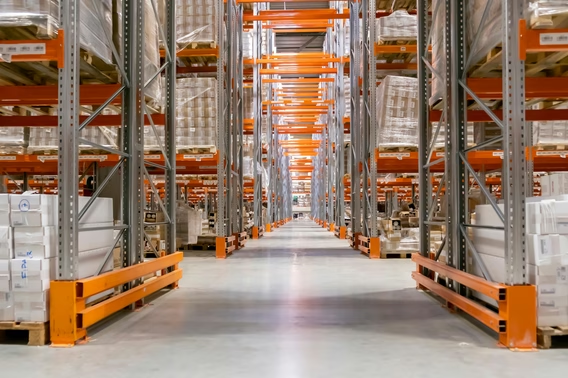

General liability is the coverage that answers for the people and property around your business — not your own crew, and not your own building, racking, or inventory, but everyone else who can be hurt or have something damaged because of what your operation does. For a warehousing or distribution business it is the foundation policy: the one a landlord wants to see on the lease, the one your 3PL and distribution customers build their insurance requirements on, and the one that decides whether a third-party claim is a phone call or a bill you pay out of pocket.
Two very different exposures live under it, because this brand insures two very different operations on one page. On the warehouse side, general liability answers the ordinary premises-and-operations risk of running a busy building — the dock, the yard, the forklift traffic, and the visitors and drivers moving through it. On the distribution and wholesaling side, it reaches something else entirely: the products-liability chain, the exposure a distributor, wholesaler, or importer carries as a seller in the chain of distribution. This page covers both frames, then slows down on the line that defines this brand — the care, custody, or control exclusion, the reason the goods you store for your customers are not a general-liability claim at all — and finally draws the honest seams where general liability stops and its neighbors begin.
Premises and operations: the dock, the yard, and the people moving through
Before anything specific to inventory or products, general liability answers for the everyday third-party risk of running a warehouse or distribution facility where the public, drivers, and other companies’ people are constantly around. A delivery driver, a customer’s representative, a vendor, or another company’s worker hurt on your premises — slipping on a wet dock, struck by a falling case off a rack, caught in the path of a forklift, or hurt in a congested yard — is a third-party bodily-injury claim, and general liability is built to respond to it and to the legal defense that comes with it.
The forklift is worth naming on its own, because it is the piece of equipment most likely to turn a busy operation into a claim. When a powered industrial truck strikes a third party — a visiting driver, a customer’s employee, someone who is not on your payroll — or damages property that is not yours, that harm is a general-liability matter. (The same forklift injuring your own operator is a workers compensation claim, a seam drawn below.) The same is true of damage you do to property that is not yours: a load dropped onto a customer’s trailer, a dock plate that damages a vehicle, a lift truck that puts a fork through freight staged by another company. These are third-party property-damage claims that arise around the operation, and general liability responds to them.
The products-liability chain: the distributor, the wholesaler, and the importer
For the distribution and wholesaling side of this brand, general liability carries a second exposure the pure warehouse does not: products liability. A business that buys, holds, and resells its own product sits in the chain of distribution, and when a product causes injury or property damage, a claim can follow that chain to any seller in it — not only the manufacturer who made the item. A distributor who never touched the design or the assembly can still be named, because the law that governs product claims reaches sellers, not just makers.
The exposure is sharpest for the importer. A wholesaler who imports goods made overseas is often the first U.S. seller of that product, and when the actual manufacturer sits beyond the reach of a U.S. claim, the importer can effectively stand in the maker’s shoes — the practical target for a products claim on goods that entered the country through them. We describe this plainly and without predicting any one outcome: the point is that an importing wholesaler’s general liability has to be sized for a products exposure a domestic-only distributor may carry more lightly.
The standard commercial general liability policy answers this through what it calls the products-completed-operations hazard. In the standard ISO coverage form — the one most policies start from, typically the occurrence-based form known as CG 00 01 — that hazard is a defined term covering bodily injury and property damage arising out of your product after it has left your possession. Because a product sold today can cause a loss months or years later, the trigger matters: the occurrence-based CG 00 01 responds to injury or damage that occurs during the policy period no matter when the claim is made, while the claims-made version, the CG 00 02 form, responds based on when the claim is reported and depends on continuous coverage and retroactive dates. For a distributor with a real products tail, that difference is worth reading before a loss, not during one; editions vary by insurer, so the wording actually attached to your policy is what governs.
The defining line: the care, custody, or control exclusion
Here is the seam that is the whole reason this brand exists, and it is worth reading slowly. A standard general liability policy contains an exclusion for damage to personal property in your care, custody, or control. It is a routine part of the form — and for most businesses it is unremarkable. For a warehouse, it is the center of the risk.
Think about what a public, 3PL, contract, or cold-storage warehouse actually holds: other companies’ goods, in your building, in your care. A fire, a sprinkler discharge, a theft, or a cold-chain failure that damages that freight is the loss a warehouse operator worries about most — and it is exactly the loss the care, custody, or control exclusion carves out of general liability. The goods are personal property in your care, so general liability, by its own terms, does not answer for them.
That carve-out is not a hole in your program to paper over; it is the reason a separate, purpose-built line exists. Warehouse legal liability is written precisely to answer for the customers’ goods that general liability’s care, custody, or control exclusion removes — the bailee coverage for freight that is not yours but is your responsibility while it sits under your roof. It is Signature #1 of this brand, and it exists because of the exclusion described here. We name the exclusion by function rather than by clause number, because the wording and its specific letters vary by form and edition; what does not vary is the shape of it — the goods in your care are carved out of general liability, and warehouse legal liability is where they are answered.
Additional insured: the endorsements your leases and contracts require
Warehousing and distribution run on contracts, and two kinds of them will demand additional-insured status on your general liability. The first is your building lease: a landlord almost always requires the tenant to name them as an additional insured for the premises, so a slip-and-fall in a leased warehouse does not land solely on the owner. The second is your customer agreements — the 3PL, dedicated-warehousing, and distribution contracts where the company you serve wants additional-insured status for the operations you perform on their behalf.
There is a third, specific to the distribution side: a distributor’s downstream customer — a retailer or a larger distributor buying your product — may ask to be added as an additional insured for the goods you supply, through what the industry calls a vendors endorsement. It extends a measure of your products-liability protection to the party selling your product further down the chain.
Whether your policy adds these on a blanket basis — additional-insured status “where a written contract requires it” — rather than scheduling each landlord, customer, or vendor by name, and at what limits, depends on the endorsements actually attached to your policy, and their editions vary by insurance carrier. We describe the demand honestly and read the endorsements against your leases and customer contracts before binding, rather than discovering a missing requirement when a certificate request lands on your desk.
Where general liability stops: the seams that matter
Some exposures look like they belong here and do not, and naming them honestly is the whole point — because an operator who assumes general liability answers for everything finds the gap during a claim. General liability covers the third-party harm your operation and your products can cause. Several neighbors pick up where it stops, and the first is the one this brand draws most carefully.
The customers’-goods seam — warehouse legal liability. This is the defining seam. General liability’s care, custody, or control exclusion removes damage to the goods you hold for your customers — the freight in your building that is not yours. Those goods are answered by warehouse legal liability, the bailee line written for exactly the property general liability carves out. General liability answers the harm you cause others; warehouse legal liability answers the harm to their goods in your care. It is the single most important line-drawing on this page.
The your-own-property seam — commercial property. General liability does not pay for your own things. Your building, your racking, your material-handling systems, and, for a distributor, the inventory you own are a commercial property claim, not a general-liability one. The line is ownership: general liability answers third-party harm, commercial property answers your own building and stock while they sit at your location.
The your-inventory-in-motion seam — stock throughput. Products liability and stock throughput are two different questions about the same pallet. General liability’s products side answers the harm your product causes someone else. Stock throughput answers damage to your own product itself — anywhere it moves, from the supplier through transit into the warehouse and out to the customer. One is liability to others for what your goods do; the other is coverage for the goods themselves.
The employee-injury seam — workers compensation. A forklift operator, a picker, a loader, or a dock worker hurt on the job is your own employee, and an injury to your own worker is a workers compensation claim, not a general-liability one. General liability answers third-party bodily injury — the people who are not your crew. Workers compensation answers your crew, and on a labor-dense warehouse floor it is one of the core lines in the program. The same forklift that is a general-liability matter when it strikes a visitor is a workers compensation matter when it injures your operator.
The road seam — commercial auto. General liability answers the premises and the operations; it does not cover your vehicles. The route-delivery trucks, final-mile vans, and yard vehicles that move goods between the dock and the destination — the at-fault accident, the physical damage, the auto liability on the road — run through commercial auto. Final-mile delivery is auto territory, not general liability.
The excess seam — umbrella. General liability carries per-occurrence and aggregate limits; when a landlord, a national customer, or a retail chain demands limits above your primary layer — as large distribution and 3PL contracts often do — that added limit sits in an umbrella policy, excess of this one. Umbrella does not change what is covered; it adds height over the general liability and auto policies beneath it.
The brand’s map: whose goods are at risk
Three of those seams are really one idea, and it is the map this whole brand is built on. When something is damaged, the first question is not what happened but whose goods were at risk. Property answers what is yours and stays put — your building, your racking, your own inventory at your location. Warehouse legal liability answers what is theirs but in your care — the customers’ goods general liability’s care, custody, or control exclusion removes. Stock throughput answers what is yours anywhere it moves — your owned inventory from the supplier to the customer. Yours-here, theirs-in-your-care, yours-anywhere: three questions about the same pallet, and the reason a warehousing or distribution program is built from more than one line.
Why warehousing and distribution businesses need it
What makes this class distinctive is that general liability sits at the center of a program with several purpose-built neighbors, and getting the center right is what keeps the neighbors from being assumed. It is the line a landlord and your customers insist on before they let you operate or sign a contract, and for a distributor it is the line that answers a products claim reaching you as a seller in the chain of distribution.
Because the exposure differs by the operation, the policy has to fit it. A Warehouse operation lives on the premises-and-operations exposure — the dock, the yard, the forklift traffic, and the visitors moving through — with the customers’ goods carved to warehouse legal liability. A Distribution operation adds the fleet and the product on the move. A Wholesaler operation carries the deepest products-liability chain, the importer’s first-U.S.-seller exposure, and the vendors demands that come with selling into retail. Writing all three off one generic form misprices the work. We rate each to the real operation.
What general liability responds to
These are the categories underwriters expect on a warehousing or distribution general liability file. They are described qualitatively and with generic carrier language — every claim is handled by the insurance carrier, never named here — with no fabricated cost or frequency figures.
- Premises and operations bodily injury. A visiting driver, a customer’s representative, a vendor, or another company’s worker injured on your dock or in your yard — a slip, a struck-by from a falling case, or the path of a forklift.
- Third-party property damage. Damage to property that is not yours — a customer’s trailer, another company’s staged freight, or a vehicle in your yard harmed by your operation.
- Products-liability claims in the chain of distribution. A product a distributor, wholesaler, or importer sold that later causes injury or property damage, answered under the products-completed-operations hazard — the exposure that reaches sellers, not only makers.
- The importer’s first-U.S.-seller exposure. A products claim on imported goods where the overseas manufacturer is out of reach and the importer is the practical target — the reason an importing wholesaler’s limits are sized larger.
- Additional-insured and certificate obligations. The landlord, customer-contract, and vendors requirements a general liability policy is written to satisfy, including additional-insured status where the contract demands it.
Limits and structure
General liability is usually written with a per-occurrence limit and separate aggregates — the general aggregate for premises-and-operations claims and, for a distributor, the products-completed-operations aggregate, the cap specific to product claims, which is the piece an importing or products-heavy wholesaler watches. The right structure is driven by the operation: whether you are a bailee warehouse, a route-based distributor, or an importing wholesaler; the products you handle and where they sit in the chain of distribution; the leases and customer contracts on your books; and your claims history. Landlord and national-account contracts especially drive the additional-insured and certificate-of-insurance requirements, often demanding specified limits. Rather than quote a number, we read what your contracts demand and build the structure to satisfy them. Where a contract calls for limits above your primary layer, that is what umbrella liability is for; the customers’ goods in your care are answered by warehouse legal liability, and your own building and inventory by commercial property, as separate lines.
Why Warehouse Guard Insurance
We are an independent agency that writes one world — warehousing, distribution, and wholesaling — and we place coverage with insurance carriers that actually want the work. That focus is the point. We know to ask whether you store other companies’ freight, move product on your own fleet, or import and resell your own inventory before we quote; to read whether a products tail means occurrence coverage matters to you; to draw the care, custody, or control seam so the customers’ goods in your care are answered by warehouse legal liability rather than assumed into general liability; and to set additional-insured and vendors endorsements to match your leases and contracts. When a certificate request lands on your desk with requirements you do not recognize, that is a call we take. Start with a quote, or talk it through with us first.
Learn more
Coverage for a warehousing or distribution business works as a system. General liability pairs most often with warehouse legal liability for the customers’ goods in your care that its care, custody, or control exclusion carves out, stock throughput for your owned inventory anywhere it moves, commercial property for your building and the inventory you own at your location, workers compensation for the crew on the floor, commercial auto for the delivery and yard fleet, and umbrella liability when a contract demands limits above your primary layer. How it is written also differs by the operation across the three service pillars — Warehouse Insurance, Distribution Insurance, and Wholesaler Insurance.
Coverage for warehousing and distribution
- Warehouse Legal Liability Insurance
- Stock Throughput Insurance
- Commercial Property Insurance
- Workers Compensation Insurance
- Commercial Auto Insurance
- Umbrella Liability Insurance
Insurance by the operation you run
Get covered
Primary sources
Frequently asked questions about General Liability Insurance
What does general liability cover for a warehouse or distribution business?
General liability responds to third-party bodily injury and property damage that arise from your operation — a visitor, a driver, a customer’s representative, or another company’s worker hurt on your dock or in your yard, and physical damage to property that is not yours. For a distributor or wholesaler it also reaches the products-liability side: a product you sold and passed down the chain of distribution that injures someone or damages their property. It does not cover your own employees’ injuries, which are workers compensation; your building, racking, or your own inventory, which are commercial property; the customers’ goods in your care, which are warehouse legal liability; or your fleet on the road, which is commercial auto.
Are distributors and importers really exposed to products liability?
Yes. A distributor, wholesaler, or importer sits in the chain of distribution, and a products-liability claim over a product that causes injury or damage can reach the seller of that product, not only the manufacturer who made it. For an importer who is the first U.S. seller of goods made overseas, that exposure is especially real — as the party who brought the product into the country, an importer can effectively stand in the maker’s shoes for a U.S. products claim when the manufacturer is out of reach. The standard commercial general liability form answers this through the products-completed-operations hazard, and how your limits and any vendors requirements are set is what we read against the products you actually handle.
What is the care, custody, or control exclusion, and why does it matter to a warehouse?
This is the single most important line on the page. A standard general liability policy excludes damage to personal property in your care, custody, or control — and for a warehouse, the goods you store for your customers are exactly that: personal property in your care. So the loss a public, 3PL, contract, or cold-storage operator worries about most — a fire, water, or theft loss to a customer’s freight under your roof — is carved out of general liability by that exclusion. That carve-out is not a gap in your program; it is the reason a separate line exists. Warehouse legal liability is written precisely to answer for the customers’ goods that general liability’s care, custody, or control exclusion removes.
Does general liability cover damage to my own building or inventory?
No, and this is the seam owners most often get backwards. General liability answers harm to a third party — a person who is not your employee, and property that is not yours. Your building, your racking, and, for a distributor, the inventory you own are commercial property, answered by a separate property line. A different line again — stock throughput — answers damage to your owned inventory while it is moving, anywhere from the supplier to the customer. General liability is about the harm you cause others, not about your own things.
My landlord and my customers require me to add them as additional insured — what does that mean?
Warehousing and distribution run on contracts, and two of them usually demand additional-insured status on your general liability: your building lease, where the landlord wants to be an additional insured for the premises, and your 3PL or distribution agreements, where a customer wants the same for the work you do for them. A distributor’s downstream customer can also be added for the products you supply, through what the industry calls a vendors endorsement. Whether your policy adds these on a blanket basis where a written contract requires it, and at what limits, depends on the endorsements actually attached — which is what we read against your leases and customer contracts before binding.
Does general liability cover my delivery fleet or an employee injured on the dock?
Neither — and both are common points of confusion. Your delivery and yard vehicles run through commercial auto, not general liability; the moment a loss involves a truck on the road, it is an auto claim. And an injury to your own employee — a forklift operator, a picker, a dock worker — is answered by workers compensation, not general liability, which covers only third parties. One note on language: your insurance carrier is the company that writes your coverage, which is a different thing from a motor carrier or freight carrier that hauls goods for hire. General liability sits at the center of the program, and these neighbors pick up where it stops.
Get general liability built around whose goods are at risk
Tell us whether you store other companies’ freight, move product on your own fleet, or import and resell your own inventory, and we will market it to insurers that write the class — with the care, custody, or control seam and the products chain handled, not assumed.