
Coverage line
Commercial Property Insurance for Warehouses & Distributors
The coverage for your own things that stay put — the building, the racking and material-handling systems, and, for a distributor or wholesaler, the owned inventory held under one roof. Cut cleanly from the customers’ goods in your care and from your product on the move.
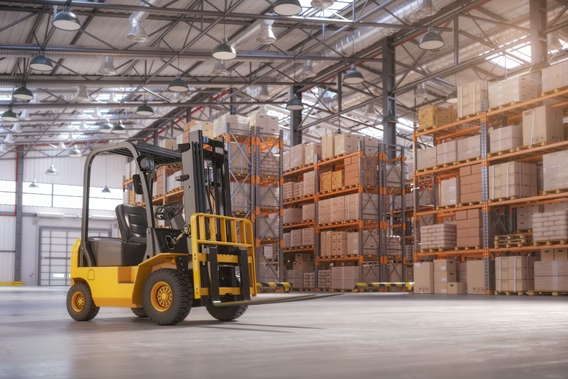

Commercial property is the coverage that answers for your own things — the physical assets your warehousing or distribution business owns and operates from, and keeps in one place. Not the people and property around you, which is general liability; not the freight your customers hand you to store, which is warehouse legal liability; and not your inventory while it is moving, which is stock throughput. Property answers the building, the racking and material-handling systems inside it, and — for a distributor or wholesaler — the inventory you own and hold under your roof.
For this class the property line carries a distinctive reality: scale. A single distribution center can put an enormous amount of value under one roof — a large building, a dense grid of racking, and, for an owner of inventory, a concentration of owned stock that most industries would spread across many locations. That concentration is the property underwriting story. This page walks through what property answers — building, racking, owned inventory, and the business income that keeps the operation whole after a loss — then draws the two seams that decide when something is not a property claim at all: the goods in your care, by ownership, and your inventory in motion, by motion.
The building, the racking, and the material-handling systems
At its foundation, commercial property answers physical loss or damage to the building you own or improve and the systems that make it a working warehouse. A fire, a windstorm, a burst pipe, a roof failure, or an impact loss to the structure is the claim property is built for — the shell itself and the improvements you have made to a leased space alike.
Inside the building, the property line reaches the equipment that turns a bare box into a distribution facility: the racking — selective, drive-in, push-back, or high-bay rack — the mezzanines, the dock levelers and dock equipment, the conveyors and sortation, and the other material-handling systems your operation runs on. In a modern warehouse these systems are a substantial share of the insured value, not an afterthought to the building, and a loss that takes out a rack line or a conveyor run can halt throughput as surely as damage to the structure. Property answers these fixed and installed assets as part of the building-and-contents picture; your powered industrial trucks and other rolling equipment are typically covered on their own terms, which is one of the details we confirm rather than assume.
Your own inventory — and the concentration a distributor carries
For a distributor or wholesaler, the property line takes on a second dimension the pure bailee warehouse does not: your own inventory. A business that buys, holds, and resells its own product owns the stock on its racks, and that owned inventory is a property exposure — covered while it sits at your insured location, subject to how the coverage handles fluctuating values and peak-season swings.
This is where the big-box reality of the class shows up most sharply. A distribution center concentrates owned-stock value under a single roof in a way few other operations do — inventory a retailer would fan out across many stores, or a maker would hold in smaller runs, sitting instead in one high-value building. That concentration is the center of the property underwriting conversation for an owner of inventory: not only what the building is worth, but what the peak value of the stock under that roof reaches when your buying season is at its height — which is why how a policy handles rising and falling inventory values, rather than a flat figure fixed at renewal, matters so much to a distributor. We size the coverage to your real concentration and describe it qualitatively; we never quote a figure we cannot stand behind.
Business income and extra expense: the shutdown after a loss
A property program that stops at the building and the stock misses the loss that often hurts most: the time the operation is down. Business income coverage answers the revenue you lose while a covered property loss keeps you from operating — the throughput that stops while you rebuild, replace racking, and get product flowing again — and extra expense answers the added cost of operating from a temporary site, expediting repairs, or rerouting product to keep customers served.
For a distribution operation built on moving volume, that downtime can be the larger loss, not the damaged building itself: a facility that cannot ship is a facility not earning, and the contracts that depend on it do not pause. We treat business income and extra expense as core parts of the property program, and we describe them qualitatively — the coverage is built to the operation, not to a number.
Fire protection and how a warehouse is underwritten
Property coverage for a warehouse is read, in large part, through how the building is protected. Construction type, the sprinkler system, whether the design is built for high-piled and rack storage — an early-suppression, fast-response arrangement is one such design — and the public fire-protection rating of the location all shape how an underwriter sees the risk and what a program looks like. High-piled and rack storage in particular raises the fire-protection expectations, because how product is stacked changes how a fire behaves and how a sprinkler system has to answer it.
We describe these as the concepts underwriters actually weigh, without quoting a protection-class rating or a sprinkler figure that would be fabricated rather than measured. What matters before a policy binds is the honest match between your building’s real protection and the storage you run — the commodity, the stacking height, the system design — because that match, not a generic assumption, is what a well-priced property program rests on.
Where property stops: the two seams that matter
Two exposures sit close enough to property that owners routinely assume they belong here — and both are answered by a different line. Naming them crisply is the whole point, because the assumption only surfaces during a claim. Each seam is drawn by a single, clean question.
The customers’-goods seam — warehouse legal liability, drawn by ownership. Property answers your own building and inventory. The freight your customers hand you to store is not yours; it is their goods in your care, and a standard general liability policy excludes damage to personal property in your care, custody, or control. That carve-out is not a gap to paper over — it is the reason a separate line exists. The customers’ goods are answered by warehouse legal liability, the bailee coverage written for exactly the freight that is not yours but is your responsibility while it sits under your roof. The dividing line is ownership: your own stock is property; the customers’ stock in your care is warehouse legal liability.
The inventory-in-motion seam — stock throughput, drawn by movement. Property answers your owned inventory while it stays put at your insured location — on the racks, on the floor, in the building. The moment that owned inventory is moving — inbound from a supplier or a port, between your facilities, or outbound to a customer — it steps outside the property line. Your owned product on the move is answered by stock throughput, the marine-family coverage written to follow your owned inventory anywhere it goes. The dividing line here is motion: property answers your stock where it sits; stock throughput answers your stock anywhere it moves.
One more neighbor: property does not answer harm to other people or their property — that is general liability, the harm your operation can cause others, not your own things.
The brand’s map: whose goods are at risk
Those seams are really one idea, and it is the map this whole brand is built on. When something is damaged, the first question is not what happened but whose goods were at risk. Property answers what is yours and stays put — your building, your racking, your own inventory at your location. Warehouse legal liability answers what is theirs but in your care — the customers’ goods general liability’s care, custody, or control exclusion removes. Stock throughput answers what is yours anywhere it moves — your owned inventory from the supplier to the customer. Yours-here, theirs-in-your-care, yours-anywhere: three questions about the same pallet, and the reason a warehousing or distribution program is built from more than one line.
Why warehousing and distribution businesses need it
Commercial property is the line that stands behind the physical operation — the building a landlord or a lender wants insured, the racking and systems the facility runs on, and, for a distributor, the owned stock that is often the single most valuable thing on the premises. Getting it right means matching the coverage to how the operation is actually built and protected.
Because that shape differs by the operation, the property program has to fit it. A Warehouse operation is read on the building, the racking, and the fire protection that a storage facility lives on — with the customers’ goods carved to warehouse legal liability, not property. A Distribution operation adds owned product that is often on the move, so the property line is drawn tightly against stock throughput. A Wholesaler operation carries the heaviest owned-inventory concentration under one roof — the peak-value story that defines its property underwriting. Writing all three off one generic form misreads the exposure; we rate each to the real operation.
Why Warehouse Guard Insurance
We are an independent agency that writes one world — warehousing, distribution, and wholesaling — and we place coverage with insurance carriers that actually want the work. That focus is the point. We know to ask what the racking and systems are worth, how much owned inventory sits under one roof at its seasonal peak, and how the building is protected for the storage you run, before we quote — and we draw the ownership seam so the customers’ goods in your care route to warehouse legal liability rather than into property, and the motion seam so your product on the move routes to stock throughput. Start with a quote, or talk it through with us first.
Learn more
Coverage for a warehousing or distribution business works as a system. Commercial property pairs most closely with warehouse legal liability for the customers’ goods in your care that its ownership seam carves out, and stock throughput for your owned inventory once it leaves the racks and moves. It sits alongside general liability for the harm your operation can cause others, workers compensation for the crew on the floor, commercial auto for the delivery and yard fleet, and umbrella liability when a contract demands limits above your primary layer. How the property program is written also differs by the operation across the three service pillars — Warehouse Insurance, Distribution Insurance, and Wholesaler Insurance.
Coverage for warehousing and distribution
- Warehouse Legal Liability Insurance
- Stock Throughput Insurance
- General Liability Insurance
- Workers Compensation Insurance
- Commercial Auto Insurance
- Umbrella Liability Insurance
Insurance by the operation you run
Get covered
Primary sources
Frequently asked questions about Commercial Property Insurance
What does commercial property insurance cover for a warehouse or distribution business?
Commercial property answers for your own physical things that stay put at your location — the building you own or improve, the racking and material-handling systems inside it, and, for a distributor or wholesaler, the inventory you own and hold under your roof. It also carries the business income and extra expense that keep the operation whole while you recover from a covered loss. It does not answer for the customers’ goods you store for others, which are carved out of your liability program and answered by warehouse legal liability; for your owned inventory while it is moving, which is stock throughput; or for harm to other people and their property, which is general liability. Property is about what is yours and stays where you keep it.
Does commercial property cover my customers’ goods stored in my warehouse?
No — and this is the seam warehouse operators most need to understand. Commercial property answers your own building and your own inventory. The freight your customers hand you to store is not yours; it is personal property in your care, custody, or control, and a standard general liability policy specifically excludes damage to it. That goods-in-your-care exposure is answered by a separate, purpose-built line — warehouse legal liability, the bailee coverage written for exactly the property your other policies leave out. The dividing line is ownership: your own stock is property, the customers’ stock in your care is warehouse legal liability.
Does property cover my owned inventory while it is in transit?
No. Commercial property answers your owned inventory while it stays put at your insured location — on the racks, on the floor, in the building. The moment that owned inventory is moving — inbound from a supplier or a port, between your facilities, or outbound to a customer — it steps outside the property line and into stock throughput, the marine-family coverage written to follow your owned product anywhere it goes. The dividing line here is motion: property answers your stock where it sits; stock throughput answers your stock anywhere it moves.
Why does the value of my inventory matter so much to a distributor’s property coverage?
Because a distribution or wholesaling operation concentrates value in a way most businesses do not. A single distribution center can hold an enormous amount of owned stock under one roof — inventory that a retailer or a maker would spread across many smaller locations. That concentration is the heart of the property underwriting conversation: the building and racking matter, but for an owner of inventory it is the peak value of the stock under that one roof — which rises and falls with your buying season — that drives how the coverage is structured. We size the coverage to your real inventory concentration, not to a flat guess, and we describe it qualitatively rather than quoting a figure.
Do sprinklers and fire protection affect my property coverage?
They shape it significantly, and understanding them is part of writing the coverage well. How a warehouse is built and protected — its construction type, its sprinkler system, whether it carries a design built for high-piled and rack storage such as an early-suppression, fast-response arrangement, and the public fire-protection rating of its location — all influence how a property underwriter reads the risk and what a program looks like. High-piled and rack storage in particular changes the fire-protection expectations. We describe these as the concepts underwriters actually weigh, without quoting a protection-class rating or a sprinkler figure, and we read your building’s real protection against the storage you actually run before a policy binds.
What is business income coverage, and does property include it?
Business income coverage answers the money you lose when a covered property loss shuts down or slows your operation — the revenue that stops while you rebuild, replace racking, and get product flowing again — along with the extra expense of operating from a temporary site or rushing repairs to reopen. For a distribution operation that runs on throughput, that downtime can be the larger loss, not the damaged building itself. It is part of a well-built commercial property program rather than an afterthought, and we describe it qualitatively — the shutdown after a loss is real, and we build the coverage to your operation rather than to a number.
Get property coverage built around what is yours and stays put
Tell us what your building, racking, and owned inventory are worth at their seasonal peak, and we will market it to insurance carriers that write the class — with the ownership seam and the motion seam drawn, not assumed.