

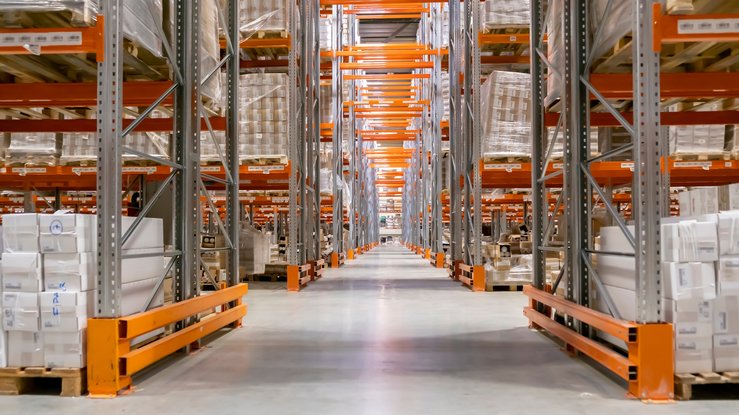
The Idaho distributor’s cost problem starts with a calendar that is not the retail calendar.
In most states, an owner of inventory peaks toward the end of the year, when the buying season fills the building. In Idaho a great deal of owned stock arrives when the crop comes off — and then stays. Potato, onion, and produce inventory, food and dairy product, agricultural inputs staged for a season that has not started yet: this is a state where a warehouse can look comfortably half empty for months and then be packed to the ceiling for months more. The average is a fiction. The peak is the whole story.
That is where the price is built, and there is no published number to shortcut it. Any figure quoted before an underwriter has seen your storage curve is a guess.
The fullest week, not the typical one
This is the number that sizes a stock throughput limit, and Idaho makes the mistake easy to commit.
Underwriters are not asking what you usually hold. They are asking: what is the maximum value of owned product concentrated in one place on one day? Because a loss does not wait for a convenient month, and in a state where the fill curve is driven by a harvest, the difference between the average answer and the true peak is not a rounding error. It is the part of your season that would be uninsured.
A limit set to the quiet stretch is a limit that fails during the full one. Seasonality is close to the center of an Idaho distributor’s submission rather than a footnote on it.
The tier you are not allowed to own
If you distribute beverages, Idaho has a ceiling written into the law rather than into the market.
The Idaho State Liquor Division is both the wholesaler and the retailer of distilled spirits. Product moves through state liquor stores and the contract retail stores the division authorizes; the division ships it out itself; bars and restaurants buy from the state. There is no private middle tier in spirits, because the state is already standing in it. But the division is equally plain that it has no oversight of beer and wine — those move through private distributors delivering to retailers in the ordinary way.
So the private Idaho beverage business is a beer-and-wine business, and the insurance consequence is direct: that inventory is genuinely yours at every step, which is exactly why it is a stock-throughput exposure and not a bailment.
The food chain you are already in
Here is the driver distributors are most surprised by, because it has nothing to do with the building.
You sit in the chain of distribution, and a products-liability claim can follow that chain to a seller — not only to the manufacturer who made the thing. A food or produce distributor sits in that chain with an ingestion profile attached to every case. An importer bringing a component into the Boise electronics cluster sits in it as the first U.S. seller of a part it never designed, and when the actual maker is beyond the practical reach of a U.S. claim, the first seller is the realistic target.
Neither of them manufactured anything. Both can be named. General liability answers this through what the standard form calls the products-completed-operations hazard, and sizing that limit against what you truly move — rather than against a generic revenue band — is a real piece of the submission.
Snow, fire, and a roof you cannot move
Commercial property does a bounded job here: your building, your racking, and your owned goods while they sit still, plus the income you lose when the building goes down.
Idaho’s two real perils for that building are fire and winter. Wildfire and wildland-urban interface exposure is a summer certainty in the rangeland and forest country, and smoke and ash can contaminate stored goods without the fire ever reaching the property — a contamination loss on a full building of food product is a total loss of the season with the walls still standing. Winter is the structural one: accumulated snow load on a wide, low-slope roof is a genuine collapse risk, and a hard freeze threatens sprinkler piping and dock seals in a building that was never designed for a long cold snap. Idaho carries seismic activity, though mostly in the sparsely built central mountains rather than under the Treasure Valley corridor. Flood is its own placement.
The trucks, the crew, and a distinction worth drawing
A distribution business moves its own product, which puts vehicles on I-84 through the Treasure Valley. Commercial auto prices the fleet on unit count, radius, what you haul, and above all who drives. Note the word: your insurance carrier writes your policy; a motor carrier hauls goods. Two meanings, one word, and the contracts you sign use both.
On workers compensation, Idaho is a private-market state with a competitive state fund selling alongside private insurers — a very different animal from the monopolistic fund next door in Wyoming. The exposures are the ordinary ones, plus a cold-room and seasonal-crew layer on the produce side where sacked and palletized farm product injures people differently than cartons do.
And there is no seaport. Idaho’s goods arrive over the road from the coast or up from Utah, which means the marine-family form here follows land transit, rail, and inland movement rather than an ocean voyage. It still follows them. The exposure is the same shape; only the map is different.
What the underwriter is actually pricing
<text x="350" y="32" text-anchor="middle" font-family="Inter, sans-serif" font-size="15" font-weight="600" fill="#0F4C5C">One building, one storage season</text>

<rect x="60" y="52" width="580" height="180" rx="8" fill="#ffffff" stroke="#C3DEDE"/>
<path d="M80 210 L200 206 L300 120 L430 108 L520 190 L620 208" stroke="#0F4C5C" stroke-width="3" fill="none"/>
<path d="M80 218 L620 218" stroke="#C3DEDE" stroke-width="2" fill="none"/>

<path d="M300 100 L430 88" stroke="#3F5B64" stroke-width="1.5" fill="none" stroke-dasharray="4 4"/>
<text x="365" y="80" text-anchor="middle" font-family="Inter, sans-serif" font-size="12" font-weight="600" fill="#0F4C5C">the crest — what the limit answers for</text>

<text x="140" y="196" text-anchor="middle" font-family="Inter, sans-serif" font-size="12" fill="#3F5B64">the quiet stretch</text>
<text x="140" y="176" text-anchor="middle" font-family="Inter, sans-serif" font-size="12" fill="#3F5B64">the number owners quote</text>

<text x="350" y="248" text-anchor="middle" font-family="Inter, sans-serif" font-size="12" fill="#3F5B64">the crop decides when the building is full</text>

<rect x="40" y="288" width="620" height="52" rx="9" fill="#C8935A" stroke="#0F4C5C"/>
<text x="350" y="312" text-anchor="middle" font-family="Inter, sans-serif" font-size="14" font-weight="600" fill="#1A1A1A">A limit set to the quiet stretch fails during the full one.</text>
<text x="350" y="331" text-anchor="middle" font-family="Inter, sans-serif" font-size="12" font-weight="600" fill="#1A1A1A">In Idaho, the harvest writes the curve — not the shopping season.</text>The honest summary
An Idaho distributor is priced on owned stock at its fullest, on what that stock actually is, and on a roof that has to survive both a fire season and a snow season. The beverage ceiling is statutory: spirits are the state’s, beer and wine are yours. There is no port, no bonded throughput trade worth building a story around, and no reason to pretend otherwise — Idaho is a real distribution market at an honest scale, and it prices like one.
If you want the coverage mechanics rather than the cost drivers, stock throughput is the line this guide orbits, wholesaling businesses is the broader program view, and the Idaho distributor and wholesaler insurance page goes deeper. If the goods in your building belong to your customers rather than to you — a grower’s crop under a bonded agricultural warehouse license, for instance — that is a different program entirely, and the Idaho warehouse cost guide is the one you want.