

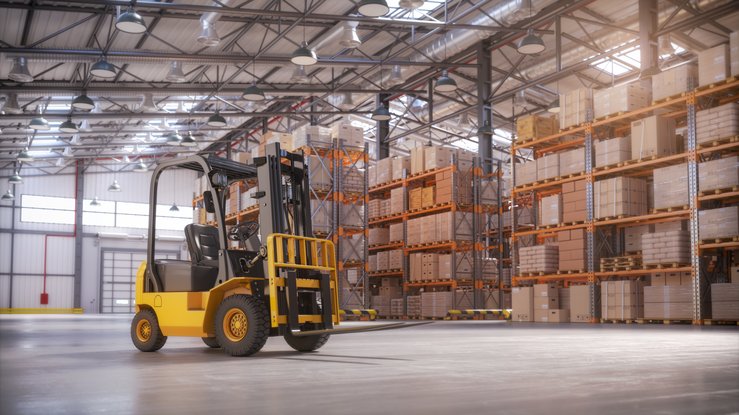
There are two distribution businesses in West Virginia, and they do not look much alike.
One is the regional supply business that covers the state itself: grocery and beverage wholesalers, building-products and industrial-supply distributors, energy and mining supply houses, holding owned inventory in Charleston, Huntington, or Parkersburg and trucking it out to a dispersed population over roads that climb. The other sits in the Eastern Panhandle, where Martinsburg and Berkeley County sit on I-81 within reach of Washington and Baltimore, and where large distribution operations located for the same corridor reasons that built the belt across the Pennsylvania line. That corridor, not the state as a whole, is where warehouse demand is actually growing.
Both own what they sell. That is the difference from the warehouse down the road, and it drives every number below. There is no published price for the insurance, and any figure quoted before an underwriter has seen the building is a guess.
Where the flat land is
Start with water, because in West Virginia an underwriter will.
The peril profile here is a mountain profile, and flash and riverine flooding in narrow valleys is the dominant catastrophe risk. The reason is simple and unavoidable: the valleys are where the flat land is, and the flat land is where warehouses get built. A distribution building and a flood path coincide by geography, not by carelessness.
For a business that owns its inventory, that fact has a sharp edge. Water arriving at a dock door does not damage a building so much as it destroys what is standing on the floor behind it — and the floor is where your product is. Flood belongs in its own placement rather than inside the property policy, and the elevation of your dock apron is the detail worth knowing before it becomes a claim, not after. Slope instability and landslide are secondary but real where a building or a rail siding was cut into a hillside.
Commercial property still does a defined job: it covers the building, the racking, and the owned inventory while it sits in a scheduled location, plus the business income you lose when that location goes down. Winter brings snow and ice load on wide-span roofs and freeze losses to sprinkler piping. Hail and tornado are comparatively light here. Seismic is not a factor.
Peak, not average
This is the number that sizes a stock throughput limit, and it is the most expensive routine mistake in the trade.
Owners answer the inventory question with an annual average. Underwriters are asking something else: what is the maximum value of owned product concentrated in one place on one day? Because a loss does not wait for a convenient month. It arrives when the building is fullest — ahead of a season, ahead of a project, ahead of a holiday — which for a wholesaler is precisely when it can least be afforded.
A limit set to the quiet season is a limit that fails in the busy one. Seasonality is close to the center of a distributor’s submission, not a footnote on it.
The spirits tier the state kept
If you distribute beverages, one structural fact decides what business is available to you — and it is narrower than most people assume.
West Virginia is a control state, but only at one tier, and only for one product. The Alcohol Beverage Control Administration sells distilled spirits at wholesale: the state occupies the spirits wholesale tier. Retail spirits sales were privatized decades ago and are made by privately owned retail liquor outlets. And wine and beer are different again — those move through private wholesalers and distributors licensed by the same agency.
So a West Virginia beverage distributor can build a real private wholesale book in wine and beer, and simply has no spirits wholesale tier to enter, because the state is already in it. The insurance consequence is direct: the wine and beer inventory in your warehouse is genuinely yours at every step, which is exactly why it is a stock-throughput exposure and not a bailment.
The product, and the chain that follows a seller
Here is the driver distributors are most surprised by, because it has nothing to do with the building or the trucks.
You sit in the chain of distribution, and a products-liability claim over something that causes injury or damage can follow that chain to a seller — not only to the manufacturer who made it. A wholesaler that never manufactured anything can still be named when a product it sold causes harm. You did not design it. You bought it and you sold it, and that is enough.
So an insurer prices what you handle. Building materials and industrial supply are one conversation; food, grocery, and beverage — anything with an ingestion profile — are another; mining and energy supply is different again. General liability answers this through what the standard form calls the products-completed-operations hazard, and sizing that limit against the goods you actually move is most of the work on the submission.
On imports, the honest description is a modest one. Bonded and duty-deferred storage exists — the state’s foreign-trade zone is centered on Charleston, and the Heartland Intermodal Gateway at Prichard functions as one of its sites — but zone activity here is genuinely thin compared with the coastal states around it, and saying so is more useful than dressing it up. If you do import, the rule is the same as anywhere: your exposure begins when the risk of loss passes to you under your purchase terms, not when the pallet lands in your building.
Mountain miles
A distribution business moves its own product, and here it moves it a long way over hard ground: I-64 and I-77 crossing at Charleston, I-79 running north, I-81 clipping the Eastern Panhandle, and a great many miles of two-lane between them.
Commercial auto prices the fleet on unit count, radius, what is hauled, and above all who drives — and grades, switchbacks, and winter surfaces make the driver-hiring file worth reading closely. One note on language this trade cannot avoid: your insurance carrier is the company that writes your policy, which is an entirely different thing from a motor carrier or a freight carrier hauling goods for hire. Owned goods on those roads are covered by the marine-family stock throughput form, not by the property policy, which stops at the walls.
Comp is a private market again
Workers compensation in West Virginia is no longer a state-fund line. Comp was moved out of the state fund and into the private market, and coverage is bought from private insurers today. That makes it a line you can genuinely market — and it makes your injury record and your loss-control program levers on your own price rather than facts you simply live with.
The exposure is the standard distribution set: powered-industrial-truck injuries, racking and stored-material falls, dock work, lifting strain. The state’s heavy-industry and river-terminal freight adds some breakbulk and bulk-handling exposure a purely pallet-and-parcel operation never carries. And a distributor carries two injury exposures rather than one — the warehouse crew, and the route drivers.
The elevation nobody asks about until it matters
<text x="350" y="32" text-anchor="middle" font-family="Inter, sans-serif" font-size="15" font-weight="600" fill="#0F4C5C">The valley gave you the flat land. It kept the water rights.</text>

<rect x="70" y="58" width="380" height="140" rx="6" fill="#ffffff" stroke="#0F4C5C" stroke-width="2"/>
<text x="260" y="80" text-anchor="middle" font-family="Inter, sans-serif" font-size="12" font-weight="600" fill="#0F4C5C">your building</text>

<rect x="100" y="108" width="70" height="80" rx="3" fill="#E2F4F3" stroke="#C3DEDE"/>
<rect x="190" y="108" width="70" height="80" rx="3" fill="#E2F4F3" stroke="#C3DEDE"/>
<rect x="280" y="108" width="70" height="80" rx="3" fill="#E2F4F3" stroke="#C3DEDE"/>
<rect x="370" y="108" width="60" height="80" rx="3" fill="#E2F4F3" stroke="#C3DEDE"/>
<text x="260" y="154" text-anchor="middle" font-family="Inter, sans-serif" font-size="12" font-weight="600" fill="#0F4C5C">owned stock, at floor height</text>

<path d="M70 198 L640 198" stroke="#0F4C5C" stroke-width="2"/>
<text x="545" y="192" text-anchor="middle" font-family="Inter, sans-serif" font-size="12" font-weight="600" fill="#0F4C5C">the dock threshold</text>

<path d="M450 214 L640 214" stroke="#0F4C5C" stroke-width="2" stroke-dasharray="6 4"/>
<text x="545" y="234" text-anchor="middle" font-family="Inter, sans-serif" font-size="12" font-weight="600" fill="#0F4C5C">flood: its own placement,</text>
<text x="545" y="251" text-anchor="middle" font-family="Inter, sans-serif" font-size="12" fill="#3F5B64">never inside the property form</text>

<text x="260" y="234" text-anchor="middle" font-family="Inter, sans-serif" font-size="12" fill="#3F5B64">property answers for the building and the racking</text>
<text x="260" y="251" text-anchor="middle" font-family="Inter, sans-serif" font-size="12" fill="#3F5B64">while the goods stand still inside it</text>

<rect x="40" y="268" width="620" height="52" rx="9" fill="#C8935A" stroke="#0F4C5C"/>
<text x="350" y="292" text-anchor="middle" font-family="Inter, sans-serif" font-size="14" font-weight="600" fill="#1A1A1A">Your dock-door elevation decides whether a water event</text>
<text x="350" y="311" text-anchor="middle" font-family="Inter, sans-serif" font-size="14" font-weight="600" fill="#1A1A1A">is an inconvenience or the loss of everything you own.</text>The honest summary
West Virginia is a small distribution economy with one genuine growth corridor and one very large peril. Price the flood decision first, then the peak, then the product, then the drivers who take your stock over the mountains. The building matters — but only for the part of the journey that stands still.
If you want the coverage mechanics rather than the cost drivers, stock throughput is the line this guide orbits, the West Virginia distributor and wholesaler insurance page goes deeper on the exposures, and our wholesaling businesses pillar covers the operating shape. And if the goods in your building belong to your customers rather than to you, none of this is your program — you want the warehouse cost guide instead.