

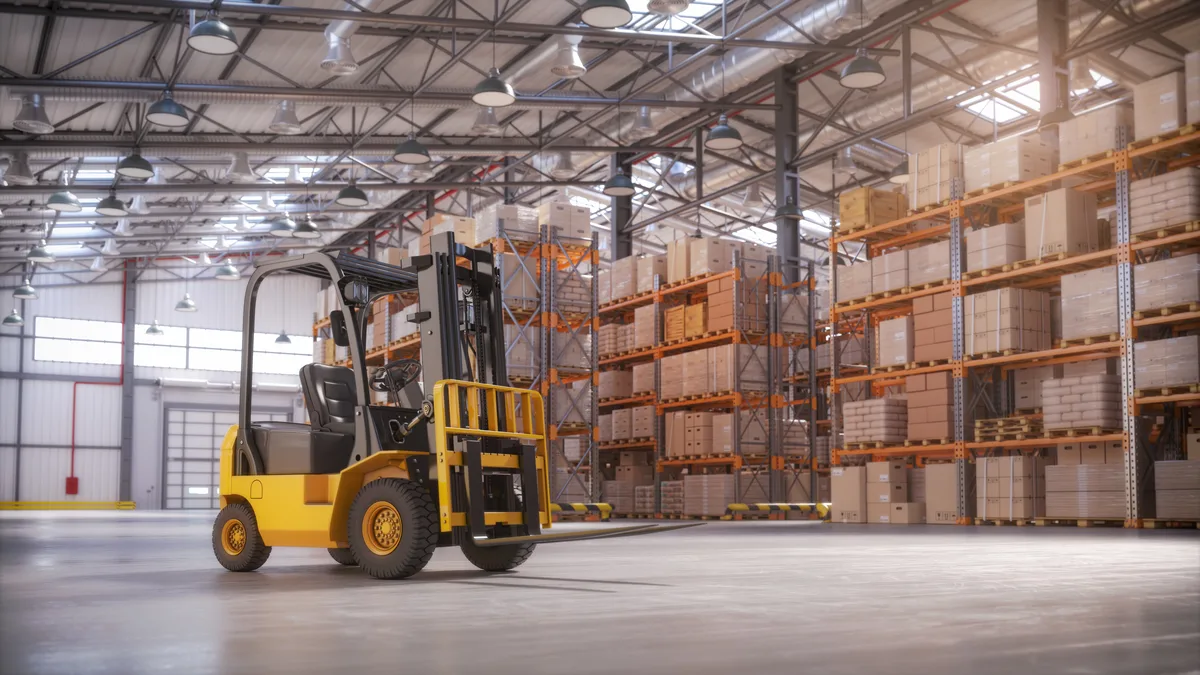
A warehouse fire is a single event. A warehouse bailee loss is not — it is as many losses as there are owners, all arriving at once.
That distinction is not academic in Maryland. A transload building behind the Port of Baltimore is holding deconsolidated import cargo for many importers and retailers at the same time. A yard near the terminals is holding vehicles and equipment for a chain of owners who have never met each other. One fire, one storm, one hail event reaches every one of them together — and every one of them has a claim against you.
So a Maryland cost guide has to begin with the arithmetic of accumulation, because that is where the limit comes from.
The aggregate, not the average
The value and the nature of the customers’ goods in your care is what sizes a warehouse legal liability limit. In a port market, the word doing the quiet work in that sentence is customers’ — plural, and more of them than you are counting.
Not your largest account. Not a typical week. Everything belonging to everybody, on the fullest day of the year. That is the number the limit has to answer for, and it is the number that gets understated — partly because none of that inventory is on your balance sheet, and partly because owners instinctively think in terms of their biggest customer rather than the sum of all of them.
Nature deserves the same honesty. Imported consumer goods staged off a terminal, grocery product in a licensed food warehouse, machinery and equipment: they occupy similar footprints and carry entirely different amounts at risk per pallet, and they are lost by entirely different routes. Some burn. Some spoil. Some walk out the door.
Rolling stock: a bailment the container markets never see
The Port of Baltimore is not a pure container gateway. It is a deep-water port with a heavy specialization in automobiles, roll-on roll-off equipment, and breakbulk, and that gives the warehouses and yards around it a custody exposure most distribution markets simply do not have.
High-value vehicles and equipment in somebody else’s custody. Frequently outdoors. Frequently in motion across a yard. And the accumulation is brutal in exactly the way described above — a single hail event touches many owners’ property at once, and each unit is worth a great deal on its own.
If any part of your custody looks like that, it has to be said plainly in the submission. An underwriter pricing a pallet-and-rack building has priced a different business than the one you are running, and the difference surfaces after a storm rather than before it — which is the worst possible time to discover it.
Bonded, along the belt
Maryland carries real foreign-trade-zone coverage anchored on the port, reaching across Baltimore City and out into the surrounding counties along the I-95 warehouse belt, with a separate zone positioned between the port, the airport, and the Washington market.
If you admit duty-deferred cargo, you have taken on customs obligations stacked on top of your ordinary duty of care to the owner. One pallet, two masters — and an underwriter prices the accumulation of both, because a loss on bonded goods triggers a customs consequence as well as a customer’s claim.
Add a grocery account, acquire a license
Maryland has no general public-warehouse licensing statute. The one storage-adjacent license the state runs is agricultural — the Department of Agriculture licenses persons buying, receiving, exchanging, or storing grain from producers, and requires proof of insurance on the grain they take into possession. Narrow, commodity-specific, and not a general warehouseman law. A Maryland third-party building storing pallets for a retailer needs no state warehouse license, and its duty runs through the bailment and the warehouse receipt.
But food is licensed by name here, and this is where operators get surprised. The Department of Health licenses and inspects food processing plants, warehouses, and milk and dairy facilities, and some counties have stepped back from licensing warehouses locally and now point applicants to the state. So a third-party operator who adds a grocery or dairy account has not merely won business — it has acquired a state license, an inspection relationship, and a plan review along with it.
For everything else, the absence of a license is a cost driver. Your storage agreement is the entire perimeter around a claim, and an underwriter reads it accordingly: the limitation-of-liability language, the released-value terms, what the contract says about goods held outside a building, and whether any of it would survive being tested.
The Chesapeake, and the height of your dock door
Commercial property carries the shell, the racking, the material-handling systems, and the income lost while the site is down. The perils, though, split along the geography:
- Flood is its own placement. Tropical systems and coastal storms drive surge and tidal flooding around the bay and up the tidal rivers, and the port and Sparrows Point industrial areas sit low. Dock-door elevation is an underwriting fact here, not a detail.
- Wind takes the roof plane on a coastal storm, and it reaches anything standing on a yard.
- Inland is a different state. Along the I-70 and I-81 approaches — the Hagerstown cluster, which behaves more like southern Pennsylvania than like the port — the recurring property loss is severe-thunderstorm wind and hail on a wide roof. Western Maryland adds snow load. Seismic is immaterial.
Reading the storage contract like an underwriter does
Because Maryland writes you no standard of care, the storage agreement is the document that decides the size of the loss. It is worth knowing which clauses actually get read, and why.
The limitation of liability. Did the customer accept it, negotiate it away, or sign a master agreement of their own that quietly overrides yours? A released-value clause that a national account struck out three renewals ago is still gone this year, and the exposure the policy is being asked to size went up when it went.
The release terms. In a port building this is where the money is. Who is authorized to take delivery of a container-load of somebody else’s cargo? What documentation does a driver present? What happens when a customer telephones and asks you to release freight to a dispatcher you have never heard of? Misdelivery is a bailee loss with no fire, no storm, and no damage — the goods simply left with the wrong person, and the duty of care was breached at a desk.
The deconsolidation record. When a container is stripped and its contents belong to several owners, the paperwork created in that hour is what will be argued over later. Whose pallet was short. Whose carton arrived crushed. Whether it was crushed before you touched it.
An underwriter reads those three because they describe how a claim would actually be defended — and a contract that would not survive being tested is priced as if it will not be.
The crew, at the water and along the corridor
Workers compensation is a private-market line here, written alongside a competitive state-chartered fund — competitive, which is a different thing from monopolistic, and the distinction matters.
The exposure tracks the port and the corridor: dock and lift-truck injuries in the I-95 and airport-area buildings, container and breakbulk handling injuries near the marine terminals, and the ordinary warehouse pattern of racking work, pallet handling, and lifting strain. The automotive and roll-on roll-off trade pulls a heavier vehicle-handling exposure into the surrounding buildings than a purely containerized market ever would, and the classifications you actually run reflect that.
One event, every owner
<text x="350" y="30" text-anchor="middle" font-family="Inter, sans-serif" font-size="15" font-weight="600" fill="#0F4C5C">A loss does not choose an account</text>

<rect x="26" y="48" width="152" height="52" rx="9" fill="#ffffff" stroke="#C3DEDE"/>
<text x="102" y="70" text-anchor="middle" font-family="Inter, sans-serif" font-size="12" font-weight="600" fill="#0F4C5C">An importer</text>
<text x="102" y="88" text-anchor="middle" font-family="Inter, sans-serif" font-size="11" fill="#3F5B64">Deconsolidated cargo</text>

<rect x="188" y="48" width="152" height="52" rx="9" fill="#ffffff" stroke="#C3DEDE"/>
<text x="264" y="70" text-anchor="middle" font-family="Inter, sans-serif" font-size="12" font-weight="600" fill="#0F4C5C">A retailer</text>
<text x="264" y="88" text-anchor="middle" font-family="Inter, sans-serif" font-size="11" fill="#3F5B64">Staged pallets on your rack</text>

<rect x="350" y="48" width="152" height="52" rx="9" fill="#ffffff" stroke="#C3DEDE"/>
<text x="426" y="70" text-anchor="middle" font-family="Inter, sans-serif" font-size="12" font-weight="600" fill="#0F4C5C">A grocery account</text>
<text x="426" y="88" text-anchor="middle" font-family="Inter, sans-serif" font-size="11" fill="#3F5B64">In licensed food storage</text>

<rect x="512" y="48" width="162" height="52" rx="9" fill="#ffffff" stroke="#C3DEDE"/>
<text x="593" y="70" text-anchor="middle" font-family="Inter, sans-serif" font-size="12" font-weight="600" fill="#0F4C5C">Vehicle owners</text>
<text x="593" y="88" text-anchor="middle" font-family="Inter, sans-serif" font-size="11" fill="#3F5B64">Rolling stock, on the yard</text>

<line x1="102" y1="100" x2="300" y2="140" stroke="#0F4C5C" stroke-width="1.5"/>
<line x1="264" y1="100" x2="330" y2="140" stroke="#0F4C5C" stroke-width="1.5"/>
<line x1="426" y1="100" x2="370" y2="140" stroke="#0F4C5C" stroke-width="1.5"/>
<line x1="593" y1="100" x2="400" y2="140" stroke="#0F4C5C" stroke-width="1.5"/>

<rect x="150" y="144" width="400" height="52" rx="9" fill="#ffffff" stroke="#0F4C5C"/>
<text x="350" y="166" text-anchor="middle" font-family="Inter, sans-serif" font-size="13" font-weight="600" fill="#0F4C5C">ONE event — a fire, a coastal storm, a hail line</text>
<text x="350" y="185" text-anchor="middle" font-family="Inter, sans-serif" font-size="11" fill="#3F5B64">It reaches all of them in the same instant</text>

<line x1="350" y1="196" x2="350" y2="222" stroke="#0F4C5C" stroke-width="2"/>

<rect x="60" y="222" width="580" height="70" rx="9" fill="#C8935A" stroke="#0F4C5C"/>
<text x="350" y="248" text-anchor="middle" font-family="Inter, sans-serif" font-size="13" font-weight="600" fill="#1A1A1A">The limit answers for the AGGREGATE, on the fullest day</text>
<text x="350" y="270" text-anchor="middle" font-family="Inter, sans-serif" font-size="12" font-weight="600" fill="#1A1A1A">Not the biggest account. Not an average week. Everything, everybody, at once.</text>

<text x="350" y="322" text-anchor="middle" font-family="Inter, sans-serif" font-size="12" font-style="italic" fill="#3F5B64">This is not a price. It is the first thing a price is built from.</text>
The honest summary
Maryland is a port state with a corridor attached, and its warehouse cost story is an accumulation story. What decides the price is the sum of what other people own inside your building and on your yard on the fullest day, whether any of it is rolling stock or duty-unpaid, how high your dock door sits above the tide, and what your storage contract says when all of that goes wrong at the same moment.
If you want to understand the coverage rather than the cost, start with warehouse legal liability, see how the whole program is assembled on our warehouse business insurance page, or read the Maryland warehouse insurance page. And if the vehicles, the equipment, or the pallets are yours — bought at the port and owned all the way to the customer — you are not a bailee, and the distributor cost guide is the one written for you.