

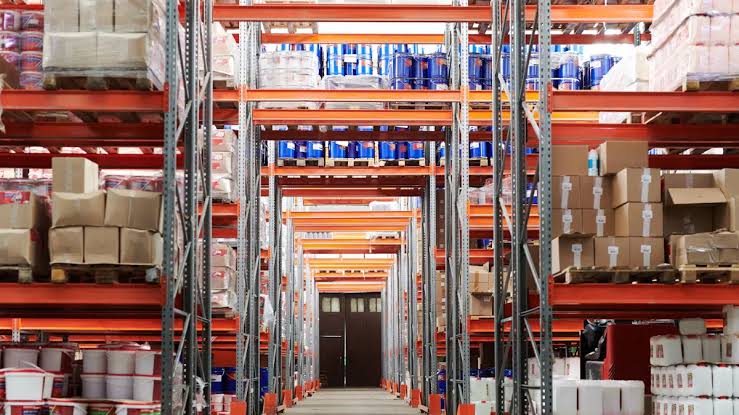
Walk a busy warehouse floor at ten in the morning and you are watching four injuries wait to happen. Not because anyone is careless — because the work is heavy, the equipment is powered, and the building is designed to move as much product as it can in a shift.
Workers compensation is the line written to answer those four. What is worth understanding is not just what it pays, but the bargain it strikes to pay it — and what happens to the same four injuries when a business sits outside that bargain.
The four injuries a warehouse actually produces
Every trade has an injury signature. Here is this one.
A powered industrial truck strikes someone on foot. A forklift, a reach truck, an order picker — the machines that do the real work of the floor — operating in aisles where people also walk. The struck-by and caught-between injuries these machines produce are the signature exposure of the class, and they are the reason an underwriter reads how many trucks run in how many aisles before reading almost anything else.
A fall, or something coming down. These are two faces of the same exposure: gravity and stored material. A worker falls from the upper levels of the racking, from a dock edge, or through an open dock door. Or the material falls instead — a case off a high shelf, a load that shifts, a bay that gives.
The dock. The few feet where the trailer meets the dock plate is the most concentrated hazard on the site: a trailer that moves when it should not, a leveler under load, a pallet jack, and a person, all occupying the same space. Crush and pinch injuries live here.
Lifting, and the shift that never ends. The pick module produces no dramatic accident at all. It produces backs, shoulders, and knees — the repetitive-strain injuries that accumulate quietly across a season and are, on a labor-dense floor, a steady and expensive part of the picture.
Four injuries, one building. The workers compensation page walks through how the coverage answers each of them and how the experience mod prices your record over time. This post is about the system those four claims run through, and the two ways a warehouse business can end up standing outside it.
The bargain: benefits in, most suits out
Workers compensation is not really a coverage in the way property is a coverage. It is a statutory trade, and the insurance is the mechanism that funds it.
The trade is this. An injured worker receives medical care and a portion of lost wages without having to prove that the employer did anything wrong — no negligence to establish, no fault to litigate. In exchange, the worker gives up the right to bring most injury suits against the employer: workers compensation is generally the exclusive remedy for a workplace injury.
Owners hear the first half of that sentence and miss the second. The second half is the one that protects the business. Run the four injuries through it and the picture is orderly: the struck picker, the fall from the rack, the crushed hand at the dock plate, the worn-out back all become claims — paid, managed, and closed — rather than lawsuits.
There is a second part of the policy worth naming, because it is where the bargain has edges. Employers liability answers injury-related suits that fall outside the no-fault channel, and it is the part of the workers compensation policy that carries a limit an umbrella can sit above. Hold on to that: it becomes the whole story in four states.
<rect x="40" y="22" width="620" height="78" rx="10" fill="#C8935A" stroke="#0F4C5C"/>
<text x="350" y="50" text-anchor="middle" font-family="Inter, sans-serif" font-size="15" font-weight="600" fill="#1A1A1A">The bargain at the center of workers compensation</text>
<text x="350" y="73" text-anchor="middle" font-family="Inter, sans-serif" font-size="13" fill="#1A1A1A">Benefits paid without proving fault — and in exchange,</text>
<text x="350" y="91" text-anchor="middle" font-family="Inter, sans-serif" font-size="13" font-weight="600" fill="#1A1A1A">the injury suit is generally kept out of court.</text>

<text x="350" y="128" text-anchor="middle" font-family="Inter, sans-serif" font-size="14" font-weight="600" fill="#0F4C5C">One warehouse injury. Two paths.</text>

<path d="M300 138 L190 168" stroke="#0F4C5C" stroke-width="2" fill="none" marker-end="url(#wcb-arrow)"/>
<path d="M400 138 L510 168" stroke="#0F4C5C" stroke-width="2" fill="none" marker-end="url(#wcb-arrow)"/>

<rect x="30" y="174" width="310" height="216" rx="10" fill="#ffffff" stroke="#C3DEDE"/>
<text x="185" y="202" text-anchor="middle" font-family="Inter, sans-serif" font-size="14" font-weight="600" fill="#0F4C5C">Inside the system</text>
<text x="185" y="230" text-anchor="middle" font-family="Inter, sans-serif" font-size="13" fill="#3F5B64">The injury becomes a claim.</text>
<text x="185" y="256" text-anchor="middle" font-family="Inter, sans-serif" font-size="13" fill="#3F5B64">Medical care and lost wages are</text>
<text x="185" y="274" text-anchor="middle" font-family="Inter, sans-serif" font-size="13" fill="#3F5B64">paid — no fault to prove.</text>
<text x="185" y="302" text-anchor="middle" font-family="Inter, sans-serif" font-size="13" fill="#3F5B64">The employer is generally</text>
<text x="185" y="320" text-anchor="middle" font-family="Inter, sans-serif" font-size="13" fill="#3F5B64">shielded from the injury suit.</text>
<text x="185" y="352" text-anchor="middle" font-family="Inter, sans-serif" font-size="13" font-weight="600" fill="#0F4C5C">Employers liability answers</text>
<text x="185" y="370" text-anchor="middle" font-family="Inter, sans-serif" font-size="13" font-weight="600" fill="#0F4C5C">what falls outside that channel.</text>

<rect x="360" y="174" width="310" height="216" rx="10" fill="#ffffff" stroke="#C3DEDE"/>
<text x="515" y="202" text-anchor="middle" font-family="Inter, sans-serif" font-size="14" font-weight="600" fill="#0F4C5C">Outside the system</text>
<text x="515" y="230" text-anchor="middle" font-family="Inter, sans-serif" font-size="13" fill="#3F5B64">The injury becomes a dispute.</text>
<text x="515" y="256" text-anchor="middle" font-family="Inter, sans-serif" font-size="13" fill="#3F5B64">The worker sues, and fault is</text>
<text x="515" y="274" text-anchor="middle" font-family="Inter, sans-serif" font-size="13" fill="#3F5B64">argued rather than assumed.</text>
<text x="515" y="302" text-anchor="middle" font-family="Inter, sans-serif" font-size="13" fill="#3F5B64">An employer that stepped out of</text>
<text x="515" y="320" text-anchor="middle" font-family="Inter, sans-serif" font-size="13" fill="#3F5B64">the bargain gives up the</text>
<text x="515" y="352" text-anchor="middle" font-family="Inter, sans-serif" font-size="13" font-weight="600" fill="#0F4C5C">common-law defenses it would</text>
<text x="515" y="370" text-anchor="middle" font-family="Inter, sans-serif" font-size="13" font-weight="600" fill="#0F4C5C">otherwise have raised.</text>

<text x="350" y="414" text-anchor="middle" font-family="Inter, sans-serif" font-size="13" fill="#3F5B64">The four injuries do not change. Only the channel they run through does.</text>
The rule that shows up in every file: powered industrial trucks
Before the insurance question there is a safety question, and on a warehouse floor it has a name.
The federal standard at 29 CFR 1910.178, titled Powered industrial trucks, covers fork trucks, tractors, platform lift trucks, motorized hand trucks, and other specialized industrial trucks powered by electric motors or internal combustion engines. In other words: the machines your floor runs on.
The core of it is competence, demonstrated rather than assumed. The standard requires the employer to ensure that each powered industrial truck operator is competent to operate a powered industrial truck safely, as demonstrated by the successful completion of the training and evaluation the standard specifies — and it describes that training as a combination of formal instruction, practical training, and evaluation of the operator’s performance in the workplace. An evaluation of each operator’s performance is to be conducted at least once every three years. And the employer is to certify that each operator has been trained and evaluated, with the certification including the name of the operator, the date of the training, the date of the evaluation, and the identity of the person or persons performing the training or evaluation.
That is what the standard says. Read it at the source — 29 CFR 1910.178 — rather than a summary of it, including this one, and treat it as a safety obligation first and an insurance one second.
But the insurance consequence is real, and it is simple. That certification is a record, and records are what a submission and a claim both ask for. An operation that can produce them is describing a floor where the trucks are run by people who were trained, evaluated, and re-evaluated on a schedule. An operation that cannot is describing something else, and it will be read that way — before a loss by an underwriter, and after one by everybody.
Four states where the line runs through a state fund
Workers compensation is not placed the same way everywhere, and this is the first of two places where a warehouse business can find itself standing outside the ordinary channel.
In North Dakota, Ohio, Washington, and Wyoming — exactly four — the statutory coverage does not come from the private market at all. It comes from a state fund. An employer operating in one of those states obtains the mandatory coverage from the state rather than from a private policy, and no amount of shopping changes that.
On its own that is simply a fact of geography. The part that matters is the piece it leaves open. The state fund provides the statutory benefits; it generally does not provide the employers liability coverage that answers injury-related suits falling outside the no-fault channel — the coverage that carries a limit, and the coverage an umbrella would otherwise sit above. A stop-gap arrangement is the usual way that hole is filled, and arranging it is the actual work in these four states.
For a single-building operator in one of them, that is a contained conversation. For a distribution business running facilities in several states at once, it is a coordination problem: private-market coverage in most of them, state-fund coverage in these four, and an employers-liability layer that has to line up across all of it so an umbrella has something coherent to sit on.
Texas: the state where the bargain is optional
The second way out of the channel is a choice rather than a geography.
Texas is the one state where workers compensation is elective for most private employers. An employer that declines to carry it is a non-subscriber, and non-subscription is a genuine, legal option that some very large employers exercise deliberately, with alternative injury-benefit programs built around it.
What makes it a decision rather than a saving is the other half of the bargain. An employer that steps outside the system forfeits the common-law defenses it would otherwise raise against an injury suit — contributory negligence, assumption of risk, and the fellow-employee defense. Those are exactly the arguments a defendant would most want available in a case about a warehouse injury, where an operator’s own conduct, a co-worker’s conduct, and the ordinary hazards of the work are usually all somewhere in the story.
So run the four injuries through a non-subscriber. The picker struck in the aisle, the fall from the rack, the hand at the dock plate, the back that finally gave — each one becomes a suit where fault is argued, and the employer argues it having given up its most natural defenses. That may still be the right call for a given business. It is simply not a small one, and it should not be made by default or by silence.
Who counts as your employee?
One more thing, because it is where the neat line between policies genuinely blurs, and warehousing runs into it constantly.
Workers compensation answers your own crew. A third party hurt by the same forklift — a visiting driver, a customer’s representative, another company’s worker staging freight in your building — is a general liability claim instead. One machine, one moment, two policies, sorted entirely by whose payroll the injured person is on.
Warehousing complicates that in a way few trades do, because so much of the floor is temporary and staffing-agency labor, especially through a peak season. When a worker supplied by an agency is injured on your dock, the answer usually runs through the agency’s coverage — but the arrangement between you and the agency, and the language in the contract you signed with them, is what actually decides how the claim develops and whether the exposure comes back around to you. It is also the setting where an injury-related suit can reach an employer from an unexpected direction, which is precisely the territory employers liability exists to answer.
The practical version: if a meaningful share of the people moving product in your building are not on your payroll, that is a conversation to have with your broker while nothing is on fire — not a discovery to make in the middle of a claim.
The short version
The four injuries are the same in every warehouse in the country: the truck, the rack, the dock, the strain.
What differs is the channel. Inside the workers compensation system, they are claims — paid without fault, and generally kept out of court. Outside it, whether by geography in the four state-fund states or by choice in Texas, they are something else, and the protections that come with the bargain do not travel with you.
Get the operator training and certification right because it is the right thing to do on a floor with powered trucks running through it. Get the coverage right so that when one of the four finally happens, everyone already knows which system it runs through. That is the whole warehouse insurance program in miniature — and if you are not certain where your business sits, ask us, and we will read what you actually have.