

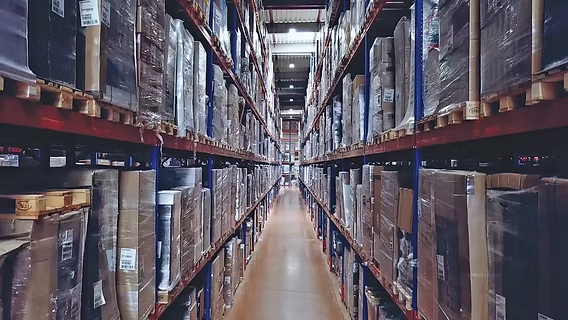
The building never burns. Nothing is broken. The load is simply no longer sellable.
That is what a cold-chain loss looks like, and it is why it does not behave like any other warehouse claim. A compressor fails on a Friday night. Or power drops for a few hours. Or a door is left open at the end of a shift. Nobody notices, because there is nothing to notice — no alarm anyone heard, no smoke, no water, no damage to the building at all.
On Monday morning the racking is exactly where it was, the doors close, the lights are on, and a customer’s perishable load is a total loss with not one thing visibly wrong with the building.
Fire, water, theft, and rack collapse all leave something an adjuster can photograph. This one does not, and that single fact produces three problems that no other warehouse loss has.
Problem one: the loss is a temperature history, not a photograph
Start with proof, because everything else follows from it.
In an ordinary property or bailee claim, the damage is the evidence. Somebody walks the building, photographs the pallets, and the loss more or less documents itself. In a cold-chain claim there is nothing to photograph. The cases are square on the pallet, the labels are clean, and the product inside them has been taken outside the range it was required to stay within — which is a condition, not an appearance.
So the evidence has to come from somewhere else, and there is only one place it can come from: the record of temperature over time. What the sensors read. When the readings left the acceptable range. How long the excursion lasted. Whether an alarm fired, whether anyone acknowledged it, and what was done in response.
That is a genuinely different posture, and here is the part that catches operators off guard: monitoring is a coverage issue, not only an operations issue. An operation with continuous, retained, tamper-resistant records can demonstrate precisely what happened, when it started, and how long it ran. An operation whose only record is a clipboard with a gap across the weekend is trying to establish the same loss on the same facts with far less to stand on.
Nobody buys a monitoring system for insurance reasons. But the system you bought for food safety and for your customers is the same system that will, one day, be the entire evidentiary basis of a claim — and it is worth knowing that before it matters rather than after.
Problem two: same freezer, different policy
Now the second question, and it has nothing to do with what failed.
Whose goods were in there?
This brand is built on that question, and the answer sorts a cold-chain loss into completely different parts of your program:
- A customer’s food, held in your care. That is a bailee loss — the territory of warehouse legal liability, the line written for goods that are not yours but are your responsibility while they sit under your roof. This is the one most cold-storage operators are actually exposed on, because the freezer is full of somebody else’s product by definition.
- Your own owned inventory. That is a property question at your location — the commercial property side — and, once that owned product is moving, a stock throughput question instead.
Same freezer. Same compressor. Same weekend. Two different policies, drawn entirely by ownership.
And the uncomfortable case is the ordinary one: a food-grade operator that holds customer product and carries some owned inventory has both exposures in the same room, and a single failure reaches both at once. The failure does not sort itself. Ownership does.
There is a further layer on the bailee side that this post will point at rather than re-litigate: whether you are liable at all may depend on whether the loss traces to something you did. A classic legal-liability form answers loss you are legally liable for; a broader all-risk bailee form can reach a physical loss regardless of fault, within its terms. In a cold-chain failure that distinction is not academic — a utility outage nobody could have prevented is a very different question than a maintenance record nobody kept. The warehouse legal liability page owns that fault-standard question and walks it properly.
<text x="350" y="34" text-anchor="middle" font-family="Inter, sans-serif" font-size="14" font-weight="600" fill="#0F4C5C">One failure. Three links. Three coverage questions.</text>

<rect x="20" y="54" width="196" height="62" rx="9" fill="#ffffff" stroke="#C3DEDE"/>
<text x="118" y="80" text-anchor="middle" font-family="Inter, sans-serif" font-size="13" font-weight="600" fill="#0F4C5C">The equipment failed</text>
<text x="118" y="102" text-anchor="middle" font-family="Inter, sans-serif" font-size="12" fill="#3F5B64">The mechanical plant</text>

<rect x="252" y="54" width="196" height="62" rx="9" fill="#ffffff" stroke="#C3DEDE"/>
<text x="350" y="80" text-anchor="middle" font-family="Inter, sans-serif" font-size="13" font-weight="600" fill="#0F4C5C">The power dropped</text>
<text x="350" y="102" text-anchor="middle" font-family="Inter, sans-serif" font-size="12" fill="#3F5B64">On site, or off it</text>

<rect x="484" y="54" width="196" height="62" rx="9" fill="#ffffff" stroke="#C3DEDE"/>
<text x="582" y="80" text-anchor="middle" font-family="Inter, sans-serif" font-size="13" font-weight="600" fill="#0F4C5C">The goods spoiled</text>
<text x="582" y="102" text-anchor="middle" font-family="Inter, sans-serif" font-size="12" fill="#3F5B64">Intact, and unsellable</text>

<path d="M216 85 L248 85" stroke="#0F4C5C" stroke-width="2" fill="none" marker-end="url(#cc-arrow)"/>
<path d="M448 85 L480 85" stroke="#0F4C5C" stroke-width="2" fill="none" marker-end="url(#cc-arrow)"/>
<text x="232" y="46" text-anchor="middle" font-family="Inter, sans-serif" font-size="11" font-weight="600" fill="#0F4C5C">seam</text>
<text x="464" y="46" text-anchor="middle" font-family="Inter, sans-serif" font-size="11" font-weight="600" fill="#0F4C5C">seam</text>

<path d="M118 116 L118 152" stroke="#0F4C5C" stroke-width="2" fill="none" marker-end="url(#cc-arrow)"/>
<path d="M350 116 L350 152" stroke="#0F4C5C" stroke-width="2" fill="none" marker-end="url(#cc-arrow)"/>
<path d="M582 116 L582 152" stroke="#0F4C5C" stroke-width="2" fill="none" marker-end="url(#cc-arrow)"/>

<rect x="20" y="158" width="196" height="128" rx="9" fill="#ffffff" stroke="#C3DEDE"/>
<text x="118" y="184" text-anchor="middle" font-family="Inter, sans-serif" font-size="12" font-weight="600" fill="#0F4C5C">Equipment breakdown</text>
<text x="118" y="210" text-anchor="middle" font-family="Inter, sans-serif" font-size="12" fill="#3F5B64">Answers certain</text>
<text x="118" y="228" text-anchor="middle" font-family="Inter, sans-serif" font-size="12" fill="#3F5B64">mechanical and</text>
<text x="118" y="246" text-anchor="middle" font-family="Inter, sans-serif" font-size="12" fill="#3F5B64">electrical failures of</text>
<text x="118" y="264" text-anchor="middle" font-family="Inter, sans-serif" font-size="12" fill="#3F5B64">the plant itself.</text>

<rect x="252" y="158" width="196" height="128" rx="9" fill="#ffffff" stroke="#C3DEDE"/>
<text x="350" y="184" text-anchor="middle" font-family="Inter, sans-serif" font-size="12" font-weight="600" fill="#0F4C5C">Power interruption</text>
<text x="350" y="210" text-anchor="middle" font-family="Inter, sans-serif" font-size="12" fill="#3F5B64">A utility failure away</text>
<text x="350" y="228" text-anchor="middle" font-family="Inter, sans-serif" font-size="12" fill="#3F5B64">from your premises is</text>
<text x="350" y="246" text-anchor="middle" font-family="Inter, sans-serif" font-size="12" fill="#3F5B64">commonly its own</text>
<text x="350" y="264" text-anchor="middle" font-family="Inter, sans-serif" font-size="12" fill="#3F5B64">question, with its terms.</text>

<rect x="484" y="158" width="196" height="128" rx="9" fill="#ffffff" stroke="#C3DEDE"/>
<text x="582" y="184" text-anchor="middle" font-family="Inter, sans-serif" font-size="12" font-weight="600" fill="#0F4C5C">Spoilage and</text>
<text x="582" y="202" text-anchor="middle" font-family="Inter, sans-serif" font-size="12" font-weight="600" fill="#0F4C5C">temperature change</text>
<text x="582" y="228" text-anchor="middle" font-family="Inter, sans-serif" font-size="12" fill="#3F5B64">Commonly an added</text>
<text x="582" y="246" text-anchor="middle" font-family="Inter, sans-serif" font-size="12" fill="#3F5B64">extension. Availability</text>
<text x="582" y="264" text-anchor="middle" font-family="Inter, sans-serif" font-size="12" fill="#3F5B64">and trigger vary.</text>

<rect x="40" y="312" width="620" height="90" rx="10" fill="#C8935A" stroke="#0F4C5C"/>
<text x="350" y="344" text-anchor="middle" font-family="Inter, sans-serif" font-size="15" font-weight="600" fill="#1A1A1A">Nothing in the building is broken</text>
<text x="350" y="370" text-anchor="middle" font-family="Inter, sans-serif" font-size="13" fill="#1A1A1A">The load is simply no longer sellable — and whose goods</text>
<text x="350" y="390" text-anchor="middle" font-family="Inter, sans-serif" font-size="13" font-weight="600" fill="#1A1A1A">they were decides which policy is even in the room.</text>

<text x="350" y="426" text-anchor="middle" font-family="Inter, sans-serif" font-size="13" fill="#3F5B64">The seams between the links are where the claim gets argued.</text>Problem three: the cause chain, and the seams inside it
Here is the part that turns one bad weekend into an argument.
A cold-chain loss is not a single event. It is a chain — and each link is a different coverage question.
The equipment that failed. The compressor, the condenser, the mechanical plant that holds the room where it needs to be. A mechanical or electrical breakdown of that equipment is one question, and equipment breakdown coverage exists, by function, to answer certain failures of that kind. That is a question about the machine.
The power that dropped. If the room warmed because power was lost, the next question is where the power was lost. A failure inside your building and a failure out on the utility system are not automatically treated the same way, and coverage for an interruption of power originating away from your premises is commonly handled as its own extension with its own terms. That is a question about the supply.
The goods that spoiled. And then, finally, the actual loss: product that is intact and worthless. Coverage for spoilage or temperature change is commonly written as an endorsement or a specified extension rather than assumed into base coverage, and its availability and its trigger vary. That is a question about the goods.
Three links. Three questions. And the seams between them are where a claim gets argued — because the machine may be answered while the goods are not, or the goods may be answered only if the cause was of a certain kind, or the cause may sit at the utility rather than in your building.
We describe all of this by function on purpose. Nobody should tell you what your policy does. The only honest instruction is the useful one: name the three scenarios out loud — my equipment fails, my power drops, the utility fails off-site — and ask what your program does in each. An answer that is clear and specific is a good sign. An answer that takes a while is the most valuable thing you will learn all quarter.
The load nobody is willing to sell
There is one more feature of this loss that has no equivalent in a fire, and it is the reason the number at the end can be larger than an owner expects.
You are usually not the one who decides whether the goods are still good.
After a temperature excursion, product can fall into an uncomfortable middle: not visibly spoiled, possibly still within tolerance, and yet not something anyone in the chain is willing to put in front of a consumer. A food-grade customer with its own quality protocol may condemn a load on the strength of the temperature record alone. A brand may refuse to accept product whose history it cannot vouch for. A regulator or the customer’s own food-safety program may make the decision for everybody. The pallets may look perfect and still be, commercially, gone.
That has two consequences worth sitting with.
The first is that the size of the loss is not yours to manage. You cannot reduce it by arguing that the product is probably fine, because the party who decides is the one whose name goes on the package. In practice, that means a modest excursion and a total loss are not as far apart as an operator would like them to be.
The second follows directly: because the goods are usually not yours, the decision to condemn them is made by the owner, and it is made against a temperature record you produced. Which brings the whole thing back around to where it started. The monitoring data is not just how you prove the loss — it is how someone else decides how big the loss is. That is a good reason to know exactly what your system records, how long it keeps it, and who can read it.
The commitment you already made in writing
One last piece, because it sits behind everything above.
A cold-storage or food-grade storage agreement commonly commits the operator to holding goods within a stated range — and often to monitoring it, alarming on it, and reporting on it. That commitment is the standard you will be measured against when a customer’s product is ruined, and it was written long before the compressor failed.
The coverage you carry is what stands behind that commitment. When the agreement promises more than the policy answers, the difference is not an abstraction and it is not an argument for later — it is precisely the amount of exposure that lands on the business, on the day of a claim, in cash. Your storage terms and your coverage are one decision, read together.
The short version
A cold-chain failure is the quietest serious loss a warehouse can have. Nothing burns, nothing breaks, and the building looks fine — and a customer’s product is gone.
So the three questions to be able to answer before it happens are not complicated. Can you prove it? — which is a question about your records, not your policy. Whose goods were they? — which decides whether you are in the bailee world or the property world. Which link in the chain failed? — which decides which coverage question is even being asked.
If you run a cold-storage or food-grade building and you are not certain how your program answers those three, that is worth a conversation while the room is still cold. The whole warehouse insurance program is built on the whose-goods question, and this is the loss that asks it most sharply. Ask us — we will read what you actually have.