
States we serve · Colorado
Distributor and wholesaler business insurance in Colorado
For the beverage, food, outdoor-goods, and component wholesalers who own what they sell in the Mountain West’s crossroads — where one Front Range building supplies a very large territory, under the worst large-hail sky on the continent.
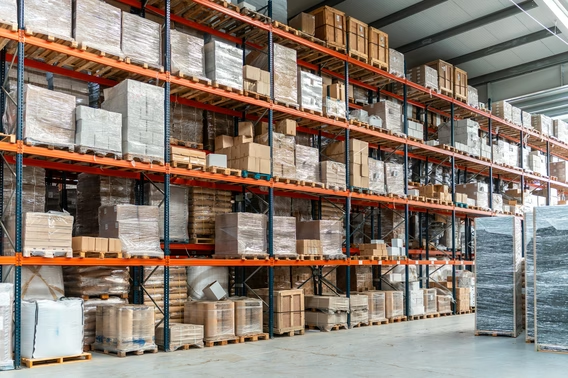

Colorado is not especially interested in what is sitting on your rack. It is interested in who owns you.
This is a license state — the state occupies neither the wholesale nor the retail tier, and private wholesalers hold a state-issued wholesaler’s license that lets them buy from manufacturers and importers and sell on to licensed retailers. But the Liquor Enforcement Division, inside the Department of Revenue, does not treat that license as a formality. It conducts individual background investigations on state-issued licenses, including the wholesaler and importer classes, and its rules are aggressive about financial separation between the manufacturing, wholesale, and retail tiers. A Colorado beverage distributor has to be able to demonstrate that its ownership and its money do not reach across a tier line.
Which is a useful way into everything else on this page, because it isolates the fact that the whole insurance program turns on: the inventory is genuinely, structurally, verifiably yours. Not held for someone. Not moved on someone’s behalf. Bought, owned, carried, and sold — and exposed at every step of that.
Product crosses the tier line. Ownership does not.
The distinction the Liquor Enforcement Division polices is the same one that decides your coverage. Goods flow down the tiers: a manufacturer sells to you, you sell to a retailer. Money and ownership do not flow across them — you cannot stand on two rungs at once, and the state will look at your books to confirm it.
So a Colorado beverage wholesaler is an owner of inventory in the purest sense the law recognises. The product on the rack is on your balance sheet, and it will still be there on the morning after a hailstorm. That is a different animal from a business that merely holds goods for a fee, and it needs a different policy stack.
The worst large-hail sky on the continent
The Front Range sits in the part of North America that takes the most large hail, and the severe season runs from spring into late summer. For anyone underwriting a big-box roof plane in metro Denver, that is the single most important fact on the table — because a distribution roof is a very large horizontal target, and hail is the one peril that aims straight down.
Here is what makes it insidious for an owner of stock. Hail does not level a warehouse. It bruises an entire membrane roof plane, batters the rooftop mechanical units, cracks skylights, and works the seams — and the building keeps standing, the doors keep opening, and the operation carries on as though nothing had happened. The failure arrives later, quietly, at some ordinary rainstorm weeks afterwards, and the water comes down onto the racking and your inventory beneath it. The damage was done in ten minutes in June; the loss is booked in August.
Commercial property is the instrument for the building, the racking, and the owned stock standing inside it, plus the business income lost while the site is down. Around hail sit the rest of Colorado’s perils and none of them are decorative: high straight-line wind coming off the foothills, tornado out on the eastern plains where the newer inland warehousing is going, wildfire and wildland-urban interface exposure along the mountain front, and deep-winter freeze that threatens sprinkler piping and dock-door seals. Flood is its own placement and stays out of the property form.
One building, and a very large territory to supply
Colorado’s warehousing demand is regional-hub demand, and that is a compliment to the geography and a warning to the risk manager. A distributor holding Front Range inventory can reach the entire Mountain West and much of the Great Plains without a second facility — which is precisely why so much owned value ends up concentrated in one building by design.
The consumer base, the restaurant economy, the outdoor-goods sector, the brewing and beverage cluster, the cannabis supply chain, and the aerospace and electronics manufacturers all buy through distributors who hold stock locally, with e-commerce fulfillment stacked on top as national retailers add Denver-area nodes to shorten delivery into a market the coastal buildings serve badly. So the question an underwriter is really asking is not what you move in a year. It is how much of it is standing in that one building on the worst afternoon of the hail season — and what happens to the territory you supply while the building is out.
Stock throughput, and a journey with many hands
Stock throughput is one marine-family policy that follows your owned product across the entire span rather than waking up only when it reaches somewhere insurable. In Colorado that span is long and it changes hands repeatedly: an overseas supplier, a coastal port, a rail intermodal transfer, a Denver warehouse, and finally a truck out to a customer four states away. The owner carries the loss at every one of those points, and a property policy is standing guard at exactly one of them.
The state’s foreign-trade zone presence reflects the same inland reality — the City and County of Denver is a grantee, Colorado Springs has its own zone corporation, and zones reach Jefferson County and the town of Limon out on the plains. Bonded and duty-deferred storage here serves goods arriving by rail, by air, and by truck off the coastal gateways rather than off a ship, so a Colorado bonded operator is usually holding duty-deferred inventory for a regional distribution program rather than working a marine terminal. The vocabulary of the coverage is marine; the geography is emphatically not. Both things are true, and the form does not mind.
The question it forces: when does risk of loss actually pass to you? If your purchase terms hand you ownership at a foreign supplier’s dock and your coverage begins when the goods reach Denver, there is an ocean and a railroad on which your own inventory is traveling uninsured by you.
The first U.S. seller, four states from an ocean
A distributor who never made anything can still be sued over what it sold. Products liability follows the chain of distribution to a seller — and for the importer, who is the first party to put a product into U.S. commerce, that means carrying the products exposure of a manufacturer even though nobody in Colorado made the thing.
General liability answers this through the products-completed-operations hazard, and the limits belong sized against what you actually handle. A wholesaler of outdoor equipment, a distributor of specialty food, and a supplier of aerospace components are three different claims files waiting to happen, and a single generic limit serves none of them well.
Licensed as a food warehouse — and licensed before you ship a drug in
Colorado regulates the distributor on the goods it owns. The Department of Public Health and Environment runs the manufactured-food and food-storage program, and its definition of a wholesaler explicitly reaches a warehouse holding food for distribution — so a food-grade warehouse or a grocery distributor sits inside a state registration and inspection regime built on the federal good-manufacturing-practice rules for manufacturing, packing, or holding human food.
On the drug side, the Colorado State Board of Pharmacy inside the Department of Regulatory Agencies licenses prescription-drug wholesalers — and an out-of-state wholesaler must hold the Colorado license before it distributes into the state. That is a sequencing fact, not a paperwork one, and it is worth knowing before the first shipment crosses the line rather than after.
The crew, the turnover, and the route
Colorado workers compensation runs through a competitive private market — the statutory line is placed with private insurers, not a state monopoly. The loss picture in a distribution building is ordinary and concentrated: powered-industrial-truck strikes and tip-overs on a busy dock, falls from ladders and mezzanines, material coming off a rack or a pallet, and the repetitive lifting and reaching a pick-and-pack operation produces. High-turnover seasonal staffing on the Front Range magnifies every one of those, because the newest employee is usually the one standing on the pick line.
The route fleet is the second, separate exposure, and commercial auto answers it. A note on the word this trade cannot avoid: your insurance carrier is the company that writes your policy, while a motor carrier or freight carrier hauls goods for hire — both meanings appear here constantly, and confusing them in a contract discussion is costly. Above the primary lines, umbrella liability is what a national customer or a landlord asks for once contract limits climb, and a route-based distribution operation is where that severity usually shows first.
What drives the pricing conversation for a Colorado distributor
We do not print premiums, and any site that does is guessing. What genuinely moves it for an owner of inventory here:
- Roof age, membrane type, and hail history — the detail that decides whether a bruised roof becomes a soaked inventory.
- Concentration — how much of the Mountain West’s supply is standing in your one building.
- The transit span you own — coastal port, rail transfer, warehouse, and the long haul out.
- What the product is — food, beverage, outdoor equipment, and aerospace components are four different products-liability appetites.
- Seasonal staffing and turnover on the pick line, and the split between warehouse and driver payroll.
- Whether flood and wildfire have been considered as their own placements rather than assumed into the property form.
Where Colorado distributors and wholesalers concentrate
Denver
Where I-25 crosses I-70 and both Class I railroads reach the metro — the reason the Mountain West distribution build-out landed here rather than anywhere else in the region. A distributor holding Front Range inventory can supply a very large territory from a single site, which concentrates enormous owned value under one roof by design rather than by accident.
Aurora
Big-box distribution space east of the city, close to the airport and the air-cargo lane. The value in these buildings is high and the roof planes are vast, and a roof plane measured in acres is the single most exposed surface a hail season has to aim at.
Greeley and the northern corridor
Where industrial development has pushed north — food, agricultural, and consumer-goods distribution on cheaper land. Owned food inventory is registered and inspected by the state health department as a food warehouse, and it fails on temperature as readily as on fire: product that is never burned simply stops being sellable.
The eastern I-70 corridor
The newer inland warehousing going out onto the plains where land is flat and cheap — and where the tornado exposure genuinely lives. A distributor consolidating out here has traded urban land cost for a severe-convective profile, which is a real siting decision rather than a neutral one.
Colorado Springs
Its own foreign-trade zone corporation, and an aerospace and electronics buyer base. A component distributor selling into those manufacturers holds high-value owned stock and inherits a products exposure sized to the system the part goes into, not to the price of the part.
Fort Collins and Loveland
The brewing and beverage cluster, and the outdoor-goods wholesalers that grew up alongside it. Beverage inventory here is owned outright under a private licensed middle tier — deep, heavy, low-margin stock where the value on the rack is large relative to the business that owns it.
Pueblo
Southern I-25 distribution and industrial supply. Distance from the metro means deeper safety stock, and deeper safety stock in a single building is a concentration question before it is a service-level one.
Grand Junction
Western Slope wholesaling across the divide, supplying a territory that a Front Range truck reaches slowly. Owned stock spends a long time in transit on I-70 in both directions, and transit is exactly the span a commercial property policy was never written to follow.
If the goods are not yours, you are on the wrong page
An honest signpost. This page is for the business that owns what it stores. If your operation holds other companies’ freight for a fee — a public, contract, third-party, or cold-storage warehouse consolidating freight off I-70 and I-25 for owners who never set foot in the building — then the goods on your racks are not owned stock, they are a bailment, and none of the above is your lead exposure. Your program begins with warehouse legal liability, the bailee line for goods in your care, custody, and control, and it turns on the storage contract and its limitation of liability rather than on your purchase terms. That is a different risk with a different stack, and it has its own page: warehouse insurance in Colorado.
Plenty of Colorado businesses do both — they distribute their own product and warehouse somebody else’s under the same hail-exposed roof. If that is you, we place both, and we draw the line between them before anything binds.
Colorado distributor and wholesaler insurance FAQs
Why does Colorado care so much about who owns my distribution business?
Because the tier separation here is enforced financially, not just structurally. Colorado is a license state — the state does not sit in the wholesale or retail tier, and private wholesalers hold a state-issued wholesaler’s license that lets them buy from manufacturers and importers and sell to licensed retailers. The Liquor Enforcement Division inside the Department of Revenue runs that licensing, and it conducts individual background investigations on state-issued licenses, including the wholesaler and importer classes. Its rules are aggressive about financial separation between the manufacturing, wholesale, and retail tiers, so a Colorado beverage distributor has to be able to show that its ownership and its money do not reach across a tier line. Product may cross the line. Ownership may not.
What does hail actually do to a building full of my inventory?
Less than you would expect on the day, and far more than you would expect afterwards. The Front Range sits in the part of North America that takes the most large hail, with a severe season running from spring into late summer — and that is the single most important fact for anyone underwriting a big-box roof in metro Denver, because a distribution roof is a very large horizontal target. Hail does not level a warehouse. It bruises a membrane roof plane, damages rooftop mechanical units, cracks skylights and works the seams. The building stands, the operation carries on, and the water that eventually comes through finds the racking and the owned inventory beneath it. Straight-line wind off the foothills, tornado out on the eastern plains, wildfire along the mountain front, and deep-winter freeze on sprinkler piping and dock-door seals fill out the picture. Flood is its own placement.
Why would a Colorado distributor need stock throughput rather than just property?
Because owned goods here move inland and through several hands before they reach a rack. A typical Colorado journey runs from an overseas supplier to a coastal port, onto a rail intermodal transfer, into a Denver warehouse, and then out on a truck to a customer four states away — and the owner carries the loss at every one of those points. Property insures inventory while it sits in a scheduled building and stops at the walls; a cargo policy responds while things are moving; the seam between them is where losses fall. Stock throughput is one marine-family form written across the entire span. The word marine is a historical artifact of where the coverage came from — Colorado has no coastline, and the form works exactly as well on a railcar crossing the plains as on a hull.
I import components and resell them. Am I really in the products-liability chain?
Yes. Products liability follows the chain of distribution to a seller, not only to the manufacturer, and a wholesaler that bought a product and resold it is a seller. For an importer the position is sharper still: as the first party to put the product into U.S. commerce, you carry the products exposure of a manufacturer even though nobody in Colorado made the thing — and when the actual maker sits beyond the practical reach of a U.S. claim, you are the party who is realistically there to answer for it. General liability responds through the products-completed-operations hazard. Sizing those limits against the products you genuinely handle, rather than against a revenue band, is most of the honest work in the placement.
Does Colorado license me because of the goods I distribute?
It does, and in two places. The Colorado Department of Public Health and Environment runs the manufactured-food and food-storage program, and its own definition of a wholesaler explicitly reaches a warehouse holding food for distribution — so a food-grade warehouse or a grocery distributor sits inside a state registration and inspection regime built on the federal good-manufacturing-practice rules for manufacturing, packing, or holding human food. On the drug side, the Colorado State Board of Pharmacy inside the Department of Regulatory Agencies licenses prescription-drug wholesalers, and an out-of-state wholesaler must hold the Colorado license before it distributes into the state — which is a fact worth knowing before the first shipment crosses the line rather than after.
How does workers compensation work for a Front Range distribution business?
Through a competitive private market — the statutory line is placed with private insurers, not a state monopoly, and a Colorado warehouse employer buys comp on the open market. The loss picture is the ordinary one and it is concentrated: powered-industrial-truck strikes and tip-overs on a busy dock, falls from ladders and mezzanines, material coming off a rack or a pallet, and the repetitive lifting and reaching a pick-and-pack operation produces. One Colorado aggravator is worth naming plainly: high-turnover seasonal staffing on the Front Range magnifies all of it, because the newest employee is usually the one on the pick line. A distribution business also carries a second and separate injury exposure in its route drivers.
Get a Colorado distributor insurance quote
Quotes in 1–2 hours during business hours.