

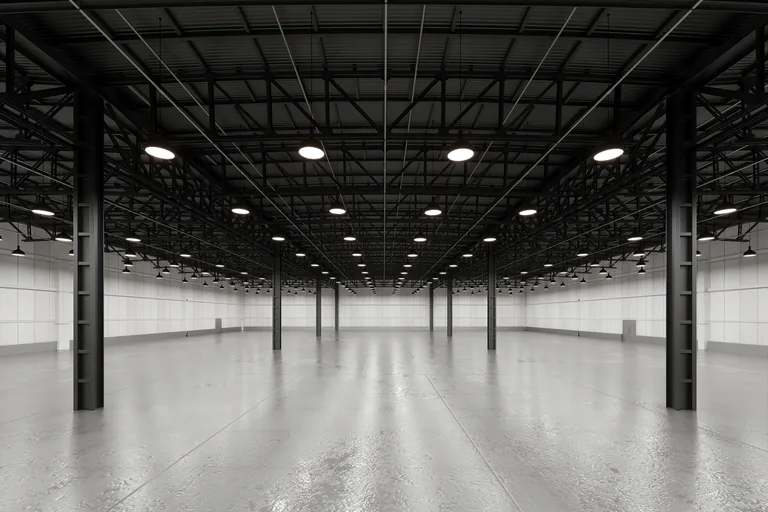
Stand in a Front Range distribution building and look up. That roof — acres of it, flat, unbroken, horizontal — is the single most consequential thing about your insurance, and it has nothing to do with the building.
It has to do with what is underneath it. Colorado’s Front Range sits in the part of North America that takes the most large hail, and the severe season runs from spring into late summer. Hail does not level a warehouse. It bruises an entire membrane roof plane, damages the rooftop units, and then the water follows — down onto the racking, where a wholesaler’s entire season is standing. For a business that owns what it sells, that is not a building loss. It is an inventory loss, and it lands squarely on your balance sheet.
There is no published price for the insurance that answers for it. An insurance carrier builds the number from your operation. Here is what actually moves it.
The roof, and what is racked beneath it
Commercial property covers your building, your racking, and your owned inventory while it sits in a scheduled location, plus the business income you lose when that location goes down. In Colorado, that policy is doing its hardest work against a peril that arrives from directly above.
Roof age and condition, membrane type, rooftop-unit protection, drainage: these are not maintenance trivia in this state, they are the underwriting file. They are also among the very few property variables a distributor can genuinely improve, which makes them the cheapest place to spend money before a renewal.
Around hail sit the rest of Colorado’s perils, and they are real: high straight-line wind coming off the foothills, tornado exposure out on the eastern plains where the newer inland warehousing is being built, wildfire and wildland-urban interface exposure along the mountain front — where smoke and ash can contaminate stored product that never came near a flame — and a deep-winter freeze that threatens sprinkler piping and dock-door seals. Flood is its own placement and stays out of the property form.
The peak, and when it lands
This is the number that sizes a stock throughput limit, and it is the most expensive routine mistake in the trade.
Owners answer the inventory question with a comfortable annual average. Underwriters are asking something sharper: what is the maximum value of owned product concentrated in one place on one day? Because a loss does not wait for a convenient month.
Colorado adds a wrinkle worth saying out loud. The severe-hail season is a known window. If your seasonal build — outdoor and sporting goods before summer, beverage before a holiday, food before a demand peak — happens to load the building during that window, then the fullest day of your year and the most dangerous day of your year are the same day. That overlap belongs in the submission, not in the footnotes. A limit set to the quiet season is a limit that fails you in exactly the week you can least afford it.
Owned goods pass through several hands
Denver became the Mountain West’s distribution hub because I-25 and I-70 cross there, and a distributor holding Front Range inventory can reach the entire region and much of the Great Plains without a second facility. That reach has an insurance consequence people rarely think through.
Your owned goods here typically move through a chain of legs: a coastal port, a rail intermodal transfer, a Denver warehouse, then a truck out to a customer four states away. You carry the loss at every one of those points — and a property policy answers only for the middle one, where the goods stand still.
Stock throughput is written for the whole run: one marine-family form following the product from the supplier, across ocean, rail, and highway, into the rack, and back out to the customer, instead of a property-plus-cargo patchwork with seams in it. The name confuses landlocked owners. It should not. The form follows the goods, not the water — and Colorado’s bonded and foreign-trade zone activity works the same way, serving goods arriving by rail, air, and truck off the coastal gateways rather than off a ship. If you import, one question decides where your exposure starts:
When does the risk of loss actually pass to you?
Not when the pallet reaches Denver. When your purchase terms say it did — which may be at a foreign supplier’s dock, half a world away.
The chain of distribution reaches the seller
Here is the driver distributors are most surprised by, because it has nothing to do with the roof or the trucks.
You sit in the chain of distribution, and a products-liability claim over something that causes injury or damage can follow that chain to a seller — not only to the manufacturer who made it. You did not design it. You did not assemble it. You bought it and you sold it, and that is enough to be named. For an importer that is the first U.S. seller of a product, the exposure sharpens: when the actual maker sits beyond the practical reach of a claim in this country, the importer becomes the realistic target, even though nobody in Colorado made the thing.
So an insurance carrier prices what you handle. Aerospace and electronics parts moving into Front Range manufacturers are one conversation. Grocery and specialty food, registered with the state health department as a food warehouse, are another. Outdoor and sporting goods — equipment a person uses at speed, at height, or in cold water — are different again. General liability answers this through what the standard form calls the products-completed-operations hazard, and sizing that limit against what you actually move is most of the work on a distributor’s submission.
A tier line your money cannot cross
If you distribute beverages, Colorado is a license state: the state does not sit in the wholesale or retail tier, and private wholesalers hold a state-issued wholesaler’s license that lets them buy from manufacturers and importers and sell to licensed retailers. The Liquor Enforcement Division inside the Department of Revenue runs the licensing and conducts individual background investigations on the state-issued classes.
The distinctive part is how hard the division polices the separation between tiers. Its rules are aggressive about financial separation between manufacturing, wholesale, and retail, so a Colorado beverage distributor has to be able to show that its ownership and its money do not reach across a tier line. That is a governance and compliance cost sitting alongside the premium — and it is the sort of discipline an underwriter reads as a signal about the rest of the operation.
The insurance consequence of the licensed middle tier itself is direct: the inventory in that warehouse is genuinely yours at every step, which is exactly why it is a stock-throughput exposure and not a bailment.
The fleet, the crew, and the newest employee
A distribution business moves its own product across long inland distances. Commercial auto prices the fleet on unit count, radius, what is hauled, and above all who drives. One note on language this trade cannot avoid: your insurance carrier is the company that writes your policy, which is an entirely different thing from a motor carrier or a freight carrier hauling goods for hire.
Workers compensation runs through a competitive private market here — the statutory line is placed with private insurers, not a state monopoly, so it is genuinely marketable. The loss picture is concentrated: powered-industrial-truck strikes and tip-overs on a busy dock, falls from ladders and mezzanines, material coming off a rack or a pallet, and the repetitive lifting and reaching a pick-and-pack operation produces. High-turnover seasonal staffing on the Front Range magnifies all of it, for a reason worth stating plainly: the newest employee is usually the one on the pick line. Onboarding and training are not a soft cost here; they are a rate lever.
The peril that arrives from above
<text x="350" y="30" text-anchor="middle" font-family="Inter, sans-serif" font-size="15" font-weight="600" fill="#0F4C5C">The loss comes from straight overhead</text>

<path d="M140 46 L140 78" stroke="#0F4C5C" stroke-width="2"/>
<path d="M220 44 L220 78" stroke="#0F4C5C" stroke-width="2"/>
<path d="M300 48 L300 78" stroke="#0F4C5C" stroke-width="2"/>
<path d="M380 44 L380 78" stroke="#0F4C5C" stroke-width="2"/>
<path d="M460 47 L460 78" stroke="#0F4C5C" stroke-width="2"/>
<path d="M540 45 L540 78" stroke="#0F4C5C" stroke-width="2"/>
<text x="620" y="66" text-anchor="middle" font-family="Inter, sans-serif" font-size="12" font-weight="600" fill="#0F4C5C">large hail</text>

<rect x="60" y="86" width="580" height="26" rx="4" fill="#E2F4F3" stroke="#0F4C5C" stroke-width="2"/>
<text x="350" y="104" text-anchor="middle" font-family="Inter, sans-serif" font-size="12" font-weight="600" fill="#0F4C5C">acres of low-slope membrane, and the units standing on it</text>

<text x="350" y="134" text-anchor="middle" font-family="Inter, sans-serif" font-size="12" fill="#3F5B64">the membrane bruises · the water follows it down</text>

<rect x="60" y="150" width="580" height="106" rx="6" fill="#ffffff" stroke="#C3DEDE"/>
<rect x="90" y="176" width="90" height="66" rx="3" fill="#E2F4F3" stroke="#C3DEDE"/>
<rect x="205" y="176" width="90" height="66" rx="3" fill="#E2F4F3" stroke="#C3DEDE"/>
<rect x="320" y="176" width="90" height="66" rx="3" fill="#E2F4F3" stroke="#C3DEDE"/>
<rect x="435" y="176" width="90" height="66" rx="3" fill="#E2F4F3" stroke="#C3DEDE"/>
<rect x="550" y="176" width="60" height="66" rx="3" fill="#E2F4F3" stroke="#C3DEDE"/>
<text x="350" y="168" text-anchor="middle" font-family="Inter, sans-serif" font-size="12" font-weight="600" fill="#0F4C5C">your season, racked and paid for</text>

<rect x="40" y="274" width="620" height="54" rx="9" fill="#C8935A" stroke="#0F4C5C"/>
<text x="350" y="298" text-anchor="middle" font-family="Inter, sans-serif" font-size="14" font-weight="600" fill="#1A1A1A">A landlord loses a roof. A distributor loses the inventory under it —</text>
<text x="350" y="317" text-anchor="middle" font-family="Inter, sans-serif" font-size="14" font-weight="600" fill="#1A1A1A">which is why the roof file is an inventory file here, not a building one.</text>The honest summary
A Colorado distributor is priced on what it owns, when the building is fullest, how many legs its goods travel before they reach a customer, what happens if the product causes harm — and on a roof that is, in this state, an inventory exposure wearing a property policy’s clothing.
If you want the coverage mechanics rather than the cost drivers, stock throughput is the line this guide orbits, the Colorado distributor and wholesaler insurance page goes deeper on the exposures, and our distribution businesses pillar covers the operating shape. And if the goods in your building belong to your customers rather than to you, none of this is your program — you want the warehouse cost guide instead.