

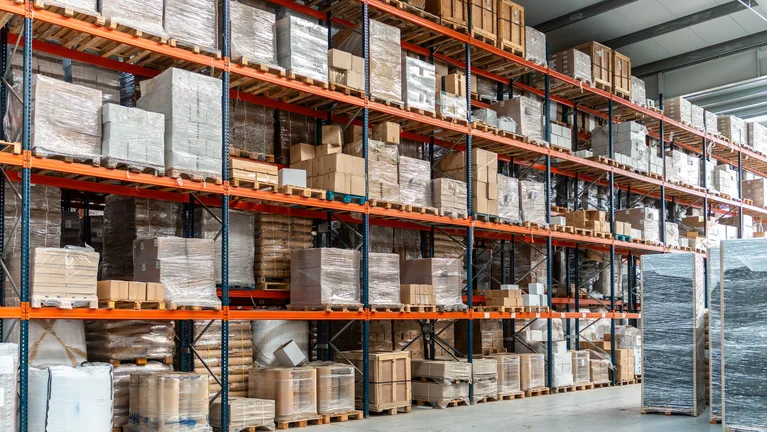
The Connecticut distributor is usually a mid-tier wholesaler with a New York-sized customer list and a Connecticut-sized building.
That mismatch is where the cost conversation starts, and it is not a rhetorical flourish. The southwestern corner of this state is effectively the outer edge of the New York consumption market, which pulls fulfillment space toward Fairfield County even though land there is scarce and dear. The corridor running north from Hartford, Connecticut toward Springfield is the real distribution belt, with room to build and highway geometry that reaches Boston, New York, and northern New England from one door. Either way, the goods are largely passing through on their way somewhere bigger.
Which means high turns, dense stock, more handling touches per unit, and an accumulation that is larger relative to the footprint than an owner instinctively believes it is.
Peak, in a building that disguises it
Everything a distributor sells, it owned first. That is the whole difference from the warehouse down the road, and it makes one number the spine of the submission: the maximum value of owned product concentrated in one place on one day.
Owners answer that question with a comfortable annual average. Underwriters are not asking about the average. A loss does not wait for a convenient month — it arrives in the week the building is fullest, and in a high-turn Connecticut operation the swing between the quiet week and the full one can be steep. The building did not get bigger; the value inside it did. A stock throughput limit set to the average is a limit that fails in exactly the week you can least afford it, and seasonality here is close to the center of the document rather than a note at the end of it.
Your brands and territories are a regulated asset
Here is something Connecticut does that very few states do, and it changes what this business actually is.
Connecticut is a license state, and the Liquor Control Division of the Department of Consumer Protection runs the whole board: suppliers sell to wholesalers, wholesalers sell to retailers, and no tier reaches past the next. The wholesale permits are split by product — a separate wholesaler liquor permit and wholesaler beer permit — and everything is applied for through the department’s online permitting system.
Then Connecticut adds the part that matters. The state holds the middle tier to price-posting and distributorship rules that make a wholesaler’s book of brands and territories a regulated asset, not just a commercial one.
Sit with that for a moment as an owner. Your balance sheet has two very different kinds of value on it. There is the product on the rack: physical, damageable, and exactly what a stock and property program is written to answer for. And there is the franchise — the brands, the territories, the posted positions — which is a regulated asset, and which a physical-damage policy was never designed to replace.
<text x="350" y="30" text-anchor="middle" font-family="Inter, sans-serif" font-size="15" font-weight="600" fill="#0F4C5C">What your business is actually made of</text>

<rect x="40" y="56" width="290" height="184" rx="8" fill="#ffffff" stroke="#0F4C5C"/>
<text x="185" y="82" text-anchor="middle" font-family="Inter, sans-serif" font-size="13" font-weight="600" fill="#0F4C5C">What is on the rack</text>
<rect x="66" y="98" width="238" height="22" rx="3" fill="#E2F4F3" stroke="#C3DEDE"/>
<text x="185" y="114" text-anchor="middle" font-family="Inter, sans-serif" font-size="11" fill="#0F4C5C">owned product</text>
<rect x="66" y="128" width="238" height="22" rx="3" fill="#E2F4F3" stroke="#C3DEDE"/>
<text x="185" y="144" text-anchor="middle" font-family="Inter, sans-serif" font-size="11" fill="#0F4C5C">physically damageable</text>
<rect x="66" y="158" width="238" height="22" rx="3" fill="#E2F4F3" stroke="#C3DEDE"/>
<text x="185" y="174" text-anchor="middle" font-family="Inter, sans-serif" font-size="11" fill="#0F4C5C">replaceable, if insured to peak</text>
<text x="185" y="212" text-anchor="middle" font-family="Inter, sans-serif" font-size="12" font-weight="600" fill="#0F4C5C">the stock program answers</text>
<text x="185" y="230" text-anchor="middle" font-family="Inter, sans-serif" font-size="12" font-weight="600" fill="#0F4C5C">for this</text>

<rect x="370" y="56" width="290" height="184" rx="8" fill="#ffffff" stroke="#0F4C5C"/>
<text x="515" y="82" text-anchor="middle" font-family="Inter, sans-serif" font-size="13" font-weight="600" fill="#0F4C5C">What is in the permit</text>
<rect x="396" y="98" width="238" height="22" rx="3" fill="#ffffff" stroke="#C3DEDE"/>
<text x="515" y="114" text-anchor="middle" font-family="Inter, sans-serif" font-size="11" fill="#3F5B64">the brand book</text>
<rect x="396" y="128" width="238" height="22" rx="3" fill="#ffffff" stroke="#C3DEDE"/>
<text x="515" y="144" text-anchor="middle" font-family="Inter, sans-serif" font-size="11" fill="#3F5B64">the territories</text>
<rect x="396" y="158" width="238" height="22" rx="3" fill="#ffffff" stroke="#C3DEDE"/>
<text x="515" y="174" text-anchor="middle" font-family="Inter, sans-serif" font-size="11" fill="#3F5B64">the posted positions</text>
<text x="515" y="212" text-anchor="middle" font-family="Inter, sans-serif" font-size="12" font-weight="600" fill="#0F4C5C">a regulated asset —</text>
<text x="515" y="230" text-anchor="middle" font-family="Inter, sans-serif" font-size="12" font-weight="600" fill="#0F4C5C">not a physical one</text>

<rect x="40" y="282" width="620" height="56" rx="9" fill="#C8935A" stroke="#0F4C5C"/>
<text x="350" y="307" text-anchor="middle" font-family="Inter, sans-serif" font-size="14" font-weight="600" fill="#1A1A1A">The policy answers for the goods. It does not answer for the franchise.</text>
<text x="350" y="327" text-anchor="middle" font-family="Inter, sans-serif" font-size="12" font-weight="600" fill="#1A1A1A">A program built only around the pallets has priced only half the business.</text>The insurance consequence of the licensed middle tier itself is direct: the product in that warehouse is genuinely yours at every step, which is why it prices as a stock throughput exposure and not as somebody else’s goods in your care.
One department, several divisions, decided by the pallet
Connecticut is unusual in putting food and drug distribution under the same roof, and it is worth knowing which desk you have walked up to.
The Department of Consumer Protection’s Food and Standards Division issues the Food Warehouse and Food Manufacturing Establishment licenses — Connecticut is one of the very few states that licenses a food warehouse by that name. The same department’s Drug Control Division separately registers wholesalers of drugs, medical devices, and cosmetics, including out-of-state wholesalers shipping in. So a distributor carrying both grocery and health-and-beauty lines is answering to two divisions of one department, and each of them is a real operating cost sitting alongside the premium.
There is physical infrastructure behind that too: the Connecticut Regional Market in Hartford, Connecticut is a state-created wholesale perishable-food market with refrigerated warehouse space and a rail spur, now held by the Capital Region Development Authority. For a food wholesaler, that is where the cold chain and the compliance file meet.
The product, and the chain that follows it to a seller
Here is the driver distributors are most surprised by, because it has nothing to do with their building or their trucks.
You sit in the chain of distribution, and a products-liability claim can follow that chain to a seller, not only to the manufacturer. You did not design it. You bought it and you sold it, and that is enough to be named. General liability answers this through what the standard form calls the products-completed-operations hazard, and a health-and-beauty or food line — anything with an ingestion or contact profile — is a different severity conversation than a case of hardware. Sizing that limit against what you actually move rather than against a generic revenue band is most of the work.
Bulk, project cargo, and a border of a different kind
Connecticut carries four foreign-trade zones — Windsor Locks in the north, Bridgeport and New Haven on the Sound, and New London to the east — which is a lot of zone coverage for a small state, and it reflects the fact that Connecticut has three working deepwater ports rather than one. But be precise about what they are: New Haven and Bridgeport handle bulk and breakbulk rather than containers, so bonded storage here attaches to raw material, project cargo, and air-cargo imports through Bradley International, not to a container gateway.
An importer landing goods at any of them, or by air, is frequently the first U.S. seller — owning both the goods and a products position for something it never made. And behind that sits the question importers most often answer by accident:
When does the risk of loss actually pass to you?
Whatever your purchase terms say, that is when your exposure begins — not when the shipment reaches your dock. Stock throughput is the marine-family form written to follow owned goods across that entire span, rather than a property policy that stops at the walls and a cargo policy that starts elsewhere with a seam between them.
The seam Connecticut sits on
Commercial property covers the building, the racking, and the owned goods while they sit in a scheduled location, plus the income lost when that location cannot ship. It stops at the walls, and in Connecticut those walls face two entirely different problems.
Along Long Island Sound — the industrial waterfronts at Bridgeport, New Haven, and New London — the exposure is coastal wind and storm surge, and flood there is a separate placement that a property policy will not simply absorb. Inland, in the Connecticut River valley and the basin around Hartford, Connecticut, the story flips: snow load on a wide distribution roof, drift against parapets and rooftop units, ice damming, and freeze failures in wet sprinkler systems that soak stored goods without a fire ever starting. Severe thunderstorm and the occasional valley tornado are real but secondary.
Two loss geographies, one small state — and the goods on the floor are on your balance sheet under both of them.
The crew, the fleet, and the loss runs
Workers compensation is a private-market line here, and a distributor carries two injury exposures, not one: the warehouse crew — powered-industrial-truck contact, product falling from racking, strain on manual pick lines, dock injuries where the trailer meets the plate — and the route drivers who load, unload, and work a lift gate all day. Refrigerated houses around the food market and the New Haven corridor add cold stress and wet-floor slips.
Commercial auto prices unit count, radius, what you haul, and above all who drives, and a wholesaler working I-95, I-91, and I-84 into two of the country’s biggest metropolitan markets is buying real radius. Worth a note on language this trade cannot avoid: your insurance carrier is the company that writes your policy, which is not the same thing as a motor carrier or a freight carrier hauling goods for hire.
An underwriter reads a distributor’s claims history for shape, not count. Cargo losses in transit, shrinkage in a high-touch building, and at-fault fleet accidents are three different stories about three different parts of the operation — and in a state where every unit gets handled more often than it would in a slow-turn building, the shrinkage-and-damage line is one an underwriter will read closely. Carry an umbrella where the customer contracts require it.
The honest summary
A Connecticut distributor is priced on a large accumulation inside a modest building, a product line that decides which division of one department it answers to, an import trade that is bulk rather than containerized, and a state that manages to be coastal and snowbound at the same time. And underneath all of it is a business whose value is only half physical — because in this state, the brand book is a regulated asset too.
If you want the coverage mechanics rather than the cost drivers, stock throughput is the line this guide orbits, our distribution business insurance page covers the broader program, and the full Connecticut distributor and wholesaler insurance page goes deeper on the exposures. And if the goods on your racks belong to your customers rather than to you, none of the above is your program — you want the Connecticut warehouse cost guide instead.