

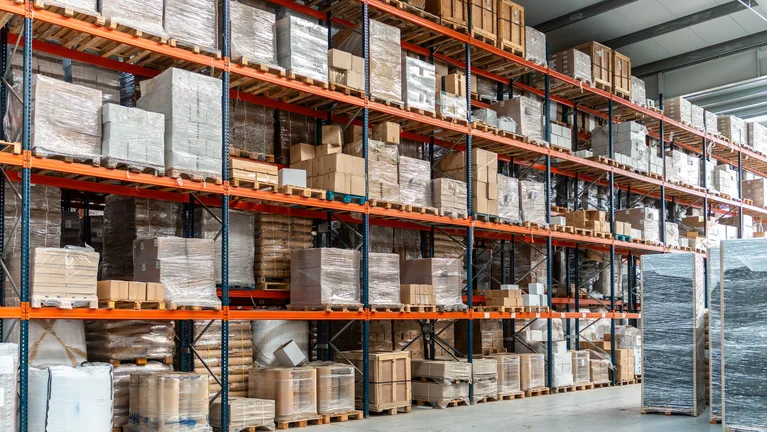
In most states a distributor’s cost story starts with how much product it holds. In Massachusetts it starts with how little room it has to hold it in.
Industrial land here is scarce and expensive. The land inside I-95 is effectively spoken for, and even out on the I-495 belt — through Franklin, Milford, Marlborough, up toward Devens — space is priced like the constrained resource it is. So operators run tighter, taller, more heavily utilized buildings than a distributor in a land-rich corridor state would. The same square footage carries more owned inventory value.
That single fact raises the ceiling on every loss the building can produce, and it is the reason a Massachusetts submission behaves differently from an identical-looking one in the Midwest. There is no published price for this coverage. Any figure quoted before an underwriter has understood how much value is stacked under your roof is a guess.
The peak, in a building that hides it
Owners answer the inventory question with a comfortable annual average. Underwriters are asking a different one: what is the maximum value of owned product concentrated under one roof on one day? Because a loss does not wait for a convenient month.
The Massachusetts trap is that a dense building hides its own accumulation. A rack that goes higher, aisles that run tighter, and a utilization rate driven by land cost rather than by demand all mean the value on the floor grows without the building appearing to. Owners think of their peak in terms of space used, which is nearly full year-round, when what matters is value held, which swings hard.
That number is what sizes a stock throughput limit, and a limit set to the average is a limit that fails in the busy season — which in a consumption-led market like Greater Boston is very busy indeed.
Weight on the roof
Commercial property does a bounded job: your building, your racking, and your owned inventory while it stays put, plus the income you lose when the location goes down. It stops at the walls.
And the peril that actually threatens a Massachusetts warehouse is weight. Wide, low-slope distribution roofs collect snow, and then drift and thaw-refreeze cycles add ice on top of it. The loss shows up as deflection, drainage failure and, at the extreme, partial collapse — with the goods below getting wet whether or not the roof gives way. For an owner of inventory that is a contents loss dressed up as a building loss.
Freeze is the quiet second exposure. A sprinkler or wet-pipe failure in an unheated or partly heated bay does more damage to stored goods than the fire the system was installed to fight, and it does it overnight while nobody is there.
Nor’easters bring the wind and the coastal surge, which matters most for harborfront and South Coast industrial land near Boston, Chelsea and New Bedford. Flood there is its own placement, not a peril you should assume is bundled into the property policy — a distinction that stops being technical the moment the goods on the floor are on your balance sheet.
The cold room, and the loss with nothing to point at
Massachusetts is one of the few states where operating refrigerated space is itself a licensed activity: no person may maintain a cold storage or refrigerating warehouse without a license from the Department of Public Health, which inspects the plant before issuing and can close an unsanitary house. Food distribution runs through the same department’s food protection division.
For a distributor that runs its own cold rooms — and in a state with this much food, seafood and life-sciences product, many do — that is a real operating obligation sitting alongside the premium. But the reason it belongs in a cost guide is the loss it points at.
A temperature excursion destroys owned product without damaging anything. No fire. No water. No wind. The building is fine, the racking is straight, the doors work — and every case of seafood, every pallet of produce, every carton of clinical material is worthless. That is a contents loss with no property damage standing behind it, and it is the one owners are least prepared to argue about. Standby power and temperature monitoring belong in the underwriting conversation, not in the housekeeping file.
Food, seafood, and a severity league of its own
Here is the driver distributors are most surprised by, because it has nothing to do with the building.
You sit in the chain of distribution, and a products-liability claim over something that causes injury can follow that chain to a seller — not only to the manufacturer who made it. You did not design it. You did not produce it. You bought it and sold it, and that is enough to be named.
Massachusetts sharpens this because of what its distributors actually hold. Food and seafood — much of it moving through Chelsea, where the New England Produce Center is a privately owned terminal market feeding grocers and restaurants across the region — carry an ingestion profile that a hard good does not. Pharmaceutical and medical-device distributors, licensed as wholesale druggists by the Board of Registration in Pharmacy, sit in a severity league of their own. And an importer landing goods at Conley is frequently the first U.S. seller of something made abroad, which puts it in the products chain from the moment the goods clear.
General liability answers this through what the standard form calls the products-completed-operations hazard, and sizing that limit against what you truly move rather than against a generic revenue band is most of the work on the submission.
A closed chain, and inventory that is traceable by law
If you distribute beverages, Massachusetts puts you inside an unusually tight structure.
The Alcoholic Beverages Control Commission is the sole issuing authority for wholesaler and importer licenses, while retail licenses are granted by city and town licensing boards subject to Commission approval. A Massachusetts wholesaler may buy only from certificate-of-compliance holders or other Massachusetts wholesalers, and may sell only to Massachusetts retail and wholesale licensees. So the beverage distributor sits in a closed, audited chain with the state on one side and hundreds of municipal boards on the other.
The consequence for an owner of inventory is worth stating plainly: the stock is legally traceable at every hop, which means a warehouse shortage is a compliance event as much as a loss. That cuts both ways at underwriting. The records an insurer would like to see, you are already required to keep — and a distributor who can produce them has a materially easier submission than one who cannot.
And because the middle tier is genuinely yours, that inventory is a stock-throughput exposure rather than a bailment.
The fleet, the crew, and one word with two jobs
A distribution business moves its own product, which in this state means short, dense, congested routes rather than long hauls. Commercial auto prices the fleet on unit count, radius, what is hauled, and above all who drives — and delivery density in an urban market is its own risk profile, not a softer version of a highway one.
A note on language this trade cannot avoid: your insurance carrier writes your policy; a motor carrier or freight carrier hauls goods for hire. Both words show up in your contracts.
Workers compensation is a private-market line here, with an assigned-risk mechanism behind it for accounts the voluntary market declines. The claim picture is the ordinary one and it is unforgiving: powered-industrial-truck strikes and tip-overs, workers struck by stored material coming out of racking, lifting and repetitive-motion strain on pick lines, dock injuries at the trailer interface. Cold-storage houses add a slip-and-fall and cold-stress layer that dry houses do not carry.
What the underwriter is actually pricing
<text x="350" y="30" text-anchor="middle" font-family="Inter, sans-serif" font-size="15" font-weight="600" fill="#0F4C5C">The same roof area. A very different loss.</text>

<rect x="70" y="150" width="200" height="100" rx="4" fill="#ffffff" stroke="#C3DEDE"/>
<path d="M62 150 L278 150" stroke="#0F4C5C" stroke-width="3"/>
<rect x="88" y="212" width="70" height="30" rx="2" fill="#E2F4F3" stroke="#C3DEDE"/>
<rect x="182" y="212" width="70" height="30" rx="2" fill="#E2F4F3" stroke="#C3DEDE"/>
<text x="170" y="272" text-anchor="middle" font-family="Inter, sans-serif" font-size="12" font-weight="600" fill="#0F4C5C">land is cheap</text>
<text x="170" y="292" text-anchor="middle" font-family="Inter, sans-serif" font-size="11" fill="#3F5B64">value spreads out</text>

<rect x="430" y="62" width="200" height="188" rx="4" fill="#ffffff" stroke="#C3DEDE"/>
<path d="M422 62 L638 62" stroke="#0F4C5C" stroke-width="3"/>
<rect x="448" y="80" width="70" height="26" rx="2" fill="#E2F4F3" stroke="#C3DEDE"/>
<rect x="542" y="80" width="70" height="26" rx="2" fill="#E2F4F3" stroke="#C3DEDE"/>
<rect x="448" y="116" width="70" height="26" rx="2" fill="#E2F4F3" stroke="#C3DEDE"/>
<rect x="542" y="116" width="70" height="26" rx="2" fill="#E2F4F3" stroke="#C3DEDE"/>
<rect x="448" y="152" width="70" height="26" rx="2" fill="#E2F4F3" stroke="#C3DEDE"/>
<rect x="542" y="152" width="70" height="26" rx="2" fill="#E2F4F3" stroke="#C3DEDE"/>
<rect x="448" y="188" width="70" height="26" rx="2" fill="#E2F4F3" stroke="#C3DEDE"/>
<rect x="542" y="188" width="70" height="26" rx="2" fill="#E2F4F3" stroke="#C3DEDE"/>
<rect x="448" y="220" width="70" height="24" rx="2" fill="#E2F4F3" stroke="#C3DEDE"/>
<rect x="542" y="220" width="70" height="24" rx="2" fill="#E2F4F3" stroke="#C3DEDE"/>
<text x="530" y="272" text-anchor="middle" font-family="Inter, sans-serif" font-size="12" font-weight="600" fill="#0F4C5C">land is scarce</text>
<text x="530" y="292" text-anchor="middle" font-family="Inter, sans-serif" font-size="11" fill="#3F5B64">value stacks up</text>

<text x="350" y="204" text-anchor="middle" font-family="Inter, sans-serif" font-size="12" font-weight="600" fill="#0F4C5C">and the winter</text>
<text x="350" y="222" text-anchor="middle" font-family="Inter, sans-serif" font-size="12" font-weight="600" fill="#0F4C5C">attacks the roof</text>

<rect x="40" y="308" width="620" height="42" rx="9" fill="#C8935A" stroke="#0F4C5C"/>
<text x="350" y="334" text-anchor="middle" font-family="Inter, sans-serif" font-size="14" font-weight="600" fill="#1A1A1A">The limit must answer for everything stacked under that roof.</text>The honest summary
A Massachusetts distributor is priced on density: how much owned value is stacked under one scarce, expensive roof, what the winter does to that roof, and what the goods themselves do if they warm up or if they fail in a customer’s hands. The beverage chain is closed and traceable, which is an underwriting advantage if you use it. And the flood and freeze placements have to be deliberate, because neither is going to be there by accident.
For coverage mechanics rather than cost drivers, stock throughput is the line this guide orbits, distribution businesses is the broader program view, and the Massachusetts distributor and wholesaler insurance page goes deeper on the exposures. And if the goods under your roof belong to your customers rather than to you, none of the above is your program — read the Massachusetts warehouse cost guide instead.