

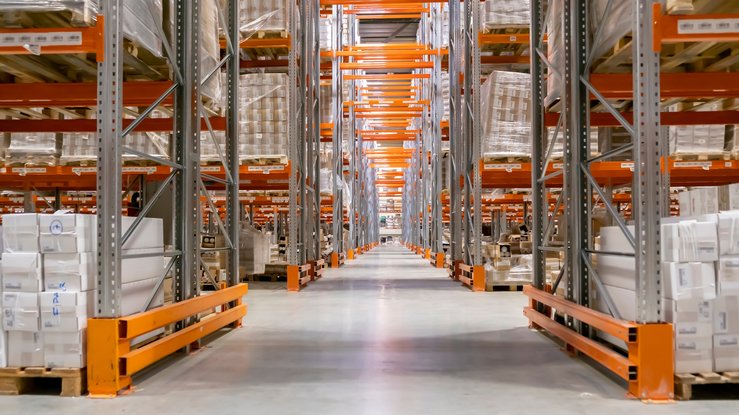
There is no published price for distributor or wholesaler insurance in Missouri, and any number quoted before an underwriter has looked at your building is a guess. An insurance carrier builds the cost from your operation — and Missouri is one of a small handful of states where the building part of that sentence is genuinely complicated, because there are four different things trying to get at the goods inside it.
Four perils, one roof, and two of them are not on the policy
Most states hand a distributor one dominant peril and a couple of secondaries. Missouri hands you the whole set.
Wind and hail. The state sits in the severe convective belt, and a distribution building presents exactly what a hailstorm punishes: acres of flat, low-slope membrane roof with rooftop units on it. Hail does not level a warehouse. It opens a roof plane, and the water that follows finds the racking with your entire owned season underneath it.
Water. Both great rivers bound and cross the state, and floodplain siting near the Missouri and the Mississippi is a real question for river-adjacent industrial land — which is where industrial land tends to be. Flood is its own placement, not a property endorsement.
Ground motion. The New Madrid Seismic Zone in the southeastern Bootheel is the most seismically active area east of the Rockies. For a warehouse the seismic story is not the shell — it is the racking. Racking that is unanchored, overloaded, or unbraced fails before the structure does, and the goods on it end up in the aisle. That is an inventory loss in a building that may still be standing. Earthquake is its own placement too, and it is the one a Missouri distributor is most likely to skip by default rather than by decision.
So a Missouri owner of inventory faces a genuinely unusual question at renewal: of the four things that could ruin the stock, which two did you actually buy coverage for? Commercial property does a real but bounded job — the building, the racking, and the owned inventory while it sits in a scheduled location, plus the income lost when that location goes down. It stops at the walls, and it stops short of two of Missouri’s four.
<text x="350" y="32" text-anchor="middle" font-family="Inter, sans-serif" font-size="15" font-weight="600" fill="#0F4C5C">Four ways to lose the same inventory</text>

<rect x="272" y="140" width="156" height="80" rx="8" fill="#E2F4F3" stroke="#0F4C5C"/>
<text x="350" y="172" text-anchor="middle" font-family="Inter, sans-serif" font-size="13" font-weight="600" fill="#0F4C5C">your owned stock</text>
<text x="350" y="194" text-anchor="middle" font-family="Inter, sans-serif" font-size="12" fill="#3F5B64">under one roof</text>

<text x="120" y="76" text-anchor="middle" font-family="Inter, sans-serif" font-size="13" font-weight="600" fill="#0F4C5C">wind</text>
<text x="120" y="96" text-anchor="middle" font-family="Inter, sans-serif" font-size="11" fill="#3F5B64">on the property form</text>
<path d="M150 104 L280 148" stroke="#0F4C5C" stroke-width="2" fill="none"/>

<text x="120" y="268" text-anchor="middle" font-family="Inter, sans-serif" font-size="13" font-weight="600" fill="#0F4C5C">hail</text>
<text x="120" y="288" text-anchor="middle" font-family="Inter, sans-serif" font-size="11" fill="#3F5B64">on the property form</text>
<path d="M150 254 L280 212" stroke="#0F4C5C" stroke-width="2" fill="none"/>

<text x="580" y="76" text-anchor="middle" font-family="Inter, sans-serif" font-size="13" font-weight="600" fill="#0F4C5C">flood</text>
<text x="580" y="96" text-anchor="middle" font-family="Inter, sans-serif" font-size="11" fill="#3F5B64">a separate placement</text>
<path d="M550 104 L420 148" stroke="#0F4C5C" stroke-width="2" fill="none" stroke-dasharray="5 4"/>

<text x="580" y="268" text-anchor="middle" font-family="Inter, sans-serif" font-size="13" font-weight="600" fill="#0F4C5C">earthquake</text>
<text x="580" y="288" text-anchor="middle" font-family="Inter, sans-serif" font-size="11" fill="#3F5B64">a separate placement</text>
<path d="M550 254 L420 212" stroke="#0F4C5C" stroke-width="2" fill="none" stroke-dasharray="5 4"/>

<rect x="40" y="300" width="620" height="46" rx="9" fill="#C8935A" stroke="#0F4C5C"/>
<text x="350" y="322" text-anchor="middle" font-family="Inter, sans-serif" font-size="14" font-weight="600" fill="#1A1A1A">Half the peril set is not on the property policy.</text>
<text x="350" y="340" text-anchor="middle" font-family="Inter, sans-serif" font-size="12" font-weight="600" fill="#1A1A1A">In Missouri, the dashed lines are decisions — make them on purpose.</text>The number every peril lands on
Whatever the peril, the loss lands on the same number — and it is the number owners get wrong most reliably.
They answer the inventory question with a comfortable annual average. The underwriter is asking something else entirely: what is the maximum value of owned product concentrated in one place on one day? That is what sizes a stock throughput limit, and a limit set to your quiet season is a limit that fails you in your busy one, because a loss does not schedule itself around your calendar. Missouri’s big-box buildings along I-70 and around the metros are built to hold a lot, and they do. Seasonality is close to the center of a distributor’s submission rather than a footnote on it.
The warehouse is the business — franchise law makes sure of it
If beverages are your book, Missouri is a license state: private wholesalers hold the middle tier under the Division of Alcohol and Tobacco Control inside the Department of Public Safety, and the division’s own materials describe the tiers — manufacturer, wholesaler, retailer — as required to stay separate and apart, with the manufacturer selling only to the wholesaler and the wholesaler only to the retailer. Which license you hold depends on the alcohol content of what you move.
But the fact that actually matters to your program is the second one. Missouri is a franchise state, so the supplier–wholesaler appointment is not simply a commercial matter the parties can unwind at will. The brand ties a wholesaler’s warehouse to a book of business that is hard to replace — and that changes the risk conversation in a way owners rarely articulate. The building, the owned inventory in it, and the income it produces are not one asset among several. They are the physical center of an enterprise whose commercial value is bound to a territory it cannot simply re-establish somewhere else. Business income and the time it would actually take to resume distribution deserve real thought here, not a default limit.
The insurance consequence of the licensed tier itself is direct: the inventory in that warehouse is genuinely yours at every step, which is exactly why it is a stock-throughput exposure and not a bailment.
The cold chain, and the loss with no damage
Missouri’s food-processing base runs deep, and a great deal of the state’s owned inventory is grocery, foodservice, and protein sitting in refrigerated and frozen space.
That produces a loss shape owners consistently under-plan for: a compressor failure or a power loss destroys the entire value of the stock without leaving a mark on the building. No fire. No wind. No water. Just a temperature excursion and a total loss of goods that were on your balance sheet — and, if you supply retailers or foodservice operators, a supply failure landing on top of it. Whether your program actually answers for that is a wording question rather than a limit question, and it is worth reading before a summer rather than after one.
What you sell, and the chain you sit in
The product is the driver distributors are most surprised by, because it has nothing to do with the building.
You sit in the chain of distribution, and a products-liability claim over something that causes injury or damage can follow that chain to a seller — not only to the manufacturer who made it. Missouri’s owned-goods economy is broad and old: grocery and foodservice distributors serving a multi-state trade area, animal-health and pharmaceutical distributors clustered around Kansas City, industrial and building-products wholesalers strung along the interstates. Those are not one conversation. Anything consumable or with an ingestion profile carries a different severity picture than a hard good. General liability answers this through the products-completed-operations hazard, and sizing it against what you truly move is most of the work.
The regulatory layer follows ownership too. The Board of Pharmacy licenses drug distributors per physical distribution site, requires a Board inspection of each one before licensure, and demands fingerprints and a background check from the manager-in-charge — so a distributor running more than one Missouri building is running more than one license. Food distribution runs through state and local health regulation layered over the federal registration a food warehouse already carries.
The inland import leg
Missouri’s duty-deferred story is inland, not maritime. A foreign-trade zone covers a broad swath of the western half of the state and operates under the alternative site framework, so a distribution building in the Kansas City metro can be activated as zone space rather than sitting inside a fenced campus; St. Louis carries its own zone on the eastern side. The practical effect: imported inventory can be warehoused in the middle of the country with duty deferred until it is withdrawn.
Which means an importer here has owned its stock for a very long time before it arrived. It came through a coastal or Gulf gateway, and it railed or trucked inland while it was already on your books. So the question that decides where your coverage begins:
When does the risk of loss actually pass to you?
If it passes at the supplier’s dock and your policy starts at your own dock, there is a long stretch of ocean and rail where your inventory is traveling uninsured by you. A marine-family stock throughput form closes exactly that span — and it works precisely the same way for a landlocked distributor, following the goods across ocean, rail, and highway rather than waking up at the four walls. An importer railing goods to a Missouri distribution center is also frequently the first U.S. seller, and it inherits the products position that comes with that role.
The fleet, the crew, and the loss runs
Commercial auto prices unit count, radius, what is hauled, and above all who drives — and a Missouri fleet works a crossroads: I-70 end to end, I-44 to the southwest, I-55 down the river corridor. A note on the language this trade cannot avoid: your insurance carrier is the company that writes your policy, which is an entirely different thing from a motor carrier or a freight carrier that hauls goods for hire.
On workers compensation, Missouri runs a private market. A distributor carries two injury exposures, not one: the warehouse crew on powered industrial trucks, racking, and the pick line, and the route drivers loading and unloading all day. The state’s big-box buildings run enough shifts that the exposure is a headcount-times-hours question long before it is a rate question.
Claims history is read for shape rather than count — cargo in transit, shrinkage in the building, and at-fault fleet losses are three different stories. Limits and retention are the lever entirely in your hands: fund the routine yourself, and put the money into a stock throughput limit sized to the peak, a products limit sized to what you actually sell, and an umbrella over the tail rather than the noise.
Where a Missouri program is won or lost
A Missouri distributor is priced on what it owns, how deep the inventory gets, what would destroy it, and which of the four things that could do so it actually bought coverage for.
If you want the coverage mechanics rather than the cost drivers, stock throughput is the line this guide orbits, the distribution businesses pillar covers how these programs are assembled, and the Missouri distributor and wholesaler insurance page goes deeper. If the goods in your building belong to your customers rather than to you, this is the wrong guide — read the warehouse cost guide instead, or ask us for a quote.