

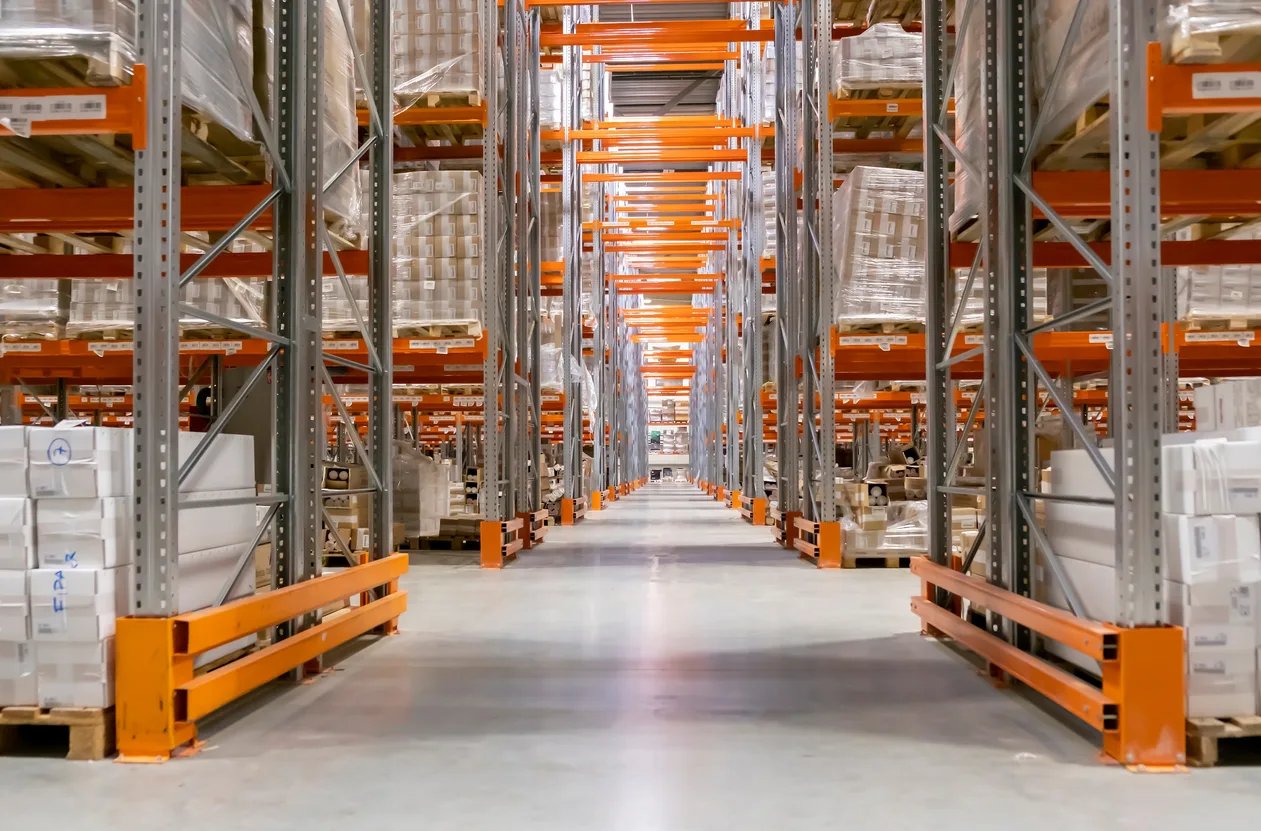
Missouri is one of the few states where a warehouse owner has to think about all four of wind, hail, water, and ground motion — and where all four of them arrive at the same destination.
Not the roof. Not the steel. The pallets on the racking that belong to somebody else.
That is the thing worth holding onto through everything that follows, because it is what an underwriter is really pricing. Your building and your racking are on your balance sheet, so you know what they cost. The customer inventory sitting on that racking tonight is not, and it is frequently worth more than the structure around it.
A building that answers to four perils
Missouri sits in the severe convective belt, and a distribution building presents exactly what a hailstorm punishes: acres of flat, low-slope membrane roof with rooftop units bolted through it. The tornado exposure is genuine and severe, and a large-footprint building cannot be sited out of it.
Both great rivers bound and cross the state, so floodplain siting near the Missouri and the Mississippi is a real question for river-adjacent industrial land — and flood is its own placement, not a property endorsement to argue about after the water has gone down. The water reaches the floor, the staged outbound, and the bottom beam of the racking, which is where the heaviest freight lives.
And then there is the one that surprises people.
The racking is what moves first
The New Madrid Seismic Zone in the southeastern Bootheel is the most seismically active area east of the Rockies. That makes rack seismic bracing and the shake-out of high-bay storage a genuine Missouri conversation rather than a West Coast one — and most owners here have never had it.
The key insight is that in a warehouse, ground motion does not begin by damaging the structure. It begins by moving the racks and what is on them. A rack bay walks, product slides off a beam, an aisle goes down, and the loss arrives in three forms at once: your steel (a property claim), your customers’ inventory on the floor underneath it (a bailee claim), and the people who were working in that aisle (a comp claim).
So rack anchorage, rack capacity and configuration, seismic bracing, and whether stored product is restrained or free to walk are not engineering trivia in this state. They are among the highest-leverage controls an underwriter can find — and earthquake is its own placement, like flood, rather than something that rides the property form.
Your structure, racking, material-handling systems, and the business income lost while a site is down belong on the commercial property side. But in every peril on this list, the second half of the loss is warehouse legal liability — because the second half of the loss is not yours.
Value, nature, and the number owners get wrong
The bailee limit is sized by the value and the nature of the goods in your care, and it is the figure operators most reliably understate — precisely because that inventory never appears in their own accounts.
Value is the maximum amount of customer-owned freight under your roof on the worst possible day, not on an average Tuesday. Nature is the half that gets missed: identical square footage on identical racking, holding high-value consumer goods rather than bulky low-value freight, prices nothing alike, because the amount at risk per pallet position differs by an order of magnitude — and so does what a thief will do to get at it. Refrigerated and food-grade space, well represented here given the state’s food-processing base, adds a third failure mode entirely: the room drifts, and a customer’s goods are gone without a mark on the building.
Grain is licensed. The 3PL is not
The warehouse license that actually exists in Missouri is agricultural, not general.
The Department of Agriculture’s Grain Regulatory Services program licenses, bonds, and audits grain warehouses and grain dealers under the Missouri Grain Warehouse Law, RSMo Chapter 411. Any elevator storing grain for others must hold a state or federal warehouse license, and auditors verify inventory against outstanding obligations. That is a serious, structured program — and it is a grain program.
There is no parallel general-merchandise public-warehouse license. A 3PL storing pallets of consumer goods in Kansas City or St. Louis is not licensed by the state as a warehouse at all. Its duties to the goods run through the bailment relationship and the warehouse receipt, not through a permit.
Which makes the storage agreement the whole ballgame: the limitation-of-liability language, the standard of care you accepted, and whether the customer has been told to carry its own coverage on the goods. That absence of a license is a cost driver, not a footnote — two identical buildings running identical volumes can price differently on their contracts alone, and an underwriter reads them before binding rather than after a loss.
One other license does reach into a building here, and it is worth knowing: the Missouri Board of Pharmacy licenses drug distributors, requires a Board inspection of each distribution site before licensure, and demands fingerprints and a background check from the manager-in-charge — a separate license for each physical distribution site, which matters to any operator running more than one building.
Duty-deferred, in the middle of the country
Missouri’s bonded story is inland rather than maritime, and it is more accessible than owners assume.
Foreign-Trade Zone 15, granted to Greater Kansas City Foreign-Trade Zone, Inc., covers a broad swath of counties in the western half of the state and operates under the alternative site framework — so a distribution building in the Kansas City metro can be activated as zone space rather than having to sit inside a fenced zone campus. St. Louis has its own zone on the eastern side of the state.
The practical effect for a bailee: imported inventory can be warehoused in the middle of the country with duty deferred until withdrawal. And the pricing effect is the accumulation. When you admit duty-deferred goods, you take on customs obligations on top of your ordinary duty of care to the owner, and you raise the value concentration under one roof without changing whose goods they are. An underwriter prices both halves.
The crew, times the shifts
Workers compensation runs through a private market here — coverage is bought from insurers competing for the business, not from a state fund — and it scales with your material-handling payroll and the classifications you actually run.
The loss picture is dominated by the same handful of mechanisms as everywhere: powered-industrial-truck strikes and tip-overs, workers struck by falling stored material or hit by a collapsing rack bay, dock-edge and trailer-creep falls, and the slow accumulation of lifting and repetitive-motion strain in a pick operation.
What Missouri adds is hours. The big-box buildings along the I-70 corridors run enough shifts that the exposure is a headcount-times-hours question long before it is a rate question — and controls that only exist on first shift are controls an underwriter will discount accordingly.
Four perils. One pallet. And it is not yours
<text x="350" y="30" text-anchor="middle" font-family="Inter, sans-serif" font-size="15" font-weight="600" fill="#0F4C5C">Wind, water, ground motion, temperature — all one address</text>

<rect x="230" y="48" width="240" height="46" rx="9" fill="#ffffff" stroke="#C3DEDE"/>
<text x="350" y="68" text-anchor="middle" font-family="Inter, sans-serif" font-size="12" font-weight="600" fill="#0F4C5C">Hail and convective wind</text>
<text x="350" y="86" text-anchor="middle" font-family="Inter, sans-serif" font-size="11" fill="#3F5B64">Acres of low-slope roof, bruised at once</text>

<rect x="20" y="160" width="200" height="60" rx="9" fill="#ffffff" stroke="#C3DEDE"/>
<text x="120" y="184" text-anchor="middle" font-family="Inter, sans-serif" font-size="12" font-weight="600" fill="#0F4C5C">River flood</text>
<text x="120" y="204" text-anchor="middle" font-family="Inter, sans-serif" font-size="11" fill="#3F5B64">Reaching the bottom beam</text>

<rect x="480" y="160" width="200" height="60" rx="9" fill="#ffffff" stroke="#C3DEDE"/>
<text x="580" y="184" text-anchor="middle" font-family="Inter, sans-serif" font-size="12" font-weight="600" fill="#0F4C5C">New Madrid ground motion</text>
<text x="580" y="204" text-anchor="middle" font-family="Inter, sans-serif" font-size="11" fill="#3F5B64">The racking moves first</text>

<rect x="230" y="292" width="240" height="46" rx="9" fill="#ffffff" stroke="#C3DEDE"/>
<text x="350" y="312" text-anchor="middle" font-family="Inter, sans-serif" font-size="12" font-weight="600" fill="#0F4C5C">A cold room that drifts</text>
<text x="350" y="330" text-anchor="middle" font-family="Inter, sans-serif" font-size="11" fill="#3F5B64">No fire, no water, no mark on the building</text>

<path d="M350 96 L350 138" stroke="#0F4C5C" stroke-width="2"/>
<path d="M224 190 L262 190" stroke="#0F4C5C" stroke-width="2"/>
<path d="M476 190 L438 190" stroke="#0F4C5C" stroke-width="2"/>
<path d="M350 288 L350 244" stroke="#0F4C5C" stroke-width="2"/>

<rect x="182" y="140" width="336" height="102" rx="10" fill="#C8935A" stroke="#0F4C5C"/>
<text x="350" y="174" text-anchor="middle" font-family="Inter, sans-serif" font-size="15" font-weight="600" fill="#1A1A1A">The customers’ goods on your racking</text>
<text x="350" y="198" text-anchor="middle" font-family="Inter, sans-serif" font-size="12" font-weight="600" fill="#1A1A1A">You did not buy it. You cannot replace it.</text>
<text x="350" y="220" text-anchor="middle" font-family="Inter, sans-serif" font-size="12" font-weight="600" fill="#1A1A1A">Your storage contract decides what you owe.</text>

<text x="350" y="366" text-anchor="middle" font-family="Inter, sans-serif" font-size="12" font-style="italic" fill="#3F5B64">Four different perils. The same bailee claim at the end of each one.</text>The honest summary
Missouri exists in freight because it is in the middle. A truck leaving Kansas City or St. Louis covers most of the U.S. population inside a two-day drive, the rail networks meet at Kansas City, and the barge terminals work the confluence. That reach is what fills the buildings — national retailers, e-commerce operators, consumer-goods companies, and the 3PLs holding their inventory.
Which means the price is built on custody, on four perils that all end at the same pallet, on racking that has to hold through a shake, and on a storage agreement that no license is standing behind.
To see how the coverage itself works rather than what it costs, start with warehouse legal liability, or read the full Missouri warehouse insurance page. Our warehouse businesses practice explains how we approach the class. And if you own the inventory you hold — a beverage wholesaler, a foodservice distributor, an animal-health or building-products supplier — none of the above is your program: read the distributor cost guide instead.