

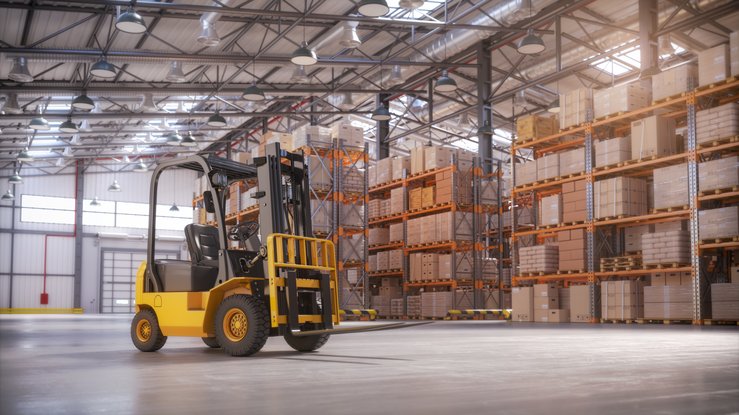
Everything an Ohio distributor sells, it owned first — except, in one corner of the beverage trade, it did not. The Division of Liquor Control holds the spirits wholesale tier itself and keeps title to that inventory right up to the moment of sale, while beer and wine move through private distributors who buy and own their own book. It is an odd, useful place to start a cost guide, because it forces the question that actually sizes an owner-of-inventory program: which pallets in your building are yours?
For almost every Ohio distributor, wholesaler, or importer, the answer is all of them — and that is precisely why the price is built the way it is. There is no published number for this coverage, and any figure quoted before an underwriter has looked at your inventory is a guess. Here is what the underwriter is actually doing instead.
Start with the fullest day of the year
This is the number that sizes a stock throughput limit, and getting it wrong is the most expensive routine mistake in the trade.
Owners answer the inventory question with a comfortable annual average. Underwriters are not asking for the average. They are asking: what is the maximum value of owned product sitting in one building on one day? Because a loss does not arrive in a quiet month. It arrives in the season you spent the year buying for, when the racking is deepest and the value on the floor is at its high-water mark.
A limit set to the quiet season is a limit that fails you in the busy one. And Ohio sharpens this, because Ohio concentrates. The Columbus market exists on drive-time arithmetic — a very large share of the country sits inside a day’s truck cycle — and the buildings that arithmetic produces are big ones. Inventory that would be spread across four modest warehouses in another state sits under one roof here. Accumulation is not an abstraction in this state; it is the business model.
What you sell decides more than where you store it
Here is the driver Ohio distributors are most surprised by, because it has nothing to do with the building or the trucks.
You sit in the chain of distribution, and a products-liability claim over something that injures somebody can follow that chain to a seller. Not only to the manufacturer. You did not design it, you did not build it — you bought it and sold it, and that is enough to be named on the suit.
So an insurer prices the goods. Ohio’s owned-stock economy runs heavily to consumer products, food, industrial supply, and automotive and truck parts, and those are not one exposure. A pallet of brackets and a pallet of something people eat carry different severity pictures, and anything reaching children is different again. General liability answers this through what the standard form calls the products-completed-operations hazard, and sizing that limit against what you actually move — rather than against a generic revenue band — is most of the work on the submission.
Comp in a state with no comp market
Ohio is one of a handful of monopolistic workers’ compensation states, and it genuinely changes the shape of a distributor’s program.
There is no private market for the statutory line. You buy from the Ohio Bureau of Workers’ Compensation state fund or you qualify to self-insure. What neither route gives you is employers liability — the part that answers a lawsuit rather than a benefits claim — and that has to be picked up separately, almost always through the stop-gap endorsement written onto the general liability policy. It is a small, cheap, easily forgotten piece of paper, and its absence is discovered in the worst possible circumstances.
A distributor carries two injury exposures rather than one: the warehouse crew lifting, picking, and working around powered industrial trucks, and the route drivers loading, unloading, and running a lift gate all day. Both land on the same split program. See workers compensation for the mechanics.
The import leg, and when your risk actually begins
Ohio imports by air more than most states realize. The Columbus Regional Airport Authority holds the foreign-trade zone whose sites reach across Rickenbacker and the Groveport and Alum Creek parks — an inland port built to take international air freight and hold it in zone status before it is released to the domestic market. Greater Cincinnati and Cleveland carry their own zone programs.
For a distributor, that means owned goods are frequently in the air, or on a truck coming in from a coastal port, long before they reach the rack. Which raises the question importers most often answer by accident:
When does the risk of loss actually pass to you?
Your purchase terms may hand you ownership at the foreign supplier’s dock, at the point of loading, or on arrival. Whichever it is, that is when your exposure begins — not when the pallet lands in Groveport. If risk passes early and coverage starts late, there is a stretch of the journey where your own inventory is traveling uninsured by you. That gap is invisible until it is a claim.
And there is a second consequence: an importer is very often the first U.S. seller of goods made somewhere else. When the actual manufacturer sits beyond the practical reach of a U.S. claim, the importer becomes the realistic target for a products claim on goods it never made.
This is the span stock throughput exists for — one marine-family form following the goods from the supplier, through ocean or air transit, across the inland leg, into the warehouse, and out to the customer, instead of a property-plus-cargo patchwork with seams in it.
Hail on an acre of roof, with your season underneath
Commercial property still matters, and it does a specific, bounded job: your building, your racking, and your owned inventory while it sits still, plus the business income you lose when the building goes down. It stops at the walls.
Ohio sits at the eastern edge of the severe-convective belt, and the peril that costs distributors most is the one that lands flat. Hail does not level a warehouse; it bruises an entire membrane roof plane at once, invisibly from the dock, and the water that follows finds the racking and your season underneath it. Tornado exposure is real through the western and central corridors. The northeast takes lake-effect snow off Erie, which makes drift load on a long clear-span roof a design question rather than a theory, and a hard freeze threatens wet sprinkler piping in unheated bays and the refrigeration on any cold-chain building. Flood belongs in its own placement, which matters a great deal when the goods on the floor are on your balance sheet.
The fleet, and a word this trade uses two ways
A distribution business moves its own product, which puts trucks on the road across I-70, I-71, and I-75. Commercial auto prices the fleet on unit count, radius, what you haul, and above all who drives.
One note on language, because this niche cannot avoid it: your insurance carrier is the company that writes your policy. A motor carrier or freight carrier hauls goods. Two different words wearing the same coat, and the distinction matters when you are reading a contract.
Claims read for shape, not just for count
An underwriter reads a distributor’s loss run for shape. Cargo damage in transit, shrinkage inside the building, and at-fault fleet accidents are three different stories about three different parts of your operation. One large cargo loss reads very differently from a steady drip of driver incidents — the second suggests something structural about hiring or routing; the first may just be a bad day.
Limits and retention are the lever that is genuinely yours. You are choosing how much of the routine to fund yourself in exchange for a better price on the part that could actually end the business. Fund the small stuff, buy a serious stock throughput limit sized to the peak and a products limit sized to what you really sell, and you are buying insurance in the right order.
What the underwriter is actually pricing
<text x="350" y="32" text-anchor="middle" font-family="Inter, sans-serif" font-size="15" font-weight="600" fill="#0F4C5C">Two control regimes, one distribution business</text>

<rect x="36" y="52" width="290" height="230" rx="8" fill="#ffffff" stroke="#C3DEDE"/>
<text x="181" y="76" text-anchor="middle" font-family="Inter, sans-serif" font-size="13" font-weight="600" fill="#0F4C5C">Yours — and therefore priced</text>
<text x="181" y="108" text-anchor="middle" font-family="Inter, sans-serif" font-size="12" fill="#3F5B64">owned inventory, at its peak</text>
<text x="181" y="134" text-anchor="middle" font-family="Inter, sans-serif" font-size="12" fill="#3F5B64">the products chain you sit in</text>
<text x="181" y="160" text-anchor="middle" font-family="Inter, sans-serif" font-size="12" fill="#3F5B64">the fleet, and who drives it</text>
<text x="181" y="186" text-anchor="middle" font-family="Inter, sans-serif" font-size="12" fill="#3F5B64">the building, while goods sit still</text>
<text x="181" y="212" text-anchor="middle" font-family="Inter, sans-serif" font-size="12" fill="#3F5B64">the import leg you already own</text>
<text x="181" y="252" text-anchor="middle" font-family="Inter, sans-serif" font-size="12" font-weight="600" fill="#0F4C5C">this column is the submission</text>

<rect x="374" y="52" width="290" height="230" rx="8" fill="#ffffff" stroke="#C3DEDE"/>
<text x="519" y="76" text-anchor="middle" font-family="Inter, sans-serif" font-size="13" font-weight="600" fill="#0F4C5C">The state’s — not yours to insure</text>
<text x="519" y="108" text-anchor="middle" font-family="Inter, sans-serif" font-size="12" fill="#3F5B64">the spirits wholesale tier</text>
<text x="519" y="134" text-anchor="middle" font-family="Inter, sans-serif" font-size="12" fill="#3F5B64">title to spirits, held until sale</text>
<text x="519" y="160" text-anchor="middle" font-family="Inter, sans-serif" font-size="12" fill="#3F5B64">the statutory injury line</text>
<text x="519" y="186" text-anchor="middle" font-family="Inter, sans-serif" font-size="12" fill="#3F5B64">written by the state fund</text>
<text x="519" y="212" text-anchor="middle" font-family="Inter, sans-serif" font-size="12" fill="#3F5B64">beer and wine stay private</text>
<text x="519" y="252" text-anchor="middle" font-family="Inter, sans-serif" font-size="12" font-weight="600" fill="#0F4C5C">no premium, but real obligations</text>

<rect x="40" y="308" width="620" height="54" rx="9" fill="#C8935A" stroke="#0F4C5C"/>
<text x="350" y="332" text-anchor="middle" font-family="Inter, sans-serif" font-size="14" font-weight="600" fill="#1A1A1A">Employers liability belongs to neither column by default.</text>
<text x="350" y="352" text-anchor="middle" font-family="Inter, sans-serif" font-size="12" font-weight="600" fill="#1A1A1A">In Ohio it is arranged on purpose — or it is simply missing.</text>The honest summary
An Ohio distributor is priced on what it owns, how much of it is in one place on the worst possible day, and what happens if the thing it sold hurts somebody. The state fund takes the injury line and leaves employers liability behind; the state takes the spirits tier and leaves everything else to you. Everything that is left is the submission.
If you want coverage mechanics rather than cost drivers, stock throughput is the line this whole guide orbits, distribution businesses is the broader program view, and the Ohio distributor and wholesaler insurance page goes deeper on the exposures. And if the goods in your building belong to your customers rather than to you, none of the above is your program — read the Ohio warehouse cost guide instead.