

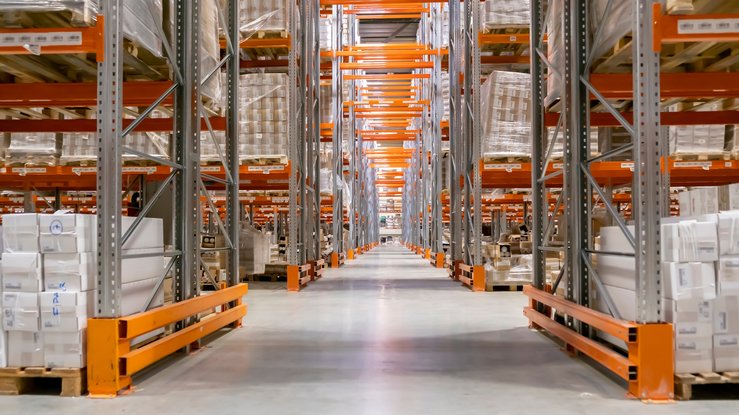
A Pennsylvania distribution building is almost never in Pennsylvania because of Pennsylvania. It is there because of what a truck leaving it can reach by evening.
That single fact reorganizes the cost conversation for an owner of inventory. Central Pennsylvania and the Lehigh Valley became one of the great distribution markets in North America because a truck pulling out of Carlisle or Bethlehem in the morning can serve New York, Philadelphia, Baltimore, Washington, and much of New England the same day — on land, at rents the coastal markets cannot offer. So a wholesaler does not put one building here for the local trade. It puts one very large building here and serves an enormous customer base out of it.
Which means the owned inventory piles up. And accumulation is the first thing an underwriter prices.
The accumulation a reach market builds
Everything you sell, you owned first. That is the whole difference from the warehouse down the road, and it is why the sizing question for a distributor is not really about square footage at all — it is about the maximum value of owned product concentrated in one place on one day.
Owners answer that question with a comfortable annual average. Underwriters are not asking about the average. They are asking about the peak, because a loss does not wait for a convenient month; it arrives in the season you built up for, when the racking is deepest and the value on the floor is at its high-water mark. A stock throughput limit set to your quiet season is a limit that fails you in your busy one.
Pennsylvania makes that harder than most states, and the reason is the same reason the building is here. A distributor serving five metropolitan markets from one Cumberland County site is holding under one roof what a company in a fragmented market would have spread across four buildings in four counties. The consolidation is efficient right up until the day it is not. Seasonality is not a footnote on a Pennsylvania distributor’s submission; it is close to the center of it.
In Pennsylvania, a beverage distributor is a beer distributor
If your product is beverage, stop here, because no other state states its terms this bluntly.
Pennsylvania is a control state, and it is the unusual kind: the Commonwealth occupies both the wholesale and the retail tier for wine and spirits. The Liquor Control Board buys the wine and spirits, warehouses them, and sells them — to the public through its own Fine Wine and Good Spirits stores, and to licensees through its own ordering and distribution system. There is no private wine-and-spirits wholesaler tier to be in. Not a hard one to enter. Not a competitive one. There is none.
Malt and brewed beverages are the exception, and they are the whole of the private opportunity. Beer moves through privately held distributor and importing-distributor licenses issued by the Liquor Control Board. So the practical fact, and it is a fact about the business before it is a fact about the insurance: a private Pennsylvania beverage distribution business is a beer business.
The insurance consequence follows directly. The beer in that warehouse is genuinely yours at every step — you bought it from the brewer, it sits on your rack, and you sell it onward. Nobody else has title to it while it is under your roof. That is exactly why it prices as an owned-goods, stock throughput exposure rather than as somebody else’s property in your care, and why the peak-accumulation question above applies to it in full force.
<text x="350" y="30" text-anchor="middle" font-family="Inter, sans-serif" font-size="15" font-weight="600" fill="#0F4C5C">Two products, one open lane</text>

<text x="290" y="60" text-anchor="middle" font-family="Inter, sans-serif" font-size="13" font-weight="600" fill="#0F4C5C">Wine and spirits</text>
<text x="530" y="60" text-anchor="middle" font-family="Inter, sans-serif" font-size="13" font-weight="600" fill="#0F4C5C">Malt and brewed</text>

<text x="120" y="98" text-anchor="middle" font-family="Inter, sans-serif" font-size="12" fill="#3F5B64">Producer tier</text>
<rect x="190" y="78" width="200" height="34" rx="5" fill="#ffffff" stroke="#C3DEDE"/>
<text x="290" y="100" text-anchor="middle" font-family="Inter, sans-serif" font-size="12" fill="#3F5B64">private</text>
<rect x="430" y="78" width="200" height="34" rx="5" fill="#ffffff" stroke="#C3DEDE"/>
<text x="530" y="100" text-anchor="middle" font-family="Inter, sans-serif" font-size="12" fill="#3F5B64">private</text>

<text x="120" y="150" text-anchor="middle" font-family="Inter, sans-serif" font-size="12" fill="#3F5B64">Wholesale tier</text>
<rect x="190" y="128" width="200" height="38" rx="5" fill="#E2F4F3" stroke="#0F4C5C"/>
<text x="290" y="152" text-anchor="middle" font-family="Inter, sans-serif" font-size="12" font-weight="600" fill="#0F4C5C">held by the Commonwealth</text>
<rect x="430" y="128" width="200" height="38" rx="5" fill="#ffffff" stroke="#0F4C5C"/>
<text x="530" y="146" text-anchor="middle" font-family="Inter, sans-serif" font-size="12" font-weight="600" fill="#0F4C5C">OPEN — your business</text>
<text x="530" y="161" text-anchor="middle" font-family="Inter, sans-serif" font-size="11" fill="#3F5B64">distributor license</text>

<text x="120" y="204" text-anchor="middle" font-family="Inter, sans-serif" font-size="12" fill="#3F5B64">Retail tier</text>
<rect x="190" y="182" width="200" height="38" rx="5" fill="#E2F4F3" stroke="#0F4C5C"/>
<text x="290" y="206" text-anchor="middle" font-family="Inter, sans-serif" font-size="12" font-weight="600" fill="#0F4C5C">held by the Commonwealth</text>
<rect x="430" y="182" width="200" height="38" rx="5" fill="#ffffff" stroke="#C3DEDE"/>
<text x="530" y="206" text-anchor="middle" font-family="Inter, sans-serif" font-size="12" fill="#3F5B64">licensed retailers</text>

<text x="350" y="252" text-anchor="middle" font-family="Inter, sans-serif" font-size="12" font-weight="600" fill="#0F4C5C">There is no private wine-and-spirits wholesale tier to enter.</text>

<rect x="40" y="278" width="620" height="56" rx="9" fill="#C8935A" stroke="#0F4C5C"/>
<text x="350" y="303" text-anchor="middle" font-family="Inter, sans-serif" font-size="14" font-weight="600" fill="#1A1A1A">The private lane in Pennsylvania is beer.</text>
<text x="350" y="323" text-anchor="middle" font-family="Inter, sans-serif" font-size="12" font-weight="600" fill="#1A1A1A">And the beer on your rack is yours — which is why it prices as owned stock.</text>What the product actually is — and which desk it answers to
Here is the driver distributors are most surprised by, because it has nothing to do with the building or the trucks. It is the goods.
You sit in the chain of distribution, and a products-liability claim can follow that chain to a seller, not only to the manufacturer who made the thing. You did not design it. You bought it and you sold it, and that is enough to be named. So general liability does real work on a distributor’s program through what the standard form calls the products-completed-operations hazard, and sizing that limit against what you actually move — rather than against a generic revenue band — is most of the work on the submission.
Pennsylvania adds a wrinkle worth knowing before renewal: the regulatory desk is chosen by what is on the pallet, and the desks are not where you would guess. The Department of Agriculture’s Bureau of Food Safety and Laboratory Services registers food establishments, a category that expressly includes facilities that hold and distribute food and cold-storage warehouses among them — so a distributor adding a grocery line acquires a registration it did not previously need. Pharmaceutical wholesaling does not sit with a pharmacy board at all; the Department of Health’s Drug, Devices and Cosmetics program licenses wholesale prescription drug distributors. That is a compliance cost sitting alongside the premium, and it moves the moment your product mix moves.
The import leg, and when the risk of loss passes
PhilaPort is a genuine seaport with a distinctive specialization in imported fruit and perishables, and that specialization creates a very particular owned-goods exposure.
An importer bringing fruit through Philadelphia owns that fruit from the grower to the retailer — across the water, off the ship, into a cold chain, and out to a customer. The entire route is the exposure, and most of the route is not in the building. That importer is also, very often, the first U.S. seller of goods made or grown somewhere else, and when the actual producer sits beyond the practical reach of a U.S. claim, the importer becomes the realistic target for a products claim on a thing it never grew.
Which raises the question importers most often answer by accident:
When does the risk of loss actually pass to you?
Your purchase terms may hand you ownership at the foreign dock, at the port of loading, or on arrival. Whichever it is, that is when your exposure begins — not when the pallet lands on your rack. If risk passes early and coverage starts late, there is a stretch of ocean or highway where your own inventory is traveling uninsured by you. That is precisely the span stock throughput is written for: one marine-family form following owned goods from the supplier, through ocean cargo and inland transit, into the warehouse, and out to the customer — instead of a property-plus-cargo patchwork with seams in it.
One local advantage worth using. Pennsylvania’s foreign-trade zones land directly on top of the warehouse corridors — the northeast around Pittston, the south-central counties from Berks and Lancaster through Cumberland, Dauphin and York, the Philadelphia zone at the port, and the Pittsburgh region — which means duty-deferred storage is available in a building a distributor would have leased anyway. That is not true in most states, and it is worth asking about before you sign a lease.
The roof, which is the largest thing you own
Commercial property does a specific and bounded job for a distributor: it covers the building, the racking, and the owned inventory while it sits in a scheduled location, plus the income lost when that location cannot ship. It stops at the walls.
What an underwriter weighs is the accumulation problem again, seen through Pennsylvania weather. These buildings are enormous, and the peril that matters most is whatever can find a very large roof plane: severe thunderstorm wind and hail across the southeast and the Lehigh Valley, and snow and ice load on wide-span roofs in the north and the mountains. Hail does not level a warehouse — it bruises a whole membrane, and the water that follows finds the racking and the season underneath it. Tropical remnants are a recurring flood driver in the southeastern counties, and flood belongs in its own placement rather than the property form, which matters a great deal when the goods on the floor are on your balance sheet. Freeze losses to sprinkler piping in unheated dock and mezzanine areas are quiet and common.
The fleet and the crew
A distribution business moves its own product, which puts trucks on the road. Commercial auto prices unit count, radius, what you haul, and above all who drives — and a Pennsylvania distributor whose routes run out onto I-78, I-81, and I-83 toward four metropolitan markets is buying a serious auto exposure, not an incidental one. A note on language this trade cannot avoid: your insurance carrier is the company that writes your policy, which is an entirely different thing from a motor carrier or a freight carrier hauling goods for hire.
On workers compensation, Pennsylvania runs a private market with a competitive state-operated fund available alongside it. A distributor carries two separate injury exposures, not one: the warehouse crew picking, lifting, and working at rack height, and the route drivers loading, unloading, and working a lift gate all day. Freezer and cooler work in the food-grade buildings adds cold stress on top of that.
Claims history, and the limits you actually choose
An underwriter reads a distributor’s loss runs for shape, not just for count. Cargo losses in transit, shrinkage in the building, and at-fault fleet accidents are three different stories about three different parts of your operation. One large cargo claim reads very differently from a steady drip of driver incidents; the second suggests something structural about hiring or routing.
And limits are a genuine decision. You are choosing how much of the routine to fund yourself in exchange for a better price on the part that could actually end the business. A distributor that can absorb ordinary shrinkage and handling damage, and then buys a serious stock throughput limit sized to the peak plus a products limit sized to what it really sells — supported by an umbrella where the contracts demand it — is buying its insurance in the right order.
The honest summary
A Pennsylvania distributor is priced on a building chosen for reach, holding a consolidated peak that most states would have spread across four sites, selling a product that can follow the chain of distribution back to it, and running trucks toward several of the country’s biggest markets at once. And if the product is beverage, the Commonwealth has already made the largest decision for you.
If you want the coverage mechanics rather than the cost drivers, stock throughput is the line this guide orbits, our wholesaling business insurance page covers the broader program, and the full Pennsylvania distributor and wholesaler insurance page goes deeper on the exposures. And if the goods in your building belong to your customers rather than to you, none of the above is your program — you want the Pennsylvania warehouse cost guide instead.