

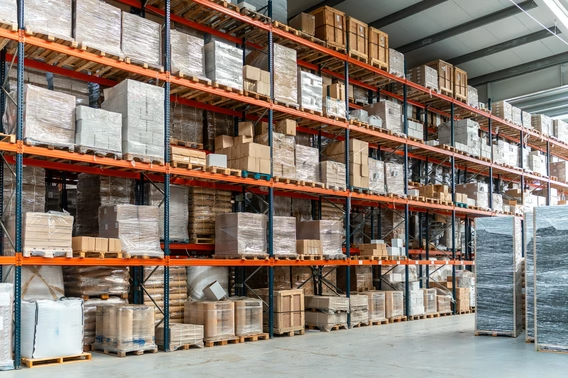
Most cost guides can afford to talk about the geographic spread of a distributor’s inventory. In Rhode Island there usually is not any.
A Rhode Island wholesaler is typically a business with a New England-sized customer list and its entire owned inventory sitting in one or two buildings. That is not a criticism; it is a rational response to a small state with an expensive shoreline. But it is the first thing an underwriter sees, and it makes concentration — not the fleet, not the payroll, not the building itself — the center of the cost conversation.
One address, the whole book
Everything a distributor sells, it owned first. And a distributor that owns everything it sells, at one address, has no internal shock absorber.
A wholesaler holding stock in four states can lose a building and still ship. A Rhode Island wholesaler holding everything at Quonset cannot. That has two consequences an underwriter prices directly: the maximum loss is the whole holding rather than a share of it, and the business-income consequence of any event that closes the building is total rather than partial. The question is not just what your goods are worth — it is what happens to your customers on the morning after.
<text x="350" y="30" text-anchor="middle" font-family="Inter, sans-serif" font-size="15" font-weight="600" fill="#0F4C5C">Where the inventory actually sits</text>

<text x="175" y="62" text-anchor="middle" font-family="Inter, sans-serif" font-size="13" font-weight="600" fill="#3F5B64">A spread book</text>
<rect x="60" y="82" width="66" height="56" rx="5" fill="#ffffff" stroke="#C3DEDE"/>
<rect x="142" y="82" width="66" height="56" rx="5" fill="#ffffff" stroke="#C3DEDE"/>
<rect x="224" y="82" width="66" height="56" rx="5" fill="#ffffff" stroke="#C3DEDE"/>
<text x="175" y="162" text-anchor="middle" font-family="Inter, sans-serif" font-size="12" fill="#3F5B64">lose one, keep shipping</text>

<path d="M350 70 L350 230" stroke="#C3DEDE" stroke-width="2" fill="none"/>

<text x="525" y="62" text-anchor="middle" font-family="Inter, sans-serif" font-size="13" font-weight="600" fill="#0F4C5C">The Rhode Island book</text>
<rect x="425" y="82" width="200" height="112" rx="6" fill="#ffffff" stroke="#0F4C5C"/>
<rect x="441" y="98" width="168" height="20" rx="3" fill="#E2F4F3" stroke="#C3DEDE"/>
<rect x="441" y="124" width="168" height="20" rx="3" fill="#E2F4F3" stroke="#C3DEDE"/>
<rect x="441" y="150" width="168" height="20" rx="3" fill="#E2F4F3" stroke="#C3DEDE"/>
<text x="525" y="215" text-anchor="middle" font-family="Inter, sans-serif" font-size="12" font-weight="600" fill="#0F4C5C">every line, one address</text>
<text x="525" y="235" text-anchor="middle" font-family="Inter, sans-serif" font-size="12" fill="#3F5B64">no second site to ship from</text>

<rect x="40" y="272" width="620" height="54" rx="9" fill="#C8935A" stroke="#0F4C5C"/>
<text x="350" y="296" text-anchor="middle" font-family="Inter, sans-serif" font-size="14" font-weight="600" fill="#1A1A1A">One address is the whole balance sheet.</text>
<text x="350" y="316" text-anchor="middle" font-family="Inter, sans-serif" font-size="12" font-weight="600" fill="#1A1A1A">The limit has to answer for all of it, and so does the continuity plan.</text>The peak, when there is nowhere for it to go
The number that sizes a stock throughput limit is not the comfortable annual average an owner instinctively quotes. It is the maximum value of owned product concentrated in one place on one day — and in a single-site business those words are almost redundant, because one place is the only place there is.
A loss does not wait for a convenient month. It arrives in the season you built up for, when the racking is deepest and the value on the floor is at its high-water mark. A limit set to your quiet season is a limit that fails you in your busy one, and here it fails you with no fallback at all.
The import trade is real, and it is unusual
Rhode Island’s import story is genuine, and it does not look like anybody else’s. The Port of Davisville at Quonset is one of the busiest automobile import ports on the East Coast and also handles break-bulk and project cargo; ProvPort is a working deepwater breakbulk and bulk terminal on the Providence River; T.F. Green carries air cargo. The state’s single foreign-trade zone, administered by the Rhode Island Commerce Corporation, has its magnet sites at ProvPort, the business park beside the airport, and Quonset and Davisville — and Quonset is where bonded and duty-deferred storage actually lives.
A Rhode Island company landing owned stock at any of those gateways is frequently the first U.S. seller of goods it did not make. That seats it squarely in the chain of distribution: a products-liability claim can follow that chain to a seller, not only to the manufacturer, and when the actual maker sits beyond the practical reach of a U.S. claim, the importer is the realistic defendant. General liability answers this through what the standard form calls the products-completed-operations hazard, and it is the driver distributors are most surprised by, because they never made the thing.
Importing also lengthens the span your goods are exposed for. Which raises the question importers most often answer by accident:
When does the risk of loss actually pass to you?
Whatever your purchase terms say, that is when your exposure begins — not when the container reaches Quonset. Stock throughput exists to cover that entire span in one marine-family form, rather than a property policy that stops at your walls and a cargo policy that starts somewhere else with a seam between them.
Two licensing tiers, two different regulators
If you distribute beverages, Rhode Island is a license state with a split worth knowing. Manufacturer and wholesaler licenses are issued by the state, through the Department of Business Regulation’s commercial licensing division. Retail licenses are issued by the cities and towns. So a Rhode Island wholesaler is selling into a retail tier it does not share a regulator with. State law also polices who may hold the wholesale license — an out-of-state distiller or winery cannot hold or hold an interest in one — which keeps the middle tier genuinely independent of the first.
The insurance consequence is direct: the product on that rack is genuinely yours at every step, which is why it prices as an owned-goods exposure and not as somebody else’s property in your care.
Food is the other licensed lane. The Department of Health licenses food processors, distributors, and wholesalers, and it draws a working line between a dry warehouse holding packaged, shelf-stable goods and a warehouse handling exposed or temperature-dependent product — the latter carrying the heavier hazard-analysis and preventive-controls burden. Seafood is the distinctive local line, with Point Judith and Galilee feeding processors and cold storage around Narragansett Bay, where a temperature failure destroys owned product outright.
Water at the head of the bay, snow on the roof
Commercial property covers the building, the racking, and the owned goods while they sit in a scheduled location, plus the income lost when that location cannot ship. It stops at the walls — and in Rhode Island what tests those walls is water in two forms.
The state is small enough that almost everything industrial is near salt water, which makes coastal wind and surge a first-order concern rather than a footnote: Narragansett Bay funnels storm surge inland toward Providence. Flood is its own placement, separate from the property policy, and in a single-site business that placement is not optional. Inland and in winter the exposure flips — snow and ice load on a wide, low-slope roof, drift behind parapets, and freeze failures in wet sprinkler systems that ruin stored goods without a fire ever starting.
Crew, trucks, claims
Workers compensation is a private-market line here, and a distributor carries two injury exposures, not one: the warehouse crew and the route drivers. The seafood and cold-storage houses add wet floors, cold stress, and repetitive processing motion. Commercial auto prices unit count, radius, what you haul, and above all who drives — and a Providence-based wholesaler working I-95 into Boston and New York is buying real radius out of a very small state. A note on language this trade cannot avoid: your insurance carrier is the company that writes your policy, which is not the same thing as a motor carrier or a freight carrier hauling for hire.
An underwriter reads a distributor’s claims history for shape, not count — a cargo loss in transit, shrinkage in the building, and at-fault fleet accidents are three different stories about three different parts of the operation.
The honest summary
A Rhode Island distributor is priced on concentration first and everything else second. One address, one book, no fallback — and then the product, the import leg, the water, and the drivers. That is the whole list. It is a shorter list than Texas or California would produce, and that is not a gap in the guide; it is an accurate description of the state.
If you want the coverage mechanics rather than the cost drivers, stock throughput is the line this guide orbits, our wholesaling business insurance page covers the broader program, and the full Rhode Island distributor and wholesaler insurance page goes deeper on the exposures. And if the goods in your building belong to your customers rather than to you, this is not your guide — read the Rhode Island warehouse cost guide instead.