

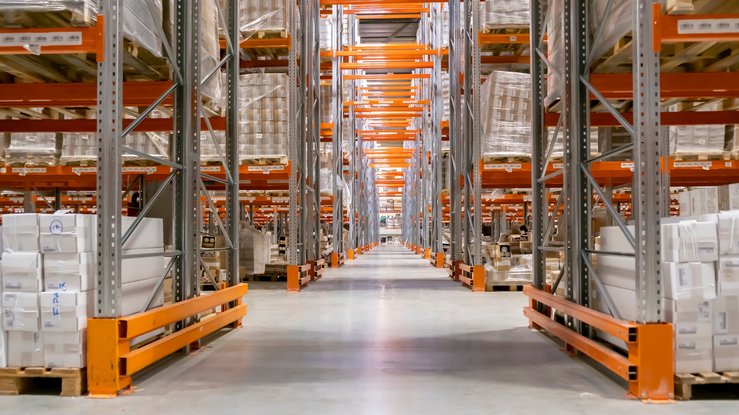
In most states, where a distributor’s goods physically go is a business decision. In Wisconsin, for one important category, it is the law.
Intoxicating liquor sold by a wholesaler here must be physically unloaded at the premises named in the wholesaler’s permit — or at a warehouse premises for which the wholesaler also holds a permit — before it can be delivered to a retailer. There is no shortcut from the producer straight to the customer. The product comes off a truck, onto your floor, and back onto a truck. The building is not incidental to the license; it is written into it.
That single rule tells you something an insurance submission ought to say out loud: the accumulation of owned stock under your roof is a requirement, not a choice. You cannot route around it, and neither can your limit. There is no published price for the coverage — an insurer builds it from your operation — and in Wisconsin the operation begins with a floor the law insists your product cross.
The concentration the statute builds
This is the number that sizes a stock throughput limit, and it is the most expensive routine mistake in the trade.
Owners answer the inventory question with a comfortable annual average. Underwriters are asking something sharper: what is the maximum value of owned product concentrated in one place on one day? Because a loss does not wait for a convenient month. It arrives in the season you built up for.
A limit set to the quiet season is a limit that fails you in the busy one. And in a state whose rules deliberately funnel goods through your own premises, that concentration is guaranteed rather than incidental — which makes the peak number less of an estimate and more of a fact you should already know.
Cold is the loss cause
Wisconsin’s owned-goods economy is food-first, and that changes what the insurance is actually protecting against.
Dairy processing, cheese, meat, and packaged food generate an enormous refrigerated and frozen requirement, and a Wisconsin wholesaler that owns its inventory is very often moving perishable product it bought and must sell before it turns. For that business, the thing that destroys value is not fire and not impact. It is temperature — a refrigeration breakdown, a power interruption, a failed unit on a long haul. The pallets can be a total loss with no mark on the building or the trailer, and because you own the goods, it is a hole in your balance sheet rather than a third-party claim.
That is a stock throughput and spoilage conversation, and it is priced on things inside your control: refrigeration maintenance, temperature monitoring, alarm response, standby power, and a written plan for the middle of the night. Ammonia systems on a large cold-storage building add a release exposure that is simultaneously life-safety, property, and environmental, and it will be asked about directly.
The regulatory frame reflects the same reality. The state agriculture department licenses food warehouses and milk distributors by name, and its dairy rules reach the storage and movement of milk and milk products directly — so an operator holding dairy inventory sits inside a licensing regime rather than outside one. That is a compliance cost sitting alongside the premium, and an underwriter reads it as a discipline signal.
A seller who never made the thing
Here is the driver distributors are most surprised by, because it has nothing to do with the building or the trucks.
You sit in the chain of distribution, and a products-liability claim over something that causes injury or damage can follow that chain to a seller — not only to the manufacturer who made it. A distributor of a food or beverage product it never made still sits in that chain, as the seller. You bought it and you sold it, and that is enough to be named.
So an insurance carrier prices what you handle. Machinery and industrial parts, paper and packaging, are one conversation. Dairy, cheese, meat, and beverage carry an ingestion profile and a very different severity picture. Consumer goods imported through the Kenosha–Racine corridor are different again, because an importer is frequently the first U.S. seller of a foreign-made product, and when the actual maker sits beyond the practical reach of a claim in this country, the importer is the realistic target. General liability answers all of this through what the standard form calls the products-completed-operations hazard, and sizing that limit against what you actually move is most of the work on the submission.
Snow on a long-span roof
Commercial property does a bounded job for a distributor: your building, your racking, and your owned inventory while it sits in a scheduled location, plus the business income lost when that location goes down. It stops at the walls.
Snow load is the peril a Wisconsin warehouse is actually designed around — long-span low-slope roofs carrying accumulated snow, with drift against parapets and roof-level equipment as the failure mode, and lake-effect bands adding to it along Lake Michigan. Deep and sustained freeze is the second: wet sprinkler systems in unheated bays, and refrigeration systems on a cold-storage building that cannot be allowed to fail.
Every one of those failures ends in the same place for an owner of goods — water or temperature reaching the rack, and the rack is holding what you paid for. Hail and severe convective wind reach the southern half of the state; tornado exposure is real but lower than on the plains; river flooding is a separate placement.
Transit, and the corridor to Chicago
Wisconsin is not a container gateway. Its logistics identity is manufacturing moving out and food and dairy moving in refrigerated trailers, on a spine that runs I-94 from the Illinois line through Kenosha and Racine to Milwaukee, Madison, and on toward the Twin Cities. Port Milwaukee’s foreign-trade zone reaches the southeastern counties along that same industrial belt, where kitting, warehousing, and duty deferral for imported components and consumer goods are practical rather than exotic — and elsewhere in the state, zone activity is thin, which is worth saying plainly.
For an owner of inventory, the transit leg is where the property policy quietly stops. Owned goods in motion belong to a marine-family form — stock throughput — which follows the product from the supplier, across ocean, rail, and highway, into the building, and back out to the customer, under one wording instead of a property-plus-cargo patchwork with seams in it. In a refrigerated book, that form is also what answers when the unit on the trailer fails somewhere between Green Bay and a customer.
And if you import, one question decides where the exposure begins:
When does the risk of loss actually pass to you?
Not when the pallet reaches your permitted premises. When your purchase terms say it did.
The fleet, and a crew that works cold
Commercial auto prices the fleet on unit count, radius, what is hauled, and above all who drives — and a refrigerated trailer carries a cargo failure mode a dry van does not. One note on language this trade cannot avoid: your insurance carrier is the company that writes your policy, which is an entirely different thing from a motor carrier or a freight carrier hauling goods for hire.
Workers compensation runs through a private market here, and the exposures skew cold and heavy. Refrigerated and freezer storage is a much larger share of the building stock in Wisconsin than in most states, and freezer work brings slips on iced floors, cold stress, and awkward handling of frozen product on top of the ordinary forklift strikes, racking falls, and lifting strain. Dairy and food-plant environments add wet-floor and sanitation-related injuries a dry-goods building never sees. A distributor carries two injury exposures rather than one: the warehouse crew and the route drivers.
The shortcut the law will not let you take
<text x="350" y="32" text-anchor="middle" font-family="Inter, sans-serif" font-size="15" font-weight="600" fill="#0F4C5C">The goods have to touch your floor. That is not optional.</text>

<rect x="40" y="66" width="150" height="60" rx="7" fill="#ffffff" stroke="#C3DEDE"/>
<text x="115" y="92" text-anchor="middle" font-family="Inter, sans-serif" font-size="13" font-weight="600" fill="#0F4C5C">the producer</text>
<text x="115" y="112" text-anchor="middle" font-family="Inter, sans-serif" font-size="11" fill="#3F5B64">where it is made</text>

<rect x="510" y="66" width="150" height="60" rx="7" fill="#ffffff" stroke="#C3DEDE"/>
<text x="585" y="92" text-anchor="middle" font-family="Inter, sans-serif" font-size="13" font-weight="600" fill="#0F4C5C">the retailer</text>
<text x="585" y="112" text-anchor="middle" font-family="Inter, sans-serif" font-size="11" fill="#3F5B64">where it is sold</text>

<path d="M190 96 L510 96" stroke="#3F5B64" stroke-width="2" stroke-dasharray="4 6"/>
<path d="M330 78 L370 114" stroke="#0F4C5C" stroke-width="3"/>
<path d="M370 78 L330 114" stroke="#0F4C5C" stroke-width="3"/>
<text x="350" y="140" text-anchor="middle" font-family="Inter, sans-serif" font-size="12" font-weight="600" fill="#0F4C5C">not a permitted route</text>

<path d="M115 126 L115 186 L245 186" stroke="#0F4C5C" stroke-width="2" fill="none"/>
<path d="M455 186 L585 186 L585 126" stroke="#0F4C5C" stroke-width="2" fill="none"/>

<rect x="245" y="160" width="210" height="66" rx="7" fill="#E2F4F3" stroke="#0F4C5C" stroke-width="2"/>
<text x="350" y="186" text-anchor="middle" font-family="Inter, sans-serif" font-size="13" font-weight="600" fill="#0F4C5C">your permitted premises</text>
<text x="350" y="206" text-anchor="middle" font-family="Inter, sans-serif" font-size="11" fill="#3F5B64">physically unloaded, every case</text>

<rect x="40" y="256" width="620" height="62" rx="9" fill="#C8935A" stroke="#0F4C5C"/>
<text x="350" y="280" text-anchor="middle" font-family="Inter, sans-serif" font-size="14" font-weight="600" fill="#1A1A1A">The law makes your building a mandatory stop — so the owned stock</text>
<text x="350" y="300" text-anchor="middle" font-family="Inter, sans-serif" font-size="14" font-weight="600" fill="#1A1A1A">accumulating under your roof is a requirement, not a business choice.</text>The honest summary
A Wisconsin distributor is priced on what it owns, how much of it the law obliges to sit under one roof, whether that product survives a warm hour, what happens if the thing it sold makes somebody ill, and how the roof handles a hard winter.
If you want the coverage mechanics rather than the cost drivers, stock throughput is the line this guide orbits, the Wisconsin distributor and wholesaler insurance page goes deeper on the exposures, and our distribution businesses pillar covers the operating shape. And if the goods in your building belong to your customers rather than to you, none of this is your program — you want the warehouse cost guide instead.