

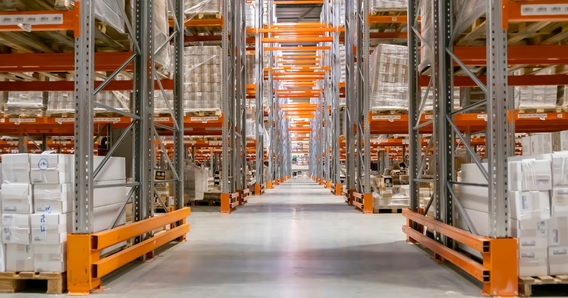
In most states, the first question about a warehouse is how big it is. In Wisconsin, the first question is what you agreed to put in it — because the commodity you accept decides your licensing posture, your equipment exposure, your loss profile, and the limit you need.
That is not a rhetorical flourish. It is how the state actually works, and it is why a Wisconsin cost guide has to start with the pallet rather than the property.
The commodity decides everything downstream
Wisconsin has no general public-warehouse licensing statute — but it licenses warehouses by commodity to a degree very few states match. The Department of Agriculture, Trade and Consumer Protection licenses food warehouses and milk distributors under its food-warehouse rules, and separately licenses grain warehouse keepers — operators who store grain for others — in their own class.
A dry general-merchandise warehouse holding non-food goods for hire needs no state license at all. Its duties to those goods come from the bailment and the storage agreement, and nowhere else.
Sit with the consequence for a moment. A third-party operator in this state who takes on a dairy account has not simply added revenue — it may have moved itself into a licensing regime, acquired an inspection relationship, and changed the character of what is in its coolers. Very few commercial decisions in this trade carry that much regulatory weight, and an underwriter will want to know which side of the line you are standing on.
Holding other people’s food
Wisconsin is the state where holding other people’s goods is most likely to mean holding other people’s food. Public refrigerated warehousing is a genuine industry here, built to serve the dairy, cheese, meat, and packaged-food economy around it, and the operator in that building is squarely a bailee.
Which means the loss that matters most does not damage the operator’s property at all.
A temperature excursion. A refrigeration breakdown. An ammonia release. None of those destroys the building — they destroy the customer’s inventory, and that is precisely the loss warehouse legal liability is written to answer. The compressors stop, the temperature drifts, and by the time it is over the racking is fine, the roof is fine, and a customer’s entire holding is worthless.
So the underwriting is about reliability, and the questions are specific and practical: system redundancy, alarm monitoring and who actually answers it at night, maintenance and inspection records on the refrigeration and ammonia plant, how long the building holds temperature when the power goes, and how fast the product can be moved if it does not. Those questions are the pricing.
What the limit is actually set to
Under the licensing and the equipment sits the driver that decides every bailee program anywhere: the value and the nature of the customers’ goods in your care.
Value is the maximum amount of customer-owned product under your roof at the seasonal peak — not the average across a year. Frozen inventory concentrates, and it concentrates on a calendar.
Nature is what the product actually is. A customer’s cheese, a customer’s protein, a customer’s packaged goods, a machinery distributor’s parts inventory: they can occupy the same footprint and carry entirely different amounts at risk per pallet position, and they go to zero by entirely different routes. Cheese does not burn; it warms.
And it is the figure Wisconsin operators most often understate — for the same reason operators everywhere do. The freight is not on their balance sheet, so nobody has ever had to know what it is worth.
A roof designed around the winter
Commercial property carries the shell, the racking, the refrigeration equipment, and the income lost while the site is down. In Wisconsin the property conversation is a load conversation.
Snow load is the peril a Wisconsin warehouse is actually designed around — a long-span, low-slope roof carrying accumulation, with drift against parapets and roof-level equipment as the failure mode, and lake-effect bands adding to it along Lake Michigan. A structural failure in a warehouse is never only a property claim: the pallets in the aisle underneath belong to a customer, and that loss arrives in the same instant.
Deep, sustained freeze is the companion. Wet sprinkler systems in unheated bays. Refrigeration and ammonia systems that cannot be allowed to fail. A frozen sprinkler line that lets go over somebody else’s stored product is a bailee claim with no fire anywhere in the file.
Hail and severe convective wind reach the southern half of the state. Tornado exposure is real but lower than in the plains, and it would be dishonest to inflate it. River flooding is a separate placement.
Fire protection, measured against what you actually stack
There is one property question that reaches a bailee harder than it reaches an ordinary building owner, and it is worth a section of its own: does the sprinkler design match what is in the building now?
Sprinkler protection is engineered against a commodity and against a storage arrangement — what the goods are, how they are packaged, how high they are stacked, and how the racking is configured. A system designed for one commodity class, in a building that has since filled up with another, is a real and common gap. And in a third-party warehouse it is an especially common gap, because the commodity changes when the customer changes, and the customer changes without anyone consulting the fire-protection drawings.
Ask the awkward version of the question. When you won the account that filled the building, did anyone check that what came in was what the system was designed to protect? When you raised the stack height to fit the season, did the design still hold?
Alongside it sits the ammonia plant, on the cold side. That is engineered equipment with a maintenance regime, an inspection history, and a failure mode that reaches both the crew and the customer’s product. An underwriter reads its records the way it reads the sprinkler drawings — as evidence about whether the building is being run or merely occupied.
The crew, on a floor that is cold and often wet
Workers compensation is a private-market line here, and it scales with material-handling payroll. The Wisconsin exposure skews cold and heavy, because refrigerated and freezer storage is a much larger share of the building stock than in most states.
Freezer work brings slip-and-fall on iced floors, cold stress on long shifts, and the awkward handling of frozen product — all of it sitting on top of the ordinary forklift strikes, racking falls, and lifting strain. Dairy and food-plant warehouses add wet-floor and sanitation-related injuries that a dry-goods building never sees. The classifications you actually run matter here as much as the payroll figure does.
And the contract, where there is no license
For everything that is not food, dairy, or grain, the absence of a license is itself a cost driver. With no statutory standard of care, your storage agreement is the entire perimeter around a claim. An underwriter reads it: the limitation-of-liability clause, the released-value terms, what the agreement says about temperature and about who specifies the holding range, and whether any of it would hold up if a customer’s lawyer tested it.
The southeastern corridor along I-94 — Kenosha, Racine, Milwaukee — is where the general-merchandise and fulfillment side of this trade concentrates, serving Chicago from lower-cost ground, with foreign-trade-zone use for imported components and consumer goods as a practical rather than glamorous option on top.
What the commodity actually sets
<text x="350" y="30" text-anchor="middle" font-family="Inter, sans-serif" font-size="15" font-weight="600" fill="#0F4C5C">What you agree to hold decides who regulates you</text>

<rect x="300" y="48" width="370" height="46" rx="9" fill="#ffffff" stroke="#0F4C5C"/>
<text x="485" y="68" text-anchor="middle" font-family="Inter, sans-serif" font-size="13" font-weight="600" fill="#0F4C5C">Dairy and milk for others</text>
<text x="485" y="86" text-anchor="middle" font-family="Inter, sans-serif" font-size="11" fill="#3F5B64">A milk distributor license, on top of the food one</text>

<rect x="220" y="104" width="370" height="46" rx="9" fill="#ffffff" stroke="#0F4C5C"/>
<text x="405" y="124" text-anchor="middle" font-family="Inter, sans-serif" font-size="13" font-weight="600" fill="#0F4C5C">Food held for other companies</text>
<text x="405" y="142" text-anchor="middle" font-family="Inter, sans-serif" font-size="11" fill="#3F5B64">A food warehouse license, and an inspector</text>

<rect x="140" y="160" width="370" height="46" rx="9" fill="#ffffff" stroke="#0F4C5C"/>
<text x="325" y="180" text-anchor="middle" font-family="Inter, sans-serif" font-size="13" font-weight="600" fill="#0F4C5C">Grain stored for others</text>
<text x="325" y="198" text-anchor="middle" font-family="Inter, sans-serif" font-size="11" fill="#3F5B64">Its own class: the grain warehouse keeper</text>

<rect x="60" y="216" width="370" height="46" rx="9" fill="#ffffff" stroke="#C3DEDE"/>
<text x="245" y="236" text-anchor="middle" font-family="Inter, sans-serif" font-size="13" font-weight="600" fill="#0F4C5C">Dry general merchandise for hire</text>
<text x="245" y="254" text-anchor="middle" font-family="Inter, sans-serif" font-size="11" fill="#3F5B64">No state license at all — the contract is the regulation</text>

<rect x="40" y="278" width="620" height="54" rx="9" fill="#C8935A" stroke="#0F4C5C"/>
<text x="350" y="300" text-anchor="middle" font-family="Inter, sans-serif" font-size="13" font-weight="600" fill="#1A1A1A">Whichever rung you stand on, the goods are still somebody else’s</text>
<text x="350" y="321" text-anchor="middle" font-family="Inter, sans-serif" font-size="12" font-weight="600" fill="#1A1A1A">Their value and nature size the limit. A license does not carry the loss.</text>

<text x="350" y="350" text-anchor="middle" font-family="Inter, sans-serif" font-size="12" font-style="italic" fill="#3F5B64">None of this is a price. It is what a price is built from.</text>The honest summary
Wisconsin prices a warehouse on commodity, on cold, and on load. Whether you hold food, dairy, grain, or dry goods sets your licensing posture and your equipment risk. Whether your refrigeration is redundant and monitored sets your biggest severity. Whether your roof is cleared and your sprinklers protected sets the rest. And the limit itself is set by the value of somebody else’s inventory sitting in your freezer tonight.
If you want the coverage rather than the cost, start with warehouse legal liability, see the full program on our warehouse business insurance page, or read the Wisconsin warehouse insurance page. And if the cheese, the protein, or the packaged goods in that freezer are yours — bought, owned, and waiting to be sold — the distributor cost guide is the one written for you.