

Most cost guides start with the inventory. Wyoming makes you start somewhere else, because there is one structural fact here that changes the shape of the entire program before anybody has looked at what you own.
You cannot buy workers compensation from an insurance carrier in this state. Wyoming is one of the four monopolistic comp states. The statutory line is written by the state fund administered by the Workers’ Compensation Division of the Department of Workforce Services, and private insurers are not permitted to write it. So when a Wyoming distributor asks what insurance costs, the honest answer starts by splitting the question in two: there is the comp, which is not a quote at all, and there is everything else, which is.
The piece the state fund does not give you
The injuries themselves do not change. A forklift strike, a fall off a dock, product coming down out of racking, a lifting injury on a pick line — those are the same in Cheyenne as they are anywhere else. What changes is where the coverage comes from, and what comes with it.
The state fund’s coverage does not carry employer’s liability. That is the protection that answers a suit brought around the edges of the comp system rather than through it, and in a private-market state it rides along on the comp policy without anyone thinking about it. Here it does not exist unless you go and buy it: stop-gap employer’s liability, added to a general liability policy purchased in the private market.
It is the most common hole we find in a Wyoming program, and it is a hole with no warning label on it, because nothing about the state fund’s paperwork tells you that something is missing.
<text x="350" y="32" text-anchor="middle" font-family="Inter, sans-serif" font-size="15" font-weight="600" fill="#0F4C5C">One operation, two places to buy the cover</text>

<rect x="40" y="58" width="270" height="46" rx="6" fill="#E2F4F3" stroke="#C3DEDE"/>
<text x="175" y="86" text-anchor="middle" font-family="Inter, sans-serif" font-size="13" font-weight="600" fill="#0F4C5C">Workers compensation</text>

<path d="M175 104 L175 138" stroke="#0F4C5C" stroke-width="2" fill="none"/>
<rect x="40" y="138" width="270" height="60" rx="6" fill="#ffffff" stroke="#0F4C5C"/>
<text x="175" y="163" text-anchor="middle" font-family="Inter, sans-serif" font-size="13" font-weight="600" fill="#0F4C5C">The state fund</text>
<text x="175" y="183" text-anchor="middle" font-family="Inter, sans-serif" font-size="12" fill="#3F5B64">No private insurer may write it</text>

<text x="175" y="222" text-anchor="middle" font-family="Inter, sans-serif" font-size="12" font-weight="600" fill="#0F4C5C">employer’s liability:</text>
<text x="175" y="240" text-anchor="middle" font-family="Inter, sans-serif" font-size="12" font-weight="600" fill="#0F4C5C">not in the fund</text>

<rect x="390" y="58" width="270" height="46" rx="6" fill="#E2F4F3" stroke="#C3DEDE"/>
<text x="525" y="86" text-anchor="middle" font-family="Inter, sans-serif" font-size="13" font-weight="600" fill="#0F4C5C">Stock, liability, fleet, building</text>

<path d="M525 104 L525 138" stroke="#0F4C5C" stroke-width="2" fill="none"/>
<rect x="390" y="138" width="270" height="60" rx="6" fill="#ffffff" stroke="#0F4C5C"/>
<text x="525" y="163" text-anchor="middle" font-family="Inter, sans-serif" font-size="13" font-weight="600" fill="#0F4C5C">The private market</text>
<text x="525" y="183" text-anchor="middle" font-family="Inter, sans-serif" font-size="12" fill="#3F5B64">Where the quote actually happens</text>

<path d="M250 231 L520 210" stroke="#0F4C5C" stroke-width="2" fill="none" stroke-dasharray="5 4"/>
<text x="525" y="232" text-anchor="middle" font-family="Inter, sans-serif" font-size="12" font-weight="600" fill="#0F4C5C">stop-gap, bolted to the</text>
<text x="525" y="250" text-anchor="middle" font-family="Inter, sans-serif" font-size="12" font-weight="600" fill="#0F4C5C">liability policy</text>

<rect x="40" y="292" width="620" height="54" rx="9" fill="#C8935A" stroke="#0F4C5C"/>
<text x="350" y="316" text-anchor="middle" font-family="Inter, sans-serif" font-size="14" font-weight="600" fill="#1A1A1A">The bridge does not build itself.</text>
<text x="350" y="336" text-anchor="middle" font-family="Inter, sans-serif" font-size="12" font-weight="600" fill="#1A1A1A">Nothing in the state fund paperwork tells you the piece is missing.</text>Then the inventory — and in Wyoming, where it sits
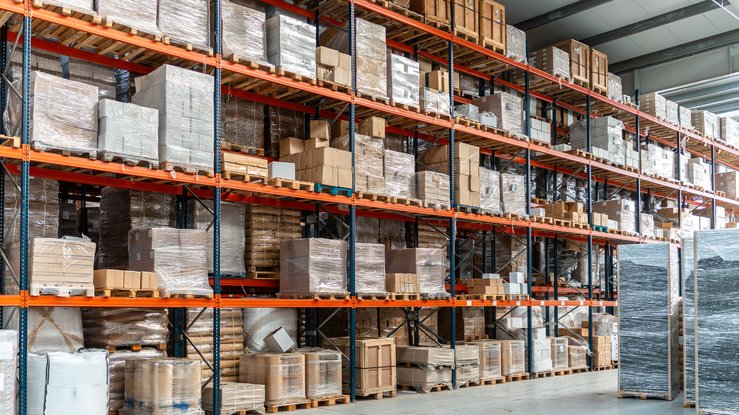
Everything a distributor sells, it owned first. That is the whole difference from the warehouse down the road: your product is on your balance sheet from the supplier’s dock to the customer’s, and that entire span is what stock throughput is built to follow.
But Wyoming asks a question the coastal states rarely have to. Is the stock even under a roof?
The oilfield, mining, and drilling-supply distributors in Casper, Gillette, and the southwest hold heavy, expensive owned inventory — pipe, valves, fittings, bits, chemicals — and a great deal of it lives in a yard. Wind is the Wyoming signature: sustained, relentless, and hardest along the I-80 corridor, loading a roof plane and every piece of rooftop equipment on it, and drifting snow into weights a flat roof was never asked to carry. Hail reaches the eastern plains. A hard, extended freeze destroys goods that cannot take the cold and splits sprinkler lines in unheated bays, which soaks the goods that could.
Commercial property answers for the building, the racking, and the owned goods while they sit in a scheduled location — and it stops at the walls. A yard full of drilling supply is precisely the exposure that falls between the property policy and the transit policy if nobody thinks about it in advance, and it is the thing an underwriter most wants to hear about honestly rather than discover later.
Peak, and what a peak looks like out here
The number that sizes a limit is not the comfortable annual average. It is the maximum value of owned product concentrated in one place on one day.
In most states that peak follows a retail calendar. In Wyoming it follows the work. A supply house builds stock ahead of a drilling program, a regional wholesaler builds ahead of a long winter in towns it cannot reach easily, and that build is exactly when the yard is fullest — and the weather is not consulting anyone’s calendar. A limit set to your quiet month is a limit that fails you in the one you actually built for.
The product, and where it ends up
Distributors are consistently surprised by this driver because it has nothing to do with their building or their trucks. It is the goods themselves.
You sit in the chain of distribution, and a products claim can follow that chain to a seller, not only to the maker. You did not design the valve. You bought it and you sold it, and that is enough to be named. In Wyoming there is a specific edge on this: a supply distributor is often selling a component into an energy operation, where a failure is consequential in a way it is not when the same part goes onto a shelf. And any Wyoming distributor that private-labels a product, or is the first U.S. seller of an imported one, carries the maker’s position without ever having been the maker.
Beer is the private tier
If you distribute beverages, the regulatory shape here is unusually clean, and it is worth stating precisely rather than generically.
Wyoming controls the wholesale tier — part of it. The Wyoming Liquor Division inside the Department of Revenue is the exclusive wholesaler of spirits and of the wines it lists, distributing to privately owned licensed retailers; the state does not run the stores. Malt beverages are the exception, and they are the opening. Beer moves through private distributors in the ordinary three-tier way. So the private beverage distributor in Wyoming is a beer distributor, and a private wholesaler cannot enter the spirits tier at all.
The insurance consequence is direct: the beer in that warehouse is genuinely yours at every step, which is exactly why it prices as a stock throughput exposure and not as somebody else’s goods in your care.
The trucks, and the distances
Wyoming is a corridor rather than a destination, and the routes reflect it. Commercial auto prices unit count, radius, what you haul, and above all who drives — and a wholesaler whose territory is measured in hours across I-80, I-25, and I-90 is buying a different auto exposure than one serving a metro. Worth a note on language this trade cannot escape: your insurance carrier is the company that writes the policy, which is not the same thing as a motor carrier or a freight carrier hauling goods for hire.
What Wyoming does not have — and why that matters to the quote
There is no seaport. There is no land border. The foreign-trade zone presence is thin and honest about it, and a Wyoming warehouse is very unlikely to be holding goods under customs bond. If an insurance conversation here starts talking about ocean cargo and bonded gateways, somebody is selling you a program built for a different state.
That does not shrink the coverage you need — the marine-family form that stock throughput comes from follows goods across land transit, rail, and long inland movement just as readily as it follows them across water, and in a state where a delivery route is a day long, that is exactly the point. It just means the Wyoming submission is shorter and truer than a coastal one, and it should read that way.
The honest summary
A Wyoming distributor is priced on a program with a seam down the middle of it: comp from the state fund, everything else from the private market, and a stop-gap bridge that somebody has to remember to build. On the private side, the drivers are the peak value of your owned stock, whether that stock is behind a wall or out in the wind, what the product is and where it ends up, the long routes, and your claims history.
If you want the coverage mechanics rather than the cost drivers, stock throughput is the line this guide orbits, our distribution business insurance page covers the broader program, and the full Wyoming distributor and wholesaler insurance page goes deeper on the exposures. And if the goods in your building belong to your customers rather than to you, this is not your guide — read the Wyoming warehouse cost guide instead.