

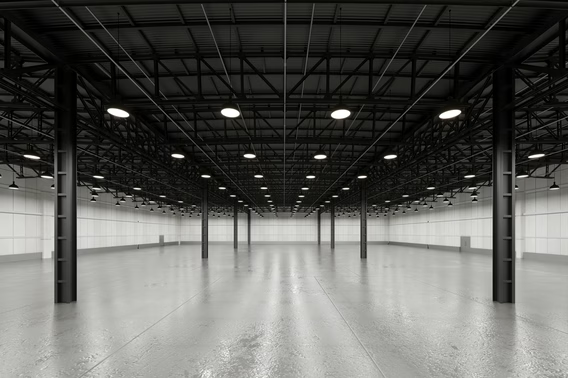
A container can clear Garden City Terminal in the morning and be on a rack in a metro Atlanta warehouse the same day. That single fact — the shortness of the handoff — is what built the Georgia warehouse economy, and it is also what defines how a Georgia warehouse gets priced.
Because when that box lands on your floor, nothing about it belongs to you. The goods inside were bought by a retailer or a consumer-goods company headquartered somewhere else entirely, they will sit in your building for weeks, and for every one of those weeks they are in your care, custody, and control. The steel and the roof are yours. The value is not.
Custody arrives by the container-load
The space that got built along the corridors south and west of Atlanta, and out toward the port, is overwhelmingly space that holds somebody else’s freight. That is what makes Georgia a third-party warehousing state in the strongest sense, and it is why the driver that leads this guide leads it by a long distance.
The value and the nature of the goods in your care is what sizes your warehouse legal liability limit — and Georgia operators understate it as reliably as operators anywhere, because that inventory never touches their accounts.
Value is the maximum amount of customer-owned freight under your roof on the worst possible day, not on an average one. Import distribution has a shape: cargo arrives in waves, and the wave that lands before a retail season is the one that determines your worst day. A limit set to a typical holding is a limit that fails you in the month it is most needed.
Nature is the input that gets skipped. A building holding imported consumer electronics and a building holding flooring and building products can be identical square footage, with identical racking and identical sprinkler design, and price nothing alike — because the amount at risk per pallet position differs by an order of magnitude, and so does what a thief will trouble to take.
The state licenses cotton, grain, and tobacco. Not your building.
Georgia genuinely does run a warehouse licensing program, and it is worth knowing exactly what it reaches, because the name invites a mistake. The Department of Agriculture’s warehouse and bonding program licenses, bonds, and inspects warehouses storing cotton, grain, and tobacco, and inspects them for the quantity and quality of what is inside. That is a real regime with a real bond behind it.
It does not reach you. A general-merchandise, import-distribution, or fulfillment warehouse in Georgia holds no state warehouse license, which means the state writes you no standard of care at all. Your warehouse receipt and storage agreement are the whole perimeter around a claim, and an underwriter reads them the way a regulator would read a statute — because here, they are doing the same job.
Whether your customers accepted a limitation-of-liability or released-value clause, negotiated it out, or handed you their own contract that quietly assumed you carry a far broader form than a bare legal-liability policy provides: that changes the exposure the policy is being asked to size, and therefore the price. The absence of a license is a cost driver, not a footnote.
<text x="350" y="32" text-anchor="middle" font-family="Inter, sans-serif" font-size="15" font-weight="600" fill="#0F4C5C">The goods never change owner. They only change hands.</text>

<rect x="26" y="56" width="150" height="88" rx="9" fill="#ffffff" stroke="#C3DEDE"/>
<text x="101" y="82" text-anchor="middle" font-family="Inter, sans-serif" font-size="12" font-weight="600" fill="#0F4C5C">The owner</text>
<text x="101" y="104" text-anchor="middle" font-family="Inter, sans-serif" font-size="11" fill="#3F5B64">A retailer or importer,</text>
<text x="101" y="120" text-anchor="middle" font-family="Inter, sans-serif" font-size="11" fill="#3F5B64">headquartered somewhere</text>
<text x="101" y="136" text-anchor="middle" font-family="Inter, sans-serif" font-size="11" fill="#3F5B64">that is not Georgia.</text>

<path d="M180 100 L198 100" stroke="#0F4C5C" fill="none"/>

<rect x="202" y="56" width="150" height="88" rx="9" fill="#ffffff" stroke="#C3DEDE"/>
<text x="277" y="82" text-anchor="middle" font-family="Inter, sans-serif" font-size="12" font-weight="600" fill="#0F4C5C">The terminal</text>
<text x="277" y="104" text-anchor="middle" font-family="Inter, sans-serif" font-size="11" fill="#3F5B64">The box clears Garden</text>
<text x="277" y="120" text-anchor="middle" font-family="Inter, sans-serif" font-size="11" fill="#3F5B64">City. Custody is still</text>
<text x="277" y="136" text-anchor="middle" font-family="Inter, sans-serif" font-size="11" fill="#3F5B64">somebody else’s problem.</text>

<path d="M356 100 L374 100" stroke="#0F4C5C" fill="none"/>

<rect x="378" y="56" width="150" height="88" rx="9" fill="#ffffff" stroke="#C3DEDE"/>
<text x="453" y="82" text-anchor="middle" font-family="Inter, sans-serif" font-size="12" font-weight="600" fill="#0F4C5C">The corridor</text>
<text x="453" y="104" text-anchor="middle" font-family="Inter, sans-serif" font-size="11" fill="#3F5B64">Drayed or railed up</text>
<text x="453" y="120" text-anchor="middle" font-family="Inter, sans-serif" font-size="11" fill="#3F5B64">toward metro Atlanta,</text>
<text x="453" y="136" text-anchor="middle" font-family="Inter, sans-serif" font-size="11" fill="#3F5B64">often the same day.</text>

<path d="M532 100 L550 100" stroke="#0F4C5C" fill="none"/>

<rect x="554" y="46" width="120" height="108" rx="9" fill="#C8935A" stroke="#0F4C5C"/>
<text x="614" y="72" text-anchor="middle" font-family="Inter, sans-serif" font-size="12" font-weight="600" fill="#1A1A1A">Your rack</text>
<text x="614" y="94" text-anchor="middle" font-family="Inter, sans-serif" font-size="11" font-weight="600" fill="#1A1A1A">Weeks of care,</text>
<text x="614" y="110" text-anchor="middle" font-family="Inter, sans-serif" font-size="11" font-weight="600" fill="#1A1A1A">custody, and</text>
<text x="614" y="126" text-anchor="middle" font-family="Inter, sans-serif" font-size="11" font-weight="600" fill="#1A1A1A">control — and</text>
<text x="614" y="142" text-anchor="middle" font-family="Inter, sans-serif" font-size="11" font-weight="600" fill="#1A1A1A">none of it yours.</text>

<rect x="60" y="188" width="580" height="72" rx="9" fill="#ffffff" stroke="#C3DEDE"/>
<text x="350" y="214" text-anchor="middle" font-family="Inter, sans-serif" font-size="12" font-weight="600" fill="#0F4C5C">You are standing on the last leg of the chain</text>
<text x="350" y="238" text-anchor="middle" font-family="Inter, sans-serif" font-size="11" fill="#3F5B64">and it is the only leg where the goods are in your hands.</text>

<text x="350" y="292" text-anchor="middle" font-family="Inter, sans-serif" font-size="12" font-weight="600" fill="#0F4C5C">Warehouse legal liability answers for that leg.</text>
<text x="350" y="330" text-anchor="middle" font-family="Inter, sans-serif" font-size="12" font-style="italic" fill="#3F5B64">Nothing else on the program does — and nothing on your books tells you how big it is.</text>Bonded at the water, bonded inland
Georgia carries zone coverage at both ends of the state — at the port and across the Atlanta belt — and the rail port up at Chatsworth extends the bonded reach north. That is unusual, and it matters to a bailee.
When you admit duty-deferred cargo, it is under customs control while it sits on your floor. You now answer to the customs obligation and to the owner of the goods, over the same pallet, at the same time. That is not a doubling of the paperwork; it is an accumulation of duty, and an underwriter prices it as one.
Poultry, protein, and a freezer that is not yours
Cold storage sits alongside the dry space here, because the north Georgia poultry and food economy keeps refrigerated third-party capacity busy. A refrigerated bailment fails on a mechanism rather than a peril: nothing burns, nothing collapses, the temperature drifts or the power goes — and a customer’s protein is a total loss with your building in perfect condition.
Which is why, in a cold house, an insurance carrier asks about redundancy, alarms, monitoring, and whether the generator has actually been run under load, long before it asks about the dimensions of the room.
Two catastrophe states, one warehouse market
Commercial property answers for the structure, the racking, the material-handling systems, and the income lost while the site is down — and where in Georgia you sit changes the brief entirely.
On the coast, around Savannah and Brunswick, it is tropical: wind uplift on port-adjacent roofs, and surge and rain flooding on low ground near the terminals. Flood there is a separate placement and does not ride the property form.
Inland, it turns convective: tornadoes and downbursts run the corridors north and west of Atlanta, and hail on an acres-wide roof plane is a genuine property loss even when nothing else is touched — and the expensive version is the quiet one, where a storm bruises a membrane across the whole plane, nothing is visible from the dock, and the water finds the racking months later. Then the goods. Which are not yours.
The peak-season floor
Workers compensation scales with material-handling payroll, and Georgia produces the injuries a high-throughput building produces: forklift and pallet-jack contact in congested aisles, falls from dock plates and off the back of a trailer, cases and pallets coming down out of racking, and the shoulder and back strain of a fast pick rate.
The Georgia-specific aggravator is peak staffing. A surge of new, undertrained hands arrives on the floor at exactly the moment the building is running hardest, and that pattern shows up in a loss run with total predictability. Onboarding discipline is an underwriting variable here, not a talking point. And where you run your own yard tractors, drayage moves, and delivery fleet, commercial auto belongs in the same conversation.
It is worth being concrete about why the peak is so sharp in this state specifically. The Georgia warehouse economy is fed by a port and consumed by the Southeast, which means the building fills on somebody else’s vessel schedule and empties on somebody else’s retail calendar. The operator controls neither. When rail moves boxes straight off the terminal without a truck leg, the cargo arrives faster than a slower gateway would deliver it — which is excellent for the customer and unforgiving for the floor, because the labor has to be there the week the wave lands.
That same rhythm is what makes the worst-day figure so much larger than the average one, and it is why the two conversations — the warehouse legal liability limit and the peak-season injury profile — are really the same conversation seen from two ends of the building. An operator who can show an underwriter a documented staffing ramp, a training standard that does not bend in October, and a rack-inspection routine that survives the busy months is describing a materially different risk from the operator who simply hires bodies.
Claims, limits, and the retention you choose
Loss history moves pricing more than nearly anything else on this list — and what an underwriter is really reading is what the losses say about how the building runs. A run of small handling-damage claims tells a different story from a single large one.
Limits and retention are a real decision: how much routine damage would you rather fund yourself, in exchange for a better price on the loss you could never absorb? The operator who buys a serious warehouse legal liability limit and accepts the small stuff is buying insurance in the right order.
The honest summary
Georgia stores goods that are going to other states, owned by companies in other states, in buildings whose only legal perimeter is a contract the operator wrote. The port fills the racking; the contract sets the exposure; the limit has to be sized to freight that will never appear on your balance sheet.
If you want the coverage rather than the cost, start with warehouse legal liability, see how we work with warehouse businesses, or read the full Georgia warehouse insurance page. And if you own the goods you store rather than holding them for other companies, this is not your program: you want the Georgia distributor cost guide.