

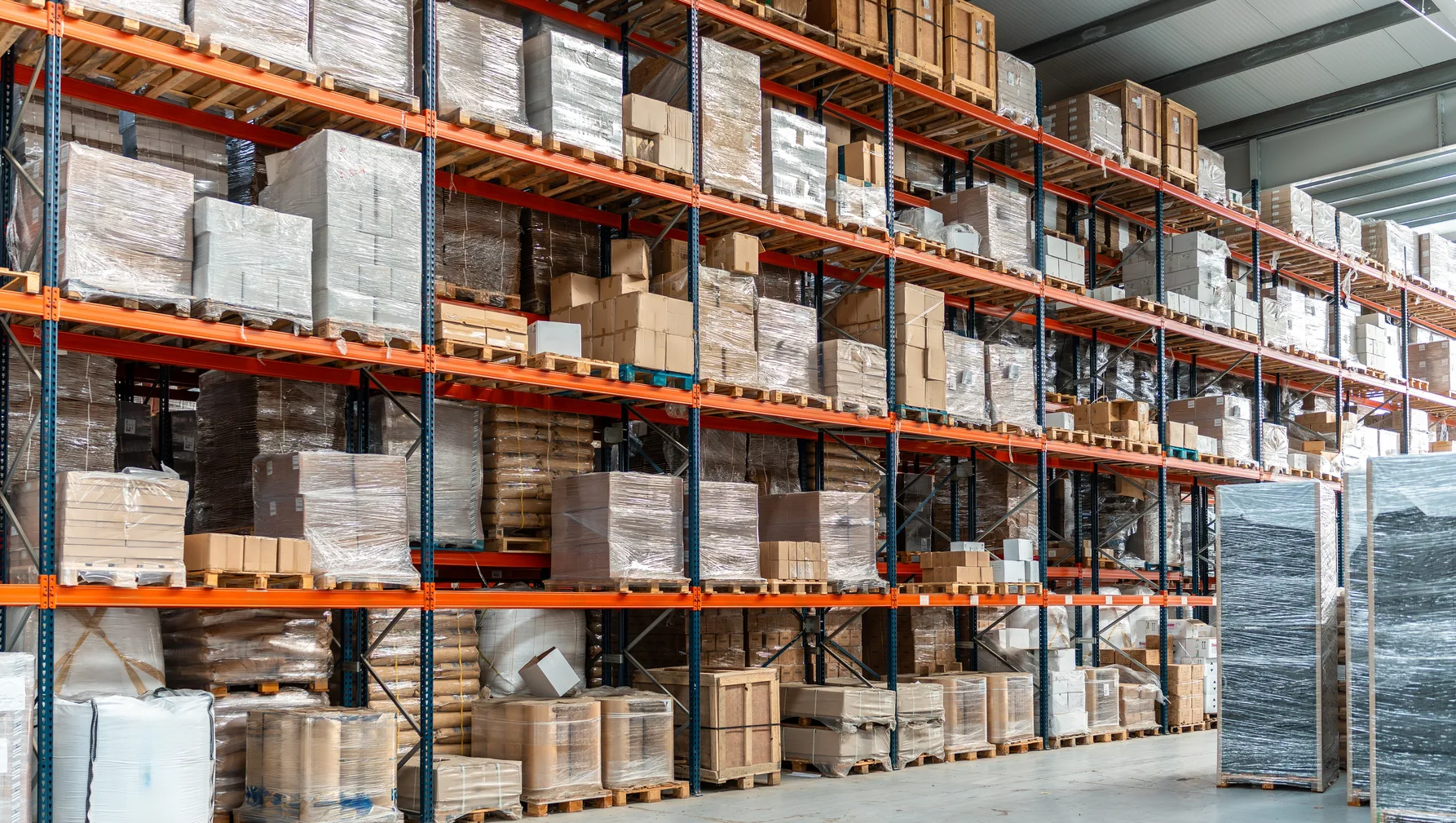
Here is the question that decides how an Iowa warehouse gets regulated, and it is not the one owners expect. It is not how big the building is, or how many docks it has, or how many people work there.
It is what is on the pallet.
Grain held for others triggers a Grain Warehouse Bureau license, a filed storage tariff, a certificate of insurance on the stored product, and financial examination — with a state grain indemnity fund standing behind the whole system. Food held for others triggers a food warehouse license from the Department of Inspections, Appeals, and Licensing, which maintains that license as a distinct thing and renews it separately from a food processing plant license. Prescription drugs held and distributed for others trigger a Board of Pharmacy wholesale license, per physical location, with facility security requirements attached.
And the general-merchandise 3PL — the Des Moines fulfillment operator holding pallets of consumer goods for accounts it has never met — is licensed by nobody at all.
That patchwork is not a piece of trivia. It is the reason Iowa warehouses price the way they do.
The lane with no rulebook is the lane most people are in
Where the state licenses a warehouse, it also supplies structure. A filed tariff. A certificate of insurance on the stored product. Books that get examined. An indemnity fund. A licensed grain house is operating inside a system that has already made a series of decisions about how custody works.
The consumer-goods 3PL gets none of that. Its warehouse receipt and storage agreement are the entire perimeter around a claim — and that absence is a cost driver, not a footnote.
An underwriter reads those agreements. Whether your customer accepted a limitation-of-liability or released-value clause, negotiated it away to win a competitive bid, or signed something that quietly assumed you carry more protection than a bare legal-liability form provides, all changes the exposure the policy is being asked to size. In the unlicensed lane, the storage contract is the regulation, and warehouse legal liability is the line that has to answer for whatever it says.
And there is a genuinely Iowa complication buried in this. A single operator that has diversified across commodities can be carrying three different regulators and one unregulated line, all under one roof — a grain license here, a food license there, a pharmacy license for the third bay, and a storage agreement doing all the work in the fourth. That is four different sets of obligations over one building, and a program that treats it as one homogeneous warehouse has not understood what it is insuring.
What is on the racks: value, and nature
The bailee limit is sized by the value and the nature of the customers’ goods in your care, and it is the figure owners most reliably understate — because that inventory never appears in their own accounts.
Value is the maximum amount of customer-owned freight under your roof on the worst possible day, not on an average one. Nature is what gets missed, and in Iowa it is unusually varied: bulk grain, frozen protein, refrigerated food, prescription drugs, and dry consumer goods are all being held for other people somewhere in this state, and no two of them are destroyed by the same thing or stolen at the same rate.
The underwriting conversation is therefore never how big is your warehouse. It is: what is in it, whose is it, and what is the most of it that is ever here at once?
The wind that does not need a tornado
Iowa is the state that taught the property market what a derecho does to a large roof.
The event that did it drove a long-track, straight-line windstorm across the state and through Cedar Rapids, and it remains the reference loss for anyone underwriting a big-box building here. Sustained high wind, acting on acres of low-slope membrane and on the rooftop mechanical units bolted through it. No tornado involved at all.
That changed the questions. An underwriter here asks about roof attachment and rooftop equipment before asking about almost anything else — because once the membrane goes, the water comes in, and what the water finds is the racking, and then the goods on it, which belong to somebody else.
Hail and tornado run through the same spring-to-summer convective season and punish the same enormous roof plane. Flooding is its own placement, and a serious and recurring siting question along the Mississippi, the Missouri, the Cedar, and the Des Moines rivers — not a property endorsement to be argued about later. Deep winter freeze puts sprinkler systems and unheated space at risk, and the frozen-pipe loss soaks a customer’s stored goods without a fire ever starting.
Your structure, racking, material-handling systems, and business income belong on the commercial property side. But in every one of those perils, the second half of the loss is the half that is not yours.
Cold, and the system that keeps it cold
Iowa’s demand base is agricultural processing turned into distribution — corn, soybeans, pork, eggs, and the food manufacturing layered on top of them — and a great deal of the outbound volume is temperature-controlled.
That means cold bailment, and cold bailment fails differently. The building never burns. The room simply drifts, and a customer’s frozen or refrigerated consignment is a total loss with the racking untouched and the sprinkler heads unbroken. Redundancy, alarms, and monitoring are what get priced.
Then there is the system itself. The ammonia refrigeration common in large cold-storage buildings introduces a release exposure that is simultaneously a life-safety problem, a property problem, and an environmental problem — and an underwriter treats it as all three at once, because a release does not confine itself to one policy. Mechanical integrity, detection, and response discipline around that system are among the most consequential controls in an Iowa cold house.
Duty-deferred, spread across the state
Iowa carries an unusually large number of foreign-trade zones for an interior state, and — this is the part that matters operationally — they are spread rather than concentrated. There is a zone at Des Moines under an Iowa foreign-trade zone corporation tied to the Greater Des Moines Partnership, one for the Quad Cities under a Davenport-based grantee straddling the Mississippi, one at Cedar Rapids under the airport commission, and one in the northwest under a Sheldon-based development corporation.
None of that is seaport bonded warehousing. It is inland duty deferral, serving manufacturers and distributors who import components and finished goods and want to hold them in the middle of the country without paying duty until withdrawal.
For a bailee, the pricing consequence is the accumulation. When you admit duty-deferred goods you take on customs obligations on top of your ordinary duty of care to the owner — two masters over one pallet — and you concentrate value under a roof that may sit in a submarket nobody thinks of as an import location. An underwriter prices both halves of that, and the second half surprises people.
The crew
Workers compensation is a private-market line here — insurers compete for the business and there is no state fund — and it scales with your material-handling payroll and the classifications you actually run.
The claim profile is the standard warehouse set, sharpened by the state’s food and protein economy: powered-industrial-truck injuries, workers struck by product coming out of a rack, dock and trailer-separation falls, and lifting and repetitive strain in high-volume picking. The state’s substantial refrigerated and frozen third-party space adds cold-stress and freezer-floor slip exposure, and frequency on a cold floor accumulates quietly.
Four commodities, four rulebooks — and one of them is blank
<text x="350" y="32" text-anchor="middle" font-family="Inter, sans-serif" font-size="15" font-weight="600" fill="#0F4C5C">Same building. Same racking. Four different regulators.</text>

<rect x="36" y="52" width="200" height="52" rx="9" fill="#ffffff" stroke="#0F4C5C"/>
<text x="136" y="84" text-anchor="middle" font-family="Inter, sans-serif" font-size="13" font-weight="600" fill="#0F4C5C">You hold grain</text>
<rect x="256" y="52" width="408" height="52" rx="9" fill="#ffffff" stroke="#C3DEDE"/>
<text x="460" y="76" text-anchor="middle" font-family="Inter, sans-serif" font-size="12" fill="#3F5B64">Grain Warehouse Bureau license, filed storage tariff,</text>
<text x="460" y="94" text-anchor="middle" font-family="Inter, sans-serif" font-size="12" fill="#3F5B64">insurance on the stored product, financial examination</text>

<rect x="36" y="114" width="200" height="52" rx="9" fill="#ffffff" stroke="#0F4C5C"/>
<text x="136" y="146" text-anchor="middle" font-family="Inter, sans-serif" font-size="13" font-weight="600" fill="#0F4C5C">You hold food</text>
<rect x="256" y="114" width="408" height="52" rx="9" fill="#ffffff" stroke="#C3DEDE"/>
<text x="460" y="146" text-anchor="middle" font-family="Inter, sans-serif" font-size="12" fill="#3F5B64">A food warehouse license, renewed on its own</text>

<rect x="36" y="176" width="200" height="52" rx="9" fill="#ffffff" stroke="#0F4C5C"/>
<text x="136" y="200" text-anchor="middle" font-family="Inter, sans-serif" font-size="13" font-weight="600" fill="#0F4C5C">You hold prescription</text>
<text x="136" y="218" text-anchor="middle" font-family="Inter, sans-serif" font-size="13" font-weight="600" fill="#0F4C5C">drugs</text>
<rect x="256" y="176" width="408" height="52" rx="9" fill="#ffffff" stroke="#C3DEDE"/>
<text x="460" y="208" text-anchor="middle" font-family="Inter, sans-serif" font-size="12" fill="#3F5B64">A pharmacy board wholesale license, per location</text>

<rect x="36" y="238" width="200" height="76" rx="9" fill="#C8935A" stroke="#0F4C5C"/>
<text x="136" y="270" text-anchor="middle" font-family="Inter, sans-serif" font-size="13" font-weight="600" fill="#1A1A1A">You hold general</text>
<text x="136" y="290" text-anchor="middle" font-family="Inter, sans-serif" font-size="13" font-weight="600" fill="#1A1A1A">merchandise</text>
<rect x="256" y="238" width="408" height="76" rx="9" fill="#C8935A" stroke="#0F4C5C"/>
<text x="460" y="268" text-anchor="middle" font-family="Inter, sans-serif" font-size="14" font-weight="600" fill="#1A1A1A">Nobody licenses you at all</text>
<text x="460" y="294" text-anchor="middle" font-family="Inter, sans-serif" font-size="12" font-weight="600" fill="#1A1A1A">Your storage contract is the only rulebook there is</text>

<text x="350" y="348" text-anchor="middle" font-family="Inter, sans-serif" font-size="12" font-style="italic" fill="#3F5B64">A diversified Iowa operator can be running all four lanes under one roof.</text>The honest summary
Des Moines became a distribution market because I-35 and I-80 cross there, and Cedar Rapids, the Quad Cities, and Council Bluffs each anchor their own industrial submarkets on the same logic. It is a serious warehousing state and a heavily licensed one — for everybody except the operator most likely to be reading this.
So the price gets built from the goods in your care, the roof over them, the temperature around them, and a storage agreement that, in the general-merchandise lane, is doing the work of a regulator that does not exist.
To see how the coverage itself works rather than what it costs, start with warehouse legal liability, or read the full Iowa warehouse insurance page. Our warehouse businesses practice explains how we approach the class. And if you own the inventory you hold — a grocery or foodservice distributor, a seed or equipment wholesaler — none of the above is your program: read the distributor cost guide instead.