

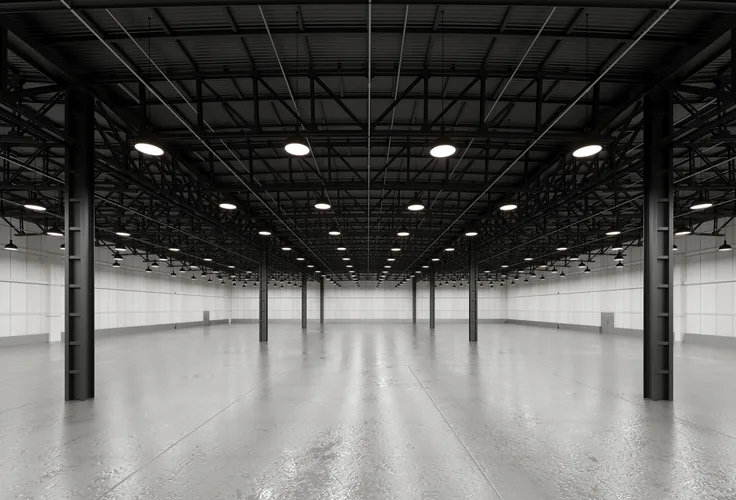
The most expensive thing in a New Hampshire warehouse in February is not on the floor. It is on the roof.
That is not a metaphor. Snow load is the New Hampshire warehouse peril, and what makes it a cost story rather than a weather story is what sits underneath: pallets of inventory that belong to somebody else. Your building and your racking are on your balance sheet, so you know what they are worth. The goods on the racking are not — and they are the loss you are most likely to have.
The roof is a bailee problem before it is a property problem
A big, flat distribution roof accumulates snow. Thaw and refreeze turn it to ice. Drainage backs up. Drift loads pile against parapets and rooftop units, in the spots nobody inspects. In a bad winter that sequence ends in structural deflection over racked inventory — and in a very bad one, it ends worse than that.
An owner naturally thinks of that as a commercial property claim, and part of it is: the roof, the steel, the racking, the business income lost while the building is closed. But the more consequential half of the loss is a warehouse legal liability claim, because the pallets that got wet, crushed, or frozen belong to a customer who is somewhere else and who will not be interested in the snowfall totals.
Freeze runs a close second, and it is quieter still. An unheated or partially heated bay is where a wet sprinkler line breaks and soaks a customer’s stored goods without a fire ever starting. No smoke, no alarm, no headline. Just a shipper’s cargo ruined and a claim that turns entirely on what your contract says.
The seacoast at Portsmouth and Hampton takes nor’easter wind and coastal flooding, and that deserves attention if you are there. But the state’s industrial base sits overwhelmingly inland, along I-93 and up the Merrimack valley, where wind is secondary and weight on the roof is not. Flood, where it applies, is its own placement.
The value and the nature of what is on the racks
This is the number that sizes the bailee limit, and the one operators most often understate — for the simple reason that the inventory never appears in their own accounts.
Value is the direct half: what is the maximum amount of customer-owned freight under your roof on the worst possible day, not on an average one. Nature is the half that gets missed. High-turn consumer goods, electronics, and anything with a cold requirement all price differently on identical racking, because the amount at risk per pallet position — and the appetite a thief has for it — differ by an order of magnitude.
The underwriting conversation is therefore never how big is the building. It is: what is in it, whose is it, and what is the most of it that is ever here at once?
The mixed-customer building, and why one loss becomes several
New Hampshire third-party storage is largely a Greater Boston overflow business. The buildings along I-93 and Route 101 hold other people’s inventory for customers whose end market is Massachusetts — high-turn consumer goods, a lot of cross-docking, and, critically, many accounts under one roof.
That last detail is a pricing fact and it is easy to miss. A dedicated building holding one customer’s goods has one bailor. A multi-customer building has a dozen, and a roof failure or a sprinkler discharge does not choose between them. One event reaches many bailors at once — each with its own contract, its own idea of what its goods were worth, and its own view of what you owe.
That accumulation is precisely what a warehouse legal liability limit has to be sized against. A limit that would comfortably cover your largest single account can be badly short of covering the building on a night when everything in it gets wet.
No license, one exception, and a contract doing all the work
New Hampshire has no public-warehouse licensing statute. A warehouse’s duties arise from the bailment and the warehouse receipt, not from a state permit.
The one license that reaches into a warehouse here is a food license: anyone who manufactures, processes, stores, or distributes food in New Hampshire must be licensed by the Food Protection Section of the Department of Health and Human Services, and that trigger explicitly reaches storage and distribution rather than only preparation. So a 3PL that signs a grocery account acquires a license it did not previously need — and the dry-goods operator across the parking lot holds none at all.
For everyone outside the food regime, the storage contract is the regulation. Whether your customers accepted a limitation-of-liability or released-value clause, negotiated it away, or signed something that assumed a level of protection your policy does not actually provide, changes the exposure an underwriter is being asked to price. That absence of a license is a cost driver, not a footnote, and it is the reason we read the storage agreements before we go to market rather than after a loss.
The crew, and a yard that freezes
Workers compensation is a private-market line here, and it scales with your material-handling payroll and the classifications you actually run. The exposures inside the four walls are the ordinary ones: powered-industrial-truck contact and tip-over, workers struck by product falling out of racking, lifting and repetitive strain on pick lines, dock injuries at the trailer.
Winter adds a layer a warmer state does not carry. Ice in the yard and on the dock plate is a real frequency driver from November through March — and frequency is what an underwriter looks at when deciding how a building actually runs.
Two winters, one bailee loss
<text x="350" y="30" text-anchor="middle" font-family="Inter, sans-serif" font-size="15" font-weight="600" fill="#0F4C5C">The loss that reaches your customers’ goods starts overhead</text>

<rect x="36" y="52" width="280" height="42" rx="9" fill="#ffffff" stroke="#0F4C5C"/>
<text x="176" y="78" text-anchor="middle" font-family="Inter, sans-serif" font-size="13" font-weight="600" fill="#0F4C5C">Snow, then thaw, then ice</text>

<rect x="384" y="52" width="280" height="42" rx="9" fill="#ffffff" stroke="#0F4C5C"/>
<text x="524" y="78" text-anchor="middle" font-family="Inter, sans-serif" font-size="13" font-weight="600" fill="#0F4C5C">A hard freeze in an unheated bay</text>

<path d="M176 96 L176 116" stroke="#0F4C5C" stroke-width="2"/>
<path d="M524 96 L524 116" stroke="#0F4C5C" stroke-width="2"/>

<rect x="36" y="118" width="280" height="60" rx="9" fill="#ffffff" stroke="#C3DEDE"/>
<text x="176" y="142" text-anchor="middle" font-family="Inter, sans-serif" font-size="12" fill="#3F5B64">Drains back up, drift piles on parapets</text>
<text x="176" y="162" text-anchor="middle" font-family="Inter, sans-serif" font-size="12" fill="#3F5B64">and the deck deflects over the racking</text>

<rect x="384" y="118" width="280" height="60" rx="9" fill="#ffffff" stroke="#C3DEDE"/>
<text x="524" y="142" text-anchor="middle" font-family="Inter, sans-serif" font-size="12" fill="#3F5B64">A wet sprinkler line lets go and water</text>
<text x="524" y="162" text-anchor="middle" font-family="Inter, sans-serif" font-size="12" fill="#3F5B64">finds the pallets on the bottom beam</text>

<path d="M176 180 L176 200 L350 200 L350 216" stroke="#0F4C5C" stroke-width="2" fill="none"/>
<path d="M524 180 L524 200 L350 200" stroke="#0F4C5C" stroke-width="2" fill="none"/>

<rect x="90" y="218" width="520" height="72" rx="9" fill="#C8935A" stroke="#0F4C5C"/>
<text x="350" y="246" text-anchor="middle" font-family="Inter, sans-serif" font-size="15" font-weight="600" fill="#1A1A1A">Somebody else’s goods, destroyed — with no fire and no alarm</text>
<text x="350" y="270" text-anchor="middle" font-family="Inter, sans-serif" font-size="13" font-weight="600" fill="#1A1A1A">In a mixed-customer building it happens to several bailors at once</text>

<text x="350" y="318" text-anchor="middle" font-family="Inter, sans-serif" font-size="12" font-style="italic" fill="#3F5B64">Which is why the limit is sized to the building, not to your largest account.</text>The honest summary
New Hampshire is a small warehousing state and it does not need a long guide. What it needs is an accurate one.
The price of your program is set by the freight in your care, by how many customers share the roof over it, and by whether that roof and the pipes running under it will get through a winter. There is no license standing behind you, so your storage contract is the only thing that will.
To see how the coverage works rather than what it costs, start with warehouse legal liability, or read the full New Hampshire warehouse insurance page. Our warehouse businesses practice explains our approach to the class. And if you own the inventory in the building rather than holding it for someone else, none of the above is your program — read the distributor cost guide instead.