
States we serve · New Hampshire
Warehouse business insurance in New Hampshire
Southern New Hampshire holds a great deal of inventory whose end market is Massachusetts. For the operator storing it, two things matter more than anything else: the goods are not yours, and there is weight on the roof above them.
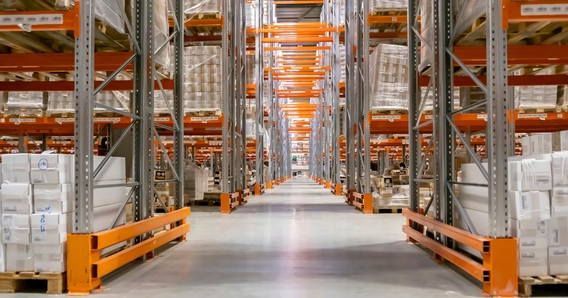

Third-party storage in New Hampshire is largely a Greater Boston overflow business. The buildings sit along I-93 and Route 101; the customers, more often than not, sit in Massachusetts. Companies priced out of the I-495 belt find land, buildings, and labor in Salem, Nashua, Manchester, and Londonderry, and put their inventory into somebody else’s warehouse an easy run up the interstate.
That shapes the risk in three specific ways. The goods are high-turn consumer stock, not slow bulk. There is a lot of cross-docking, which compresses custody to hours without making it any less binding. And the buildings are frequently mixed-customer — one roof over many bailors, which means a single fire or a single roof failure reaches a dozen owners’ property in one event. An operator who sizes the bailee limit against the largest single account has sized it against the wrong number.
No warehouse license — but there is a food license
New Hampshire has no public-warehouse licensing statute. Nobody permits your building as a warehouse, nobody inspects your racking, and no statute hands you a standard of care. Your duties arise from the bailment and the warehouse receipt, which makes the storage agreement — and the limitation-of-liability language inside it — your entire legal perimeter.
There is one exception worth knowing before you sign an account. Anyone who manufactures, processes, stores or distributes food in New Hampshire must be licensed by the Food Protection Section of the Department of Health and Human Services, and that licensing reaches wholesale distributors and storage operations — not just kitchens. Take in a food customer and you have acquired a state license along with the pallets. Prescription-drug wholesale distribution is licensed separately by the Board of Pharmacy through the Office of Professional Licensure and Certification, and it applies to resident and non-resident distributors alike. Beyond those two, New Hampshire keeps its regime lean; there is no agriculture-department warehouse registration layered on top.
Why the bailee line leads the program
The loss that ends a warehouse’s year is a loss to somebody else’s property. And a standard general liability policy excludes damage to personal property in your care, custody, or control — which is what a customer’s cartons on your racks are, precisely and by definition. The exclusion is not an oversight; it is the reason a separate line exists.
Warehouse legal liability answers exactly what that exclusion removes. In this state the point is unusually sharp, because New Hampshire’s two signature perils do not destroy the operator’s property at all. Snow comes down on a roof over customer-owned inventory. A sprinkler line freezes and soaks customer-owned cartons. In both cases the building survives and the goods do not, and the only policy in the stack facing that loss is the bailee line. That is why it leads the warehouse program here, ahead of the building.
Weight on the roof
Snow load is the New Hampshire warehouse peril, full stop. A big flat distribution roof accumulates snow, then ice as thaw and refreeze work on it, and the failure modes are ordinary and progressive: drainage backup, drift loading against parapets and rooftop units, and — in a bad winter — structural deflection or collapse over racked inventory.
Freeze runs a close second, and it is the sneakier of the two. An unheated or partially heated bay is where a wet sprinkler line breaks and destroys stored goods without a fire ever starting. There is no smoke, no alarm, no dramatic event — just water on a customer’s pallets by morning. The seacoast at Portsmouth and Hampton takes nor’easter wind and coastal flooding, but the state’s industrial base is overwhelmingly inland along I-93 and the Merrimack valley, where wind is a secondary conversation and weight is not.
The building, the crew, and the yard in February
Commercial property answers for what is genuinely yours — the shell, the racking and material-handling systems, and the business income that stops when the building does. It is the smaller half of the exposure, and holding it apart from the bailee line is the discipline the trade runs on: property covers what is yours and stays put; warehouse legal liability covers what is theirs and sits in your care.
Workers compensation is a private-market line here, and the exposures are physical and predictable: powered-industrial-truck contact and tip-over, workers struck by product falling out of racking, lifting and repetitive strain on pick lines, dock injuries at the trailer. Winter adds a layer a warmer state does not carry — ice in the yard and on the dock plate is a real frequency driver from November through March. An umbrella sits over the liability stack, and commercial auto attaches when your own equipment moves a customer’s freight off the property.
What an underwriter weighs here
- The value of the goods in your care across all customers in a mixed-tenant building — not the largest account.
- The roof. Age, drainage, and how the span is designed to handle drift is the New Hampshire property question.
- Heat in every bay that carries a wet sprinkler line, which is the cheapest loss-prevention answer in the state.
- Whether you hold food, and therefore whether you are licensed and inspected.
- The storage agreement and its liability cap — with no license, this is the whole of your legal position.
- Claims history, which moves pricing more than almost anything else on this list.
Major New Hampshire warehouse markets
Salem and the I-93 line
The first exits over the Massachusetts border, where companies priced out of the I-495 belt find land and buildings. Storage-for-hire here is Boston overflow: the customer is south of the line, the inventory is north of it, and the operator holds high-turn consumer goods for owners who chose this building on a rent calculation rather than a geography one.
Londonderry
Cross-dock and distribution space with an easy run down I-93. Cross-docking compresses the custody window to hours — but a short custody is not a small one, because the value crossing that floor in a week can exceed the value of the building, and a bailee answers for goods it held for an afternoon exactly as it answers for goods it held for a year.
Manchester
The state’s largest freight market and the location of Manchester-Boston Regional Airport, which carries air cargo and sits inside the state’s foreign-trade zone. Air-freight bailment concentrates value in a small footprint and runs on a tight clock, so a delay or a mishandling here costs more per pallet than a bulk building ever does.
Nashua
Multi-tenant industrial space on the Route 101 and I-93 triangle, frequently holding freight for several unrelated customers under separate storage agreements. Concentration is the underwriting question: one fire or one roof failure reaches many bailors at once, and a warehouse legal liability limit sized against the biggest account is sized wrong.
Portsmouth and the seacoast
The Port of New Hampshire is a working bulk and breakbulk port rather than a container gateway, run by the Port Authority under the Pease Development Authority. Bailment here attaches to raw material, aerospace and advanced-manufacturing components, and project cargo — heavy, high-value, and held for owners whose production schedule depends on it.
Pease International Tradeport
Inside the state’s foreign-trade zone, granted to the Pease Development Authority, with sites reaching the marine terminal, the Portsmouth industrial park, and Manchester’s airport — a reorganization under the alternative site framework extended the service area across most of southern and central New Hampshire. Duty-deferred custody here means answering to a customs regime as well as to the owner of the goods.
Concord and Rochester
Regional storage north of the metro belt, where a building is often the only warehouse between a supplier and a wide customer territory. When that building stops, the customer’s supply stops with it — and whether the storage agreement contemplated that consequence is a question best answered before the winter that raises it.
If the goods are yours, you are on the wrong page
One signpost. This page speaks to the operator holding other people’s inventory. If your New Hampshire business owns what it stores — a beer wholesale distributor licensed by the Liquor Commission, a consumer-goods wholesaler serving the cross-border retail draw, an importer using the Portsmouth marine terminal or air freight through Manchester — then nothing on your floor is a bailment. As the first U.S. seller of an imported product you sit in the products-liability chain, and your goods are at risk on every leg from the foreign supplier to the customer. That is stock throughput territory, and it has its own page: distributor and wholesaler insurance in New Hampshire.
If you do both, we place both — the distribution side and the wholesale side — and we map the seam between them before quoting either.
New Hampshire warehouse insurance FAQs
Does New Hampshire license a warehouse?
Not as a warehouse, no. New Hampshire has no public-warehouse licensing statute — a warehouse’s duties arise from the bailment and the warehouse receipt, not from a state permit. The one license that does reach a warehouse is a food license: anyone who manufactures, processes, stores or distributes food in New Hampshire must be licensed by the Food Protection Section of the Department of Health and Human Services, and that licensing reaches wholesale distributors and storage operations, not just kitchens. So a house that takes in a food account acquires a license along with the customer. For everything else, the storage contract is what sets your duty of care — and it is worth reading before a loss rather than during one.
What covers a customer’s goods if my sprinkler line breaks?
Warehouse legal liability — and this is exactly the loss that shows why. A standard general liability policy excludes damage to personal property in your care, custody, or control, and the freight on your racks is precisely that. So when a wet sprinkler line lets go in an unheated bay in February and soaks a customer’s cartons without a fire ever starting, general liability does not answer, and the property policy answers only for your own building. Warehouse legal liability is the bailee line written to answer what that exclusion removes. In New Hampshire it is the coverage the program leads with, because the state’s two signature perils — snow and freeze — both destroy other people’s goods rather than yours.
How serious is snow load for a distribution building here?
It is the New Hampshire warehouse peril, full stop. A big, flat distribution roof accumulates snow, then ice as thaw and refreeze work on it, and the failure modes are drainage backup, drift loading against parapets and rooftop units, and — in a bad winter — structural deflection or collapse over racked inventory. What is under that roof is your customers’ goods, which means a snow-load failure is a bailee loss and a property loss in the same instant, with the two lines answering separately for the two halves of one event. The state’s industrial base is overwhelmingly inland along I-93 and the Merrimack valley, where wind is secondary and weight on the roof is not.
What is the Pease foreign-trade zone actually good for?
Not what most operators assume. The state’s zone is granted to the Pease Development Authority at Portsmouth, and its sites run well beyond the waterfront — the Port Authority’s marine terminal in Portsmouth Harbor, the Portsmouth industrial park, Pease International Tradeport, and Manchester’s airport are all inside it, with a reorganization under the alternative site framework extending the service area across most of southern and central New Hampshire. But Portsmouth is a working bulk and breakbulk port rather than a container gateway, so bonded storage here attaches to raw material, aerospace and advanced-manufacturing components, and air freight — not to a stack of import boxes. For a bailee, duty-deferred custody still adds a customs obligation on top of the ordinary duty of care to the owner of the goods.
Is workers compensation a private-market line in New Hampshire?
Yes. The exposures inside a warehouse are physical and predictable: powered-industrial-truck contact and tip-over, workers struck by product falling out of racking, lifting and repetitive strain on pick lines, and dock injuries at the trailer. Winter adds an outdoor layer that a warmer state does not carry — ice in the yard and on the dock plate is a real frequency driver from November through March, and it is the exposure most amenable to management, which is why an underwriter will ask what you actually do about it.
Does the lack of a sales tax change anything for a warehouse operator?
Indirectly, and it is worth understanding because it explains your customer list. New Hampshire has no general sales tax, and the border towns along I-93 and I-95 have built a genuine retail and distribution draw on it, pulling Massachusetts consumption north across the line. Combined with land and building costs below the I-495 belt, that makes southern New Hampshire an affordable extension of the Greater Boston industrial market. For a bailee, the practical consequence is that your customers’ end market is frequently in another state — which raises the business-interruption stakes when weight on your roof stops the building, because the disruption travels down I-93 with the freight.
Get a New Hampshire warehouse insurance quote
Quotes in 1–2 hours during business hours.