

Ask a warehouse owner what their property policy covers and you will usually get two answers, quickly and confidently: the building, and the stock.
Both are right. Both are also the easy part.
The two things that most often go wrong on a distribution property program are the two nobody pictures. One is the racking — an asset most schedules treat as furniture and which is in fact engineered structure, frequently worth a great deal, and capable of failing as a system. The other has no physical form at all: it is the money that stops when the facility goes down, and for a business whose value is throughput rather than real estate, it is regularly the largest exposure on the page.
This post is about those two.
The map, stated once
Before anything else, the map this brand is built on, because it decides which policy you are even talking about:
Commercial property answers what is yours, and it stays put. · Warehouse legal liability answers what is theirs, in your care. · Stock throughput answers what is yours, anywhere it moves.
Yours-here. Theirs-in-your-care. Yours-anywhere. Three questions about the same pallet, and the reason a warehousing program is built from more than one line. The coverage pages develop each of those properly, and the general liability post explains why the goods in your care are carved out of your liability policy in the first place.
That is the map. This post stays firmly in the first box — the things that are yours and stay where you keep them — and goes deeper into it than the coverage page has room to.
The racking is not furniture
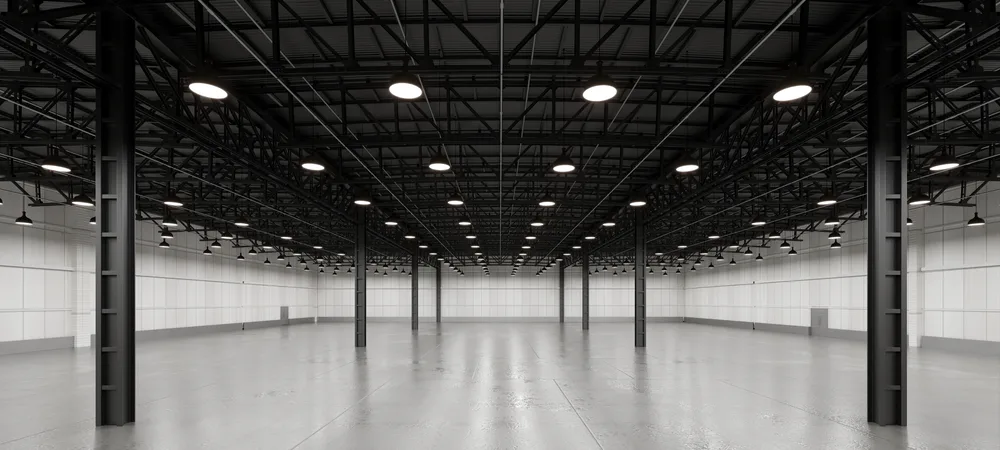
Walk a modern distribution facility and look at what the building actually is: a slab, a shell, a roof, and a grid of steel.
That grid — selective, drive-in, push-back, or high-bay rack, plus the mezzanines, the dock levelers, the conveyors and the sortation — is not an accessory to the building. It is the machine that makes the building a warehouse. In a lot of facilities it represents a serious share of the insured value, and unlike the shell, it is the part that gets rebuilt, reconfigured, and extended every time the operation changes.
Which is exactly why it drifts out of alignment on a schedule. The rack grid on your property schedule is often the one somebody built before the last expansion, before the aisle got converted to double-deep, before the conveyor run went in. Nobody decided to underinsure it. It simply stopped being looked at.
There is a second reason racking deserves its own attention, and it is the one that actually keeps operators up at night: rack does not fail politely. A forklift strike on an upright, a load that was never quite square, a beam that was overloaded by a foot of pallet — and a rack line can come down as a system rather than as a shelf.
The rack collapse: two losses in the same instant
Here is the moment where the three-way map stops being an abstraction and becomes an invoice.
A rack line comes down in aisle four. What is on the floor?
Your steel. The racking is yours and it stays put, so the damaged rack, the damaged conveyor, and any damage to the building itself are a commercial property loss. That part is intuitive.
Somebody else’s inventory. If you are storing goods for other companies — and if you are a public, third-party, contract, bonded, or cold-storage building, you are — then the pallets crushed underneath that steel are not yours. They are property in your care, and they are a warehouse legal liability question, on an entirely different policy, under an entirely different standard. Your general liability will not answer them; it excludes exactly that property.
Your own inventory. If some of what came down was product you own, it is a property question while it sits on your racking — and if you also carry stock throughput, that owner’s form is following the same goods across the whole span, which is a coordination conversation worth having before a loss rather than during one.
And the aisle is closed. Which is where the third exposure walks in.
One event. Three parts of your program, and they only work together if all three were built.
The money that stops
Now the part the coverage page names and this post owns.
Business income answers the revenue the operation would have earned during the time a covered property loss keeps it from operating. Not the building. Not the stock. The earnings that did not happen because the facility could not ship — plus the extra expense of standing up a temporary site, expediting repairs, or rerouting product to keep a customer served rather than lost.
Owners under-buy this coverage almost as a rule, and the reason is a very human one: it is the only part of the loss you cannot walk out and point at. Everything else in a property claim has a photograph. This one has a spreadsheet.
But look at what a distribution business actually is. It is not a real-estate business that happens to own inventory. It is a throughput business — it earns by moving volume — and the building is the box the volume happens to move through. A tilt-up shell with a slab and a roof is, in construction terms, close to a commodity. The operation inside it is not.
Which produces the fact that surprises owners more than any other in this class: the cheaper your building is relative to the volume moving through it, the more likely it is that your income exposure dwarfs your building exposure. A big-box facility can be the least valuable thing on its own site. Rebuilding the box is a known quantity with a known cost. Replacing months of shipping capacity — while a national customer’s volume commitments do not pause, and while somebody else’s facility is very happy to take that volume — is not.
If the building burned tonight, the structure is your smaller problem.
The period of restoration, and the date nobody circles
Business income runs for a defined stretch of time, and that stretch has a name: the period of restoration. Broadly, it is the time it takes to repair or replace the damaged property, beginning after whatever waiting period the policy sets.
Read that definition again and notice what it is a clock on. It is a clock on restoring the property. It is not a clock on restoring the business.
Those are not the same date, and in a distribution facility they are not even close. Walk the sequence out:
- The shell gets repaired. Structural work, roof, slab, doors. This is the part the policy’s clock is built around, and it is the part everybody pictures when they think about recovery.
- The rack goes back up. Engineered, permitted, ordered, installed. The building can be structurally sound and completely unable to hold a pallet.
- The inventory has to come back. Reordered and re-received on lead times you do not control — and if your goods come in on an import lane, that is not a phone call, it is a voyage.
- The crew has to be there. People who were laid off or who took other work do not all come back, and a pick module runs on trained hands.
- The volume has to be won back. Your customers did not stop shipping while you were down. They shipped through somebody else. Getting them back is not a repair; it is a sales cycle.
The day the doors reopen and the day the operation is earning at full volume again can sit a long way apart. Whether your policy contemplates any of that stretch — whether its clock stops when the property is restored or reaches into the recovery that follows — is a wording question, and it is worth asking on a day when nothing is on fire.
<text x="350" y="34" text-anchor="middle" font-family="Inter, sans-serif" font-size="15" font-weight="600" fill="#0F4C5C">After a covered loss, the operation comes back in stages</text>

<rect x="18" y="56" width="122" height="62" rx="9" fill="#ffffff" stroke="#C3DEDE"/>
<text x="79" y="82" text-anchor="middle" font-family="Inter, sans-serif" font-size="13" font-weight="600" fill="#0F4C5C">Repair</text>
<text x="79" y="102" text-anchor="middle" font-family="Inter, sans-serif" font-size="12" fill="#3F5B64">the shell</text>

<rect x="156" y="56" width="122" height="62" rx="9" fill="#ffffff" stroke="#C3DEDE"/>
<text x="217" y="82" text-anchor="middle" font-family="Inter, sans-serif" font-size="13" font-weight="600" fill="#0F4C5C">Rebuild</text>
<text x="217" y="102" text-anchor="middle" font-family="Inter, sans-serif" font-size="12" fill="#3F5B64">the racking</text>

<rect x="294" y="56" width="122" height="62" rx="9" fill="#ffffff" stroke="#C3DEDE"/>
<text x="355" y="82" text-anchor="middle" font-family="Inter, sans-serif" font-size="13" font-weight="600" fill="#0F4C5C">Restock</text>
<text x="355" y="102" text-anchor="middle" font-family="Inter, sans-serif" font-size="12" fill="#3F5B64">the inventory</text>

<rect x="432" y="56" width="122" height="62" rx="9" fill="#ffffff" stroke="#C3DEDE"/>
<text x="493" y="82" text-anchor="middle" font-family="Inter, sans-serif" font-size="13" font-weight="600" fill="#0F4C5C">Rehire</text>
<text x="493" y="102" text-anchor="middle" font-family="Inter, sans-serif" font-size="12" fill="#3F5B64">the crew</text>

<rect x="570" y="56" width="112" height="62" rx="9" fill="#ffffff" stroke="#C3DEDE"/>
<text x="626" y="82" text-anchor="middle" font-family="Inter, sans-serif" font-size="13" font-weight="600" fill="#0F4C5C">Win back</text>
<text x="626" y="102" text-anchor="middle" font-family="Inter, sans-serif" font-size="12" fill="#3F5B64">the volume</text>

<path d="M140 87 L156 87" stroke="#0F4C5C" stroke-width="2" fill="none" marker-end="url(#bi-arrow)"/>
<path d="M278 87 L294 87" stroke="#0F4C5C" stroke-width="2" fill="none" marker-end="url(#bi-arrow)"/>
<path d="M416 87 L432 87" stroke="#0F4C5C" stroke-width="2" fill="none" marker-end="url(#bi-arrow)"/>
<path d="M554 87 L570 87" stroke="#0F4C5C" stroke-width="2" fill="none" marker-end="url(#bi-arrow)"/>

<path d="M140 118 L140 156" stroke="#0F4C5C" stroke-width="2" fill="none" marker-end="url(#bi-arrow)"/>
<text x="140" y="176" text-anchor="middle" font-family="Inter, sans-serif" font-size="12" font-weight="600" fill="#0F4C5C">The building is repaired here</text>

<path d="M626 118 L626 156" stroke="#0F4C5C" stroke-width="2" fill="none" marker-end="url(#bi-arrow)"/>
<text x="600" y="176" text-anchor="middle" font-family="Inter, sans-serif" font-size="12" font-weight="600" fill="#0F4C5C">The operation earns again here</text>

<rect x="18" y="212" width="664" height="86" rx="10" fill="#C8935A" stroke="#0F4C5C"/>
<text x="350" y="244" text-anchor="middle" font-family="Inter, sans-serif" font-size="15" font-weight="600" fill="#1A1A1A">The earnings stop across the whole stretch</text>
<text x="350" y="268" text-anchor="middle" font-family="Inter, sans-serif" font-size="13" font-weight="600" fill="#1A1A1A">Business income answers the part of the loss</text>
<text x="350" y="288" text-anchor="middle" font-family="Inter, sans-serif" font-size="13" font-weight="600" fill="#1A1A1A">that never shows up in a photograph.</text>

<rect x="120" y="326" width="460" height="70" rx="9" fill="#ffffff" stroke="#C3DEDE"/>
<text x="350" y="352" text-anchor="middle" font-family="Inter, sans-serif" font-size="13" font-weight="600" fill="#0F4C5C">The policy’s clock runs on restoring the property.</text>
<text x="350" y="376" text-anchor="middle" font-family="Inter, sans-serif" font-size="12" fill="#3F5B64">Restoring the business is a different date — ask which one you bought.</text>Valuation, without the arithmetic
Two words appear on every property policy and most owners have never been walked through them.
Replacement cost is oriented to what it takes to replace the damaged property with like kind and quality today. Actual cash value takes the property’s age and wear into account, so an older asset is valued as an older asset rather than as a new one.
We describe those by function rather than with a formula, deliberately, because the wording actually attached to your policy governs and the basis can differ by asset class inside the same policy — the building on one basis, the contents or the racking possibly on another. The useful move is not to memorize a definition. It is to know, before a loss, which basis applies to your shell, to your steel, and to your stock.
What to look at before your renewal
None of this requires you to read the form yourself. It requires you to ask four questions of somebody who reads warehouse property.
- When was the racking last actually valued? Not carried forward — valued, against the grid that is in the building today, including the conveyor and the mezzanine and the last expansion.
- What is the business income figure built on? If nobody can tell you how it was derived, it was probably not derived. It was inherited.
- How long would we truly be down? Not how long the shell takes to repair — how long until we are shipping at full volume. That answer is the exposure.
- If a rack line came down on a customer’s pallets, which policies pay? If the answer names only one policy, something is missing.
The short version
Your property policy is the line that stands behind everything that is yours and stays where you keep it — the building, the steel that makes it a warehouse, and the stock on the shelf. Two of those get schedules and attention. The third thing property carries does not look like property at all, and it is the one that decides whether the business survives its own worst day.
A distribution facility is a modest box wrapped around a valuable operation. Insure the box, by all means. Then insure the operation — because the day the doors reopen is not the day the money starts again, and the distance between those two dates is the actual size of the loss.
See how the property program is built for a warehouse operation, or ask us — we will read your schedule against the building you are actually running, and tell you honestly what your downtime is worth.