
States we serve · Alabama
Warehouse business insurance in Alabama
For the contract, 3PL, food-grade, and supplier warehouses holding other companies’ goods — the parts staged for an assembly line in Vance or Montgomery, the containers moving inland from Mobile, and the pharmaceuticals a warehouse ships without ever owning.
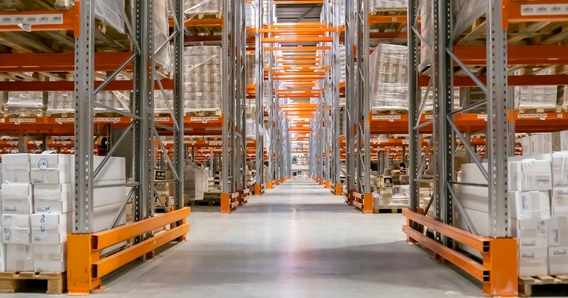

Almost every state in America tells a warehouse operator the same thing: there is no license, there is no permit, and there is no regulator — go read your storage contract. Alabama is the exception, and it is the exception in a way that is easy to overstate and easy to dismiss, so it is worth getting exactly right before anything else on this page.
Alabama has a public-warehouse statute drafted in general terms, and it sits in the commercial law title rather than the agriculture code. Alabama Code § 8-15-1 defines a public warehouse as a structure used to store cotton or other articles of value for the public. It places that warehouse under the supervision of the Commissioner of Agriculture and Industries. And § 8-15-3 requires a permit to operate one. The administrative rules that follow are unusually specific for a warehouse operator — fire-prevention standards, only authorized warehouse receipts on approved paper, receipt and record-keeping requirements, tariff and report filing, bonding, and an outright requirement to insure the goods accepted for storage.
Now the honest half. In practice, the department’s permitting activity centers on cotton and grain warehouses, and the rules themselves are visibly written around cotton. The ordinary Alabama contract warehouse operates on its bailment and its storage contract like a warehouse anywhere else. We are not going to tell a 3PL owner in Birmingham that they are running an unpermitted facility — that is not what the record supports. What we will tell them is that the statutory framework exists, that its language reaches beyond agriculture in a way no neighboring state’s does, and that this is a question for counsel rather than for a confident website. The state has written down, in its own rules, that a public warehouseman must insure the goods in his custody. Whether or not the permit reaches you, the instinct behind that rule does.
Warehouse legal liability: the coverage the statute was groping toward
Whatever the permit does or does not reach, the exposure is identical: goods that belong to a customer, sitting in a building that belongs to you. A fire in a rack aisle. A sprinkler head letting go over a pallet of components. A theft off a trailer in the yard. In each case the destroyed property is your customer’s — and your general liability policy will not pay for it.
That is the form working as designed. A standard general liability policy excludes damage to personal property in your care, custody, or control, and the freight in your racking is exactly that. The loss you worry about most is carved out of your foundation policy by its own terms. Warehouse legal liability exists to answer precisely what that exclusion removes, and on an Alabama page it leads for a reason the rest of the country does not have: a state rule already told the public warehouseman to insure the goods in his custody. This is the coverage that does it.
Just-in-time custody, and the loss that is not about the goods
Alabama warehouses what Alabama builds. The automotive assembly cluster at Vance, Montgomery, and Huntsville pulls an entire tier of supplier and parts warehousing into the state, and aerospace and defense in Huntsville does the same for high-value components. That space runs to an assembly plant’s clock rather than to a retail calendar, and it changes the character of a bailee loss in a way owners often have not thought through.
When a supplier warehouse suffers a fire or a storm, the components in custody are destroyed — and a line downstream stops. The parts are replaceable. The schedule is not. The customer’s real damage may have very little to do with the value of the pallets, and everything to do with what the supply agreement says happens when the delivery does not arrive. We read that agreement against the storage contract and against the limits before we bind, because the arithmetic of an Alabama bailee loss does not always live in the warehouse.
Heavy freight, a night shift, and a comp file
Alabama is a private-market workers compensation state, administered through the workers’ compensation division of the state labor department — no state fund, no opt-out. What shapes the exposure is what Alabama warehouses actually hold: automotive and aerospace components staged for assembly plants, which means heavy, awkward, densely packed freight rather than light cartons. Powered industrial truck incidents, falls from racking and mezzanines, struck-by injuries during putaway, dock and trailer movement, and lifting strain make up the claim set.
And then there is the tempo. The just-in-time clock a supplier warehouse runs to is itself a hazard — schedule pressure and forklift traffic do not mix well, and a night shift running against a plant’s morning start is the shift where the pace and the fatigue meet. Underwriters know this. It is worth being ready to talk about how you manage it.
The pharmacy board writes the bailee role into law
Alabama splits food between two agencies — the Department of Public Health permits food processing establishments that manufacture, pack, or hold food for wholesale or interstate distribution, while the Department of Agriculture and Industries runs its own food-safety permitting. The sharper requirement sits at the Alabama State Board of Pharmacy, which permits not only wholesale drug distributors but third-party logistics providers and repackagers as their own license categories.
Read that slowly, because it is the whole thesis of this page in one sentence: a contract warehouse that stores and ships pharmaceuticals for a manufacturer it does not own product for is, in Alabama, a permitted drug facility with a designated representative of its own. The state licenses you because the goods are not yours. Care, custody, and control is not an insurance abstraction here. It is a license category.
Storms that come at night, and a coast that watches the Gulf
Alabama sits in the part of the South where tornadoes are strongest and least seasonal — November and December as readily as April, and after dark. A distribution building is a very large, very low-profile target that cannot be engineered out of the path, and the night-shift question is a real one rather than an academic one. On the Gulf coast, Mobile and Baldwin County carry named-storm wind and surge, and the port and its warehouses are the exposed edge. Inland, hail bruises the big roof planes and the water afterwards finds the racking.
All of that is a commercial property conversation for the half of the building that is yours — the structure, the racking, the material-handling systems, the business income that stops when the facility does. It is a bailee conversation for the half that is not. Those two lines answer separately for the two halves of the same event, and an operator who buys a generous property limit against a thin bailee limit has insured the cheap half of the loss. Flood belongs in its own placement; on the coast and in the river bottoms, that placement is not optional in practice. This is the model we build the warehouse insurance program around.
What underwriters look at in Alabama
No numbers on a web page — any site quoting them is guessing. What actually drives an Alabama bailee placement:
- The value of the goods in your care, not your own assets — the figure that sizes the warehouse legal liability limit, and the one most often understated because the inventory is not on your balance sheet.
- What you hold and for whom — supplier components on a plant’s clock, bonded aerospace parts, food under a health-department permit, and pharmaceuticals under a pharmacy-board license are four different files in the same building shell.
- The supply agreement behind the storage agreement, which is where a just-in-time customer’s real damages are defined.
- Where the building sits — coastal wind at Mobile, the tornado corridor inland, and hail on a wide roof are separate conversations, and flood is separate again.
- Shift structure and forklift management, particularly on night operations.
- Claims history, which moves pricing harder than almost anything else on this list.
Major Alabama warehouse markets
Mobile and the port
The deep-water anchor, run by the Alabama Port Authority, and the fastest-growing container gate on the Gulf, with an intermodal container transfer facility that puts boxes onto Class I rail for Memphis, Chicago, and the Midwest. A bailee here holds import cargo that is only passing through Alabama — and sits on the coast, where named-storm wind and surge are underwriting facts rather than abstractions.
Birmingham
Where I-20 and I-59 cross and the Class I railroads converge, with its own foreign-trade zone. The classic Alabama contract warehouse sits here: mixed customers, mixed freight, and the state’s densest rail-to-truck transfer activity, which means custody changes hands more often per pallet than a single-customer building ever sees.
Vance and the Tuscaloosa corridor
Automotive assembly and the tier of supplier warehouses that feeds it. Freight here is heavy, awkward, and densely packed rather than light-carton, and it sits under a just-in-time clock — a fire or a storm in a supplier warehouse does not merely destroy goods in custody, it stops an assembly line, and the customer’s loss is measured in something other than the value of the pallet.
Huntsville
Air cargo, an aerospace and defense corridor, and a foreign-trade zone serving duty-deferred components rather than consumer imports. A bailee holding high-value aerospace parts for a manufacturer is carrying an unusually high value-per-square-foot, and the customs-bonded obligation attaches to the warehouse that admits the goods.
Montgomery
Assembly-plant supply on the I-65 spine, with a zone of its own. The distinctive underwriting question here is night operations: tornadoes in this part of the South come after dark and out of season, and a supplier warehouse running to an assembly plant’s clock is staffed when the sirens sound.
Decatur and the Tennessee Valley
River and rail industry in the north of the state, feeding chemicals, steel, and forest products into the manufacturing base. Bulk and breakbulk custody is not pallet custody: the goods are difficult to count, difficult to segregate, and difficult to hand back — which makes the storage agreement’s description of the goods the most-argued sentence in the file.
Dothan
A southeastern zone away from both the port and the metros, serving agricultural and industrial trade in the Wiregrass. A warehouse this far from a gateway is holding goods for owners who chose it for reach, and the storage contract — not a state regulator — is the only thing standing between the operator and a claim.
If the goods are yours, you are on the wrong page
An honest signpost. This page is written for the operator holding other people’s freight. If your Alabama business buys, holds, and resells its own product — an industrial or steel distributor, a forest-products or chemicals wholesaler, a beer and wine distributor working the private tier the state left open — then your inventory is not a bailment, and your program leads from stock throughput and products liability rather than from warehouse legal liability. Alabama’s owned-stock economy is unusually industrial, and being the first U.S. seller of a component that ends up inside somebody else’s finished machine puts a distributor squarely in the chain of distribution. That is a different risk with a different policy stack, and it has its own page: distributor and wholesaler insurance in Alabama.
Many Alabama businesses do both. If yours does, we place both sides — the distribution operation running your own product to market and the wholesale operation buying and reselling it — and the seam between what you hold and what you own is the first thing we map.
Alabama warehouse insurance FAQs
Does Alabama actually require a permit to operate a public warehouse?
Alabama is the rare state with a public-warehouse statute drafted in general terms, and it deserves a careful answer rather than a confident one. Alabama Code § 8-15-1 defines a public warehouse as a structure used to store cotton or other articles of value for the public, places it under the supervision of the Commissioner of Agriculture and Industries, and § 8-15-3 requires a permit to operate one. The rules that follow are unusually specific: fire-prevention standards, only authorized warehouse receipts on approved paper, record-keeping, tariff and report filing, bonding, and an outright requirement to insure the goods accepted for storage. But two honest caveats belong with that. In practice, the department’s permitting activity centers on cotton and grain warehouses, and the rules themselves are visibly written around cotton. So we do not tell a Birmingham 3PL owner flatly that they hold an unlawful operation — we tell them the statute on its face reaches other articles of value, which is more than any neighboring state’s warehouse law does, and that this is a question worth putting to counsel rather than guessing at.
What covers a customer’s goods while they sit in my Alabama building?
Warehouse legal liability — the bailee line. Accepting another company’s freight makes you a bailee: you hold property you do not own, and you answer for it while it is in your care, custody, and control. Your general liability policy will not answer for it, because a standard form excludes damage to personal property in your care, custody, or control — which describes the entire contents of your racking. The fire, the sprinkler discharge, the theft, the storm damage that reaches a customer’s parts: those losses are carved out of general liability by the form’s own terms, and warehouse legal liability is written to answer precisely what that exclusion removes. Alabama adds a wrinkle worth noticing — the public-warehouse rules themselves contemplate an obligation to insure the goods in custody, which is a statutory echo of exactly this coverage.
I run a just-in-time supplier warehouse for an assembly plant. How is that different?
Because the value of the loss is not the value of the goods. Alabama warehouses what Alabama builds — the automotive assembly cluster at Vance, Montgomery, and Huntsville pulls an entire tier of supplier and just-in-time parts warehousing into the state, and that space runs to the plant’s clock rather than to a retail calendar. When a supplier warehouse burns or floods, the components in custody are destroyed and the line downstream stops. The parts are replaceable; the schedule is not. That is why we read the supply agreement alongside the storage contract before we bind anything, and why the just-in-time tempo is itself a hazard on the workers compensation side — schedule pressure and forklift traffic do not mix well.
Does storing pharmaceuticals change my licensing position?
It changes it completely, and in a way that proves the point of this whole page. The Alabama State Board of Pharmacy permits not only wholesale drug distributors but third-party logistics providers and repackagers as their own license categories. A contract warehouse that stores and ships pharmaceuticals for a manufacturer — never owning a single unit of product — is, in Alabama, a permitted drug facility with a designated representative of its own. The state has written the bailee role into a licensing scheme: you are being licensed precisely because you hold goods you do not own.
Which Alabama perils actually reach a warehouse and the goods inside it?
Alabama sits in the part of the South where tornadoes are strongest and least seasonal. They come in November and December as readily as in April, and they come at night — which is the detail that makes them lethal and makes a night-shift warehouse a real question rather than an academic one. A distribution center presents a very large, very low-profile target and cannot be engineered out of the path. On the Gulf coast, Mobile and Baldwin County carry named-storm wind and surge, and the port and its warehouses are the exposed edge. Inland, hail bruises the big roof planes, and the water that follows finds the racking and the customer’s goods below. Flood belongs in its own placement, and along the coast and the river bottoms it is the placement that matters.
What does bonded or foreign-trade-zone storage add?
A second master over the same pallet. Alabama has an unusually distributed set of zones for a state its size — Mobile, Huntsville, Birmingham, Montgomery, and Dothan — and the inland ones exist because Alabama manufactures: duty-deferred parts and components feed automotive and aerospace plants well away from the water. When your building admits duty-deferred goods, you take on customs-bonded obligations on top of your ordinary duty of care to the owner. A shortage that would be an awkward phone call in an ordinary warehouse becomes a formal problem when the goods were never entered.
Get an Alabama warehouse insurance quote
Quotes in 1–2 hours during business hours.