
States we serve · Arizona
Warehouse business insurance in Arizona
Arizona runs two warehouse economies that barely resemble each other — big-box cross-dock and fulfillment across metro Phoenix, and cold-chain custody at the Nogales crossing. Both hold other people’s goods. Only one of them can lose everything without the building being touched.
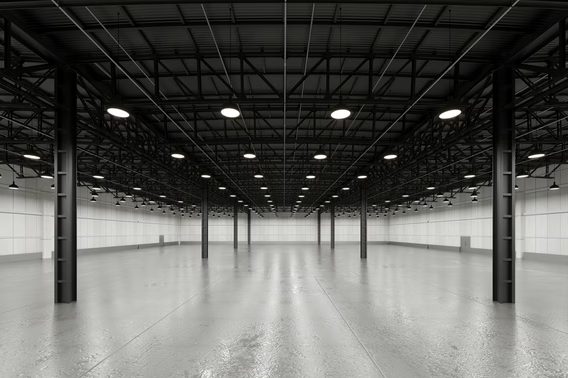

There are two warehouse businesses in Arizona and they have almost nothing in common except the fact that neither one owns what it stores.
In metro Phoenix, third-party and contract warehousing is big-box and fast — cross-docking and fulfillment for owners whose goods are moving through the building rather than resting in it, with an increasing share of that space bonded or zone-designated. In Nogales, the warehouse is something else entirely: a cold-chain custodian, holding and inspecting and repacking and consolidating imported produce that belongs to a grower or an importer somewhere else, in temperature-controlled space, against a clock. The Mariposa land port is one of the country’s major inbound produce gateways, and its customs infrastructure includes temperature-controlled inspection space. In Arizona, cold chain and bonded storage are the same conversation.
Both are bailment. But only one of them can lose everything without the building being touched.
The Nogales loss: total, and invisible
Think about how a produce warehouse actually fails. Not a fire. Not a collapse. The refrigeration goes down, or the power drops, or a release is delayed at the port — and by the time anybody notices, a customer’s load is worthless. The racking is fine. The roof is fine. The building would pass an inspection that afternoon.
There is no commercial property claim in that event. Property answers for what is yours and stays put — the shell, the racking, the refrigeration plant, the income that stops. It does not answer for a grower’s ruined produce. What answers for that is warehouse legal liability, the bailee line, and an operator who sized that limit against the value of the building rather than the value of the contents has quietly insured the wrong half of the risk. In a spoilage state, the goods are almost always worth more than the box they sit in.
The exclusion underneath all of it
This is not a Nogales quirk. It is the structural fact of the whole trade, and it applies just as hard in a Phoenix cross-dock. A standard general liability policy excludes damage to personal property in your care, custody, or control — and the freight on your floor, whether it is a pallet of imported avocados or a pallet of consumer electronics, is exactly that.
So the single loss an Arizona operator fears most is carved out of the foundation policy by its own terms, and no amount of general liability limit will reach it. Warehouse legal liability exists to answer what that exclusion removes. That is why it leads the warehouse program here rather than trailing behind the building.
No license — and the document that makes you a warehouse anyway
Arizona has no state public-warehouse licensing statute for general merchandise. Nobody permits your building. Nobody inspects your racking. But the state does something subtler that is worth understanding: it recognizes the warehouseman by reference to whether the operator issues a warehouse receipt or other document of title. That is the legal line separating a real warehouse from a mere rental of space — and it means your paperwork is not clerical. It is constitutive.
Which puts the storage contract and the receipt at the center of every claim. The limitation-of-liability language inside them — a released-value or per-package cap limiting what you owe unless the customer declares a higher value — is what a claim will be argued against, because there is no statute to argue it against instead. We read those terms before we bind the coverage that stands behind them.
Where the state does license the building: food
Arizona splits food oversight in a way that surprises operators moving in from neighboring states. The Arizona Department of Agriculture carries the food-safety program on the production, processing, and warehousing side, while the Department of Health Services and the counties handle retail food establishments — so a food distributor or a food-grade warehouse deals with the agriculture department, not the restaurant regulator. That split carries real weight in Nogales, where the produce-import trade lives. Prescription drugs run through the Arizona State Board of Pharmacy, which issues a wholesaler permit and requires a designated representative with genuine drug-distribution qualifications behind it.
Heat, monsoon, and dust — the peril set nobody else underwrites
Arizona’s peril profile is the inverse of the northern states. Extreme and sustained heat is the baseline. It stresses roofing membranes. It stresses refrigeration equipment — the equipment holding somebody else’s cold chain together. And it stresses the people on the dock, which is why heat lands in the workers compensation file as well as the property one: a metal-roofed warehouse in a Phoenix summer, and especially an open dock, is a genuine heat-illness risk for the crew working it.
Then the monsoon: violent seasonal thunderstorms, damaging outflow winds, and dust storms that scour a large roof plane, with flash flooding in washes and low ground. Hail turns up on the big flat roofs of the Phoenix distribution corridor. Wildfire matters in the higher, brushier country away from the valley floors — and smoke and ash can contaminate a customer’s stored goods even where flame never reaches the building, which is a bailee loss with no structural damage attached. Flood is its own placement and stays off the property form. Earthquake is not the Arizona story.
Comp: an open market, and one exposure most states never price
Arizona workers compensation is a private-market line — the state has a competitive fund operating alongside private insurers, which is not a monopolistic arrangement, and an Arizona warehouse employer buys comp in the open market. The exposures follow the work: forklift and powered-industrial-truck strikes in a crowded cross-dock, dock-plate and trailer-edge falls, product coming off high racks, lifting strain on a fulfillment pick line. And then the heat, which an underwriter will expect you to have a real answer for. An umbrella sits over the liability stack, and commercial auto attaches the moment your own equipment moves a customer’s freight beyond the yard.
What drives cost for an Arizona bailee
- The value of the goods in your care — and in a cold house, the value of what a single failed compressor can destroy overnight.
- Refrigeration redundancy and power backup. In Nogales and Yuma this is the loss-prevention conversation, not a footnote to it.
- Bonded and zone posture, and how inventory is reconciled against a customs obligation you cannot discharge with an apology.
- Roof condition under heat, monsoon wind, dust, and occasional hail.
- Heat management on the dock — the comp exposure that is genuinely specific to this state.
- Claims history, which moves pricing more than almost anything else on this list.
Major Arizona warehouse markets
Nogales and the Mariposa land port
One of the country’s major inbound produce gateways, with temperature-controlled inspection space in the customs infrastructure itself. The warehouse here is a cold-chain custodian: it holds, inspects, repacks, and consolidates produce belonging to a grower or an importer somewhere else, against a clock. Care, custody, and control at its sharpest — a delayed release or a power interruption destroys a customer’s inventory in hours.
Phoenix
Where I-10 out of Los Angeles meets I-17, and where the big-box build-out sells itself as the way to serve Southern California without paying to warehouse in it. The bailment here is fast: goods move through the building rather than rest in it, and the loss profile is accumulation — shrink, mis-ships, and handling damage at velocity — rather than a single catastrophic event.
The Phoenix zone bench
Grantees include the City of Phoenix and a separate Greater Maricopa zone. An increasing share of metro cross-dock and fulfillment space is bonded or zone-designated, and admitting duty-deferred goods layers a customs obligation on top of the ordinary duty of care — you answer to the owner of the freight and to a customs regime that has not been paid.
Mesa
Its own zone grantee, and part of the metro’s newer industrial absorption. Buildings taking on semiconductor, electronics, and aerospace supplier accounts are holding components whose value per pallet position is far above consumer freight — which changes the bailee limit calculation without changing the size of the building at all.
Tucson
Sun Corridor holds the zone here, and the city sits where I-10 and I-19 meet — the last metro before the Mexico line. A warehouse in Tucson frequently takes custody of freight mid-journey, inbound from the border and outbound across the interior Southwest, which puts the storage agreement rather than any state license at the center of a claim.
Chandler and Glendale
Metro fulfillment space serving a fast-growing consumer market. Fulfillment bailment is unit-level: thousands of small customer-owned items moving every day, where the underwriting question is less about fire and more about how inventory is reconciled, secured, and accounted for across a very high transaction count.
Yuma and San Luis
The southwestern crossing on I-8, with zone activity in the area. Agricultural and produce freight moves here too, which puts a second cold-chain bailee population in a part of the state whose summer heat makes a refrigeration failure faster and more complete than it would be almost anywhere else.
Flagstaff and the high country
Away from the valley floors, wildfire matters in the higher and brushier country, and smoke and ash can contaminate stored goods even where flame never reaches the building. For a bailee, contamination of a customer’s product is a bailee loss with no structural damage attached to it — which is a claim shape underwriters look for and owners rarely anticipate.
If the goods are yours, you are on the wrong page
A signpost before the questions. This page is for the operator holding other people’s goods. If your Arizona business owns what it stores — a produce importer who is the first U.S. seller of goods crossing at Nogales, a grocery or food distributor under the state agriculture food-safety program, an electronics or semiconductor-supply distributor serving the Phoenix manufacturing cluster, or a beverage wholesaler on the Series 4 license — then your inventory is not a bailment. It is owned stock, at risk from the foreign supplier all the way to your customer, and as the party that buys and resells you sit inside the products-liability chain. That belongs on its own page: distributor and wholesaler insurance in Arizona.
Plenty of Arizona companies do both, especially at the border. We place both sides — the distribution operation and the wholesale operation — and we map the seam before quoting either.
Arizona warehouse insurance FAQs
Does Arizona license a public warehouse?
No. Arizona has no state public-warehouse licensing statute for general merchandise. What the state does instead is more interesting: it recognizes the warehouseman by reference to whether the operator issues a warehouse receipt or other document of title. That is the legal line separating a genuine warehouse from a mere rental of space, and it means your paperwork is not administrative — it is what makes you a warehouse in the eyes of the law. Absent a license, the warehouse receipt and the storage contract define what you owe the owner of the goods, and there is no statutory standard of care sitting behind you.
What is different about holding produce at Nogales?
The loss can be total while the building is untouched. A Nogales warehouse is a cold-chain custodian — it holds, inspects, repacks, and consolidates imported produce that belongs to a grower or importer somewhere else, in temperature-controlled space, against a clock. A refrigeration failure, a power interruption, or a delayed release can destroy a customer’s inventory in hours. There is no fire, no collapse, no water: nothing a commercial property policy was written to respond to. There is only somebody else’s product, ruined, and a warehouse that had custody of it. That is a pure warehouse legal liability event, and it is the reason the bailee limit in a Nogales file has to be sized against the value of the produce rather than the value of the shell.
Will my general liability policy pay for a customer’s spoiled or damaged goods?
It will not. A standard general liability policy excludes damage to personal property in your care, custody, or control, and the goods you store are exactly that. So the loss you fear most — a warm freezer, a fire in a rack aisle, a theft out of a trailer, a monsoon downburst that opens a roof over a customer’s pallets — is carved out of your foundation policy by the form’s own terms. Warehouse legal liability is written to answer precisely what the exclusion removes, which is why it leads an Arizona warehouse program ahead of the building itself.
How does heat show up in an Arizona warehouse program?
In two places at once, and they are usually discussed separately when they should not be. On the property and cargo side, extreme and sustained heat stresses roofing membranes and refrigeration equipment — and in a cold-storage or produce building, a refrigeration failure in that heat destroys the contents fast, which is a bailee loss rather than a property one. On the workers compensation side, a metal-roofed warehouse in a Phoenix summer, and especially an open dock, is a genuine heat-illness risk for the people working it. Arizona is one of the few states where the same peril attacks the goods, the equipment, and the crew in a single afternoon.
What does the monsoon actually do to a distribution building?
It brings violent seasonal thunderstorms, damaging outflow winds, and dust storms that scour a large roof plane, plus flash flooding in washes and low ground. Hail is a real if less frequent problem on the big flat roofs of the Phoenix distribution corridor. Flood stays off the property form and belongs in its own placement — and it is worth remembering whose property is on the floor when the water arrives: the pallets belong to your customers, so a flooded Arizona warehouse is a bailee loss before it is a property loss. Earthquake is not the Arizona story and should not be dressed up as one.
Is Arizona workers compensation monopolistic?
No. Arizona has a competitive fund operating in the market alongside private insurers, which is not a monopolistic arrangement — an Arizona warehouse employer buys comp in the open market. The exposures follow the work: forklift and powered-industrial-truck strikes in a crowded Phoenix cross-dock, dock-plate and trailer-edge falls, product coming off high racks, and lifting strain in a fulfillment pick line. Then add the heat, which most of the country does not have to underwrite for and which an Arizona operator is expected to have a real answer for.
Get an Arizona warehouse insurance quote
Quotes in 1–2 hours during business hours.