
States we serve · Kansas
Warehouse business insurance in Kansas
For the third-party, contract, food-grade, and duty-deferred operators at Edgerton, Wyandotte County, Topeka, and Wichita — in a state with a statute called the public warehouse law that will not help you at all.
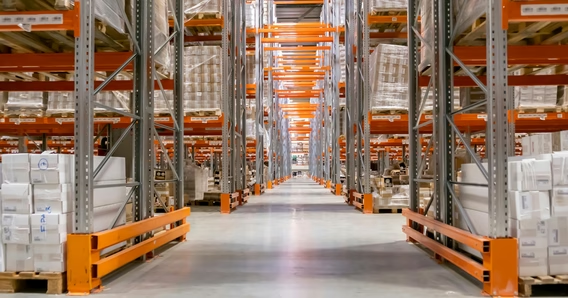

Kansas has a statute called the public warehouse law. It uses the term public warehouseman throughout. It licenses warehouses, bonds them, and examines them every year. And if you run a third-party warehouse at Edgerton holding a national retailer’s consumer goods, it has absolutely nothing to do with you.
It is a grain law. That is the fact this entire page turns on, and it is the fact that trips owners, brokers, and — more often than anyone would like — insurance submissions. The statute lives with the Department of Agriculture’s Grain Warehouse program. Its subject is grain, its duties are grain duties, and its licensees are elevators. It does not reach general-merchandise public warehousing at all.
So the operator running the most valuable stored goods in the state is licensed by nobody, and the operator running a grain elevator outside Salina is licensed, bonded, and audited. Once you see that inversion clearly, the Kansas insurance conversation gets much simpler — and considerably more urgent.
What the public warehouse law actually demands, and of whom
It is worth being precise about the statute, because precision is what keeps you out of trouble. A Kansas public warehouseman under this chapter must receive all grain tendered in suitable condition without discrimination. He must sample and weigh it. He must file a schedule of storage charges before he can be licensed at all. Anyone storing grain for the public must hold a state or federal license, and licensees are examined annually.
Every one of those obligations is written around a commodity — fungible, gradeable, weighable, poured into a bin with other people’s grain of the same grade. None of it describes a pallet of consumer electronics on a rack in Johnson County. The law is not being coy; it simply is not about you. Which is why the honest answer to “what license does my Kansas warehouse need” is: none, and that absence is the most important thing your insurance program has to answer for.
So what does govern the 3PL at Edgerton? The bailment.
You took in property that belongs to someone else, and you answer for it while it is in your care, custody, and control. That relationship — the bailment — is your legal position in full. There is no license behind it, no regulator standing over it, and no statutory standard of care to point at. What there is instead is paper: the warehouse receipt you issue and the storage agreement you signed, including whatever limitation-of-liability language the customer accepted or negotiated away.
Here is where most Kansas warehouse programs are quietly broken. The loss you actually fear — a fire in a rack aisle at Edgerton, a sprinkler head letting go over somebody’s inventory, a theft out of a trailer, a cold-room failure in a customer’s protein load — is a loss to other people’s property. And your general liability policy will not pay a dollar of it, because a standard general liability form excludes damage to personal property in your care, custody, or control. The single largest exposure in the building is carved out of the foundation policy by the policy’s own terms.
Warehouse legal liability exists to answer exactly what that exclusion removes. It is the bailee line, and on a Kansas page it leads — because in a state that licenses nothing, the coverage and the contract are one decision rather than two. We read the storage agreement against the limit before we bind.
Food: the one storage building Kansas does license
There is a genuine exception, and it matters if you are cold or food-grade. The Department of Agriculture’s food safety program treats food wholesalers, food warehouses, food re-packers, and food manufacturers as food processors — and it splits the application between facilities that process and store food and facilities that only store it. A pure food-storage warehouse therefore has its own license category, fee-rated by facility size.
Read that as a bailee and it lands differently. A food-grade 3PL in Kansas is a licensed premises holding regulated goods that belong to somebody else — a compound obligation the dry-goods operator across town does not carry. On the drug side, the Board of Pharmacy requires a wholesale distributor registration before distributing drugs or devices at wholesale, with a facility inspection before initial registration and periodically after. If your building touches either category, your duty of care has a regulatory floor under it that the rest of Kansas warehousing does not have.
Duty-unpaid goods on a Kansas rack
The other layer is customs. FTZ 17 covers the Kansas side of the Kansas City metro across nine counties — Johnson, Wyandotte, and Leavenworth among them — under the same Greater Kansas City grantee that holds the Missouri-side zone, which makes the bi-state metro effectively one duty-deferred distribution market. FTZ 161, granted to the Board of County Commissioners of Sedgwick County, covers Wichita and reflects the aviation and equipment base out there.
For a bailee, zone status is not a tax footnote. When you admit duty-unpaid goods, you answer to two masters over the same pallet: the customer who owns the freight, and a customs regime that has not been paid yet. The value concentration under your roof goes up, and so does the formality of what happens when something goes missing. This is the operating reality the warehouse insurance program has to be built to fit.
Hail is the peril that cashes the check
Kansas is the state the phrase tornado alley was coined for, and severe convective season is the defining property exposure for anything with a large roof plane. But tornado is the severe event; hail is the recurring loss. A distribution roof is a horizontal target measured in acres — rooftop mechanical units, skylights, membrane seams, all of it exposed to a single storm — and straight-line downburst wind can peel roofing off a big-box building without a tornado ever touching down. Winter adds hard freeze, burst pipe, and sprinkler-freeze exposure in unheated or partially heated space. Flash flooding along the Kansas and Arkansas river systems is a siting question through the eastern half of the state, and flood is its own placement rather than a property peril.
Now separate the two halves of that loss, because two different policies answer them. Commercial property answers what is yours and stays put: the roof, the racking, the material-handling systems, the income you lose while the building cannot ship. Warehouse legal liability answers what is theirs and sits in your care. A hailstorm at Olathe produces one event and two claims, and a Kansas operator with a generous property limit and a thin bailee limit has insured the cheaper half of it.
Forklifts, rack bays, and the cold rooms out west
Workers’ compensation in Kansas is a private-market line — insurers compete for it, and there is no state fund standing between you and coverage. The claims come from the same places they always do in a distribution building: forklift and pallet-jack contact injuries, workers struck by product falling out of a rack bay, dock and trailer falls, and lifting strain in high-throughput picking.
Out in the beef-belt towns of the southwest, the picture thickens. Cold-room work and the physical intensity of a protein warehouse add their own layer, and refrigerated space brings slip exposure on wet or frozen floors that a dry building simply does not have. A Dodge City cold storage facility and an Olathe dry-goods building are not the same workers’ compensation risk, and they should not be submitted as though they were.
What an underwriter weighs on a Kansas bailee submission
No numbers here — anyone quoting a premium on a web page is guessing. What we can tell you is what actually gets read:
- The value of the goods in your care. Not your own assets. This sizes the warehouse legal liability limit, and it is the figure owners most consistently understate, because the inventory never appears on their balance sheet.
- Your storage agreement. The limitation of liability, the standard of care, and whether a large customer negotiated the cap away. In an unlicensed state this document is your regulatory position.
- What is actually in the building — dry consumer goods, high-theft electronics, aerospace parts, food under refrigeration, or duty-unpaid import cargo. Four different risks in the same shell.
- The roof, and the hail history under it. Age, membrane, attachment, and rooftop equipment on an acre of low-slope deck in convective country.
- The material-handling floor — forklift traffic patterns, rack inspection discipline, dock protocol, and whether cold-room work is in the payroll mix.
- Claims history, which moves pricing further than almost anything else on this list.
Major Kansas warehouse markets
Edgerton and Logistics Park Kansas City
A master-planned intermodal and warehouse development built around a full-service rail terminal with wide-span gantry cranes and automated gates, connected straight into the transcontinental network. It turned Johnson County farmland into one of the strongest inland-port distribution submarkets in the interior of the country — and every contract operator inside it is a bailee with no state warehouse license, holding a national retailer’s goods on the strength of a storage agreement.
Wyandotte County and the Kansas side of the metro
Where FTZ 17 sits over the Kansas half of a bi-state duty-deferred market that shares its grantee with the Missouri side. A warehouse here can hold imported, duty-unpaid inventory belonging to a customer — a very high value concentration under one roof, and a loss that triggers customs consequences on top of the customer’s claim for the goods themselves.
Olathe
Johnson County distribution space feeding the same intermodal engine at Edgerton, much of it multi-tenant. Shared buildings raise a specific bailee question: when one tenant’s sprinkler event or forklift strike damages another company’s stored goods, whose care, custody, and control were those goods actually in when it happened?
Topeka
The I-70 midpoint between the metro and the western half of the state, with regional distribution and food-storage space. A building here that only stores food for other companies falls into the Department of Agriculture’s food-storage license category — a licensed premises holding goods that still belong to a customer.
Wichita
FTZ 161, granted to the Board of County Commissioners of Sedgwick County, sits over an aviation and equipment supply base. A bailee here holds aerospace parts and industrial components — small, high-value, traceable units where the loss that hurts is not a collapsed rack but a missing serialised part a customer cannot replace on any short timeline.
Salina and the I-135 corridor
The stitch between Wichita and the I-70 line, serving agricultural, industrial, and regional distribution demand. Convective-season hail across this corridor is the quiet, expensive peril: it does not level the building, it bruises an entire roof membrane over goods that belong to somebody else, and the water arrives afterwards.
Dodge City and Garden City
The southwest protein belt — beef processing at scale, and around it a cold-chain, packaging, and agricultural-supply economy. A refrigerated bailee here fails in a way a dry one never does: the building is untouched, the temperature simply drifts, and a customer’s protein load is a total loss with the racking standing.
The licensed grain elevators
The Department of Agriculture’s Grain Warehouse program licenses the operators the public warehouse law actually reaches, and examines them annually. They are the state’s genuine licensed bailees — obliged to receive grain tendered in suitable condition, to sample and weigh it, and to file a schedule of storage charges. The contract warehouse an hour away, holding pallets worth many times the grain, holds no license whatsoever.
If the goods are yours, you are on the wrong page
A signpost before the questions. This page speaks to the operator holding other people’s goods. If your Kansas business buys, holds, and resells its own product — a beverage distributor licensed by Alcoholic Beverage Control and reporting gallonage monthly, a protein or food wholesaler moving owned stock out of the packing towns, or an aviation and industrial-supply wholesaler in Wichita — then your inventory is not a bailment. Your program leads from stock throughput and products liability instead of from warehouse legal liability, and it has its own page: distributor and wholesaler insurance in Kansas.
Plenty of Kansas companies do both, storing a customer’s freight in one bay and their own inventory in the next. If yours does, we place both sides — the distribution operation and the wholesale operation — and the first thing we map is the seam between them, because the seam decides which policy answers when the sprinklers go off.
Kansas warehouse insurance FAQs
Kansas has a “public warehouse law.” Does my 3PL need a public warehouse license?
No — and this is the single most misread point in Kansas warehousing. The statute is real, it is genuinely called the public warehouse law, and it uses the term public warehouseman throughout. Its subject is grain. It is administered by the Department of Agriculture’s Grain Warehouse program; it obliges a public warehouseman to receive all grain tendered in suitable condition without discrimination, to sample and weigh it, and to file a schedule of storage charges before being licensed; anyone storing grain for the public must be licensed by the state or the federal government, and licensees are examined annually. It does not reach general-merchandise public warehousing. A 3PL storing consumer goods at Edgerton or in Wyandotte County is not a public warehouseman under this law, and no Kansas agency will issue it a warehouse license.
Then what sets my duty of care to the goods I store?
Your storage contract and the bailment, and nothing else. Because the only Kansas warehouse license is a grain license, a merchandise warehouse here has no state permit to lose, no regulator to answer to, and no statutory standard of care handed to it. What remains is the bailment relationship: you took in property that belongs to someone else, and you answer for it while it is in your care, custody, and control. The warehouse receipt you issue, the storage agreement you signed, and the limitation-of-liability language inside it are the entire perimeter of a claim. In a state with no license, the storage contract is the regulation — which is a reason to read it before a loss rather than during one.
Why will my general liability policy not pay for a customer’s damaged goods?
Because a standard general liability form excludes damage to personal property in your care, custody, or control — and the customers’ goods in a Kansas warehouse are the textbook case of exactly that. The loss you fear most is carved out of your foundation policy by that policy’s own terms. Warehouse legal liability is the line written to answer precisely what the exclusion removes: a fire in a rack aisle, a sprinkler discharge over a customer’s pallets, a theft from the yard, or a cold-room failure in someone else’s protein. It is the lead coverage on a Kansas bailee program, ahead of the building.
Does Kansas license a food warehouse?
Yes, and it is the one place the state comes into a storage building. The Department of Agriculture’s food safety program treats food wholesalers, food warehouses, food re-packers, and food manufacturers as food processors, and it splits the application between facilities that process and store food and facilities that only store it — so a pure food-storage warehouse has its own license category, fee-rated by facility size. The consequence for a bailee is direct: a food-grade 3PL in Kansas is a licensed premises in a way a general-merchandise 3PL down the road is not, and it is holding regulated goods on somebody else’s behalf.
What does FTZ 17 or FTZ 161 add to a warehouse operator’s exposure?
Another master over the same pallet. FTZ 17 covers the Kansas side of the Kansas City metro across nine counties, including Johnson, Wyandotte, and Leavenworth, under the same Greater Kansas City grantee that holds the Missouri-side zone — so the bi-state metro is effectively one duty-deferred distribution market. FTZ 161, granted to the Board of County Commissioners of Sedgwick County, covers Wichita and reflects the aviation and equipment base there. When you admit duty-unpaid goods you take on customs-bonded obligations on top of your ordinary duty of care to the owner of those goods. A shortage that would have been an unhappy phone call becomes considerably more formal when the goods were never entered.
Which Kansas perils actually threaten a warehouse?
Tornado is the one the state is famous for, and severe convective season is the defining property exposure for anything with a large roof plane here. But the peril that most often actually cashes a check is hail, because a distribution roof is a horizontal target measured in acres, with rooftop mechanical units, skylights, and membrane seams all vulnerable to a single storm. Straight-line downburst wind can peel roofing off a big-box building without a tornado ever touching down. Winter brings hard freeze and burst-pipe and sprinkler-freeze exposure in unheated or partially heated space. Flash flooding along the Kansas and Arkansas river systems is a siting question in the eastern half of the state — and flood is its own placement, not a property peril. Read all of that as a bailee: every one of those events puts water, heat, or debris into inventory that belongs to your customer.
Get a Kansas warehouse insurance quote
Quotes in 1–2 hours during business hours.