
States we serve · Kentucky
Warehouse business insurance in Kentucky
For the fulfillment, 3PL, bonded, and cold-chain operators around the Louisville and Northern Kentucky air hubs — where a customer’s goods can be in your building for four hours or for four years, and either way they are never yours.
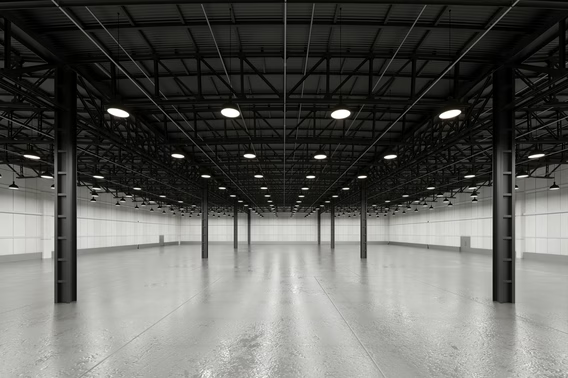

No other state asks a warehouse operator to run both ends of the clock. In a building near the Louisville air hub, a customer’s goods arrive in the evening, are picked, packed, and gone before the aircraft leaves — custody measured in hours, and a cut-off time that is not negotiable because it is set by a departure. Two hours down the road, a bourbon warehouse holds another company’s spirits on ricks for years, in a federally bonded building, while the asset quietly matures into something more valuable than it was when it arrived.
Same trade. Same legal relationship. Wildly different exposures. And in both buildings the one constant is that the goods are not yours — which is what makes a Kentucky warehouse program a bailee program before it is anything else.
Fulfillment is a bailee business, and Kentucky runs it fastest
Kentucky is a fulfillment state because of what is parked at the end of the runway. Louisville Muhammad Ali International hosts the UPS Worldport global air hub; Cincinnati/Northern Kentucky International, on the Kentucky side of the river, hosts both a DHL global superhub and an Amazon Air hub. Three global air-cargo operations in one state is a rare concentration, and the consequence for warehousing is direct: an order can be accepted here later at night than almost anywhere else in the country and still make next-day delivery.
Which means a Kentucky fulfillment operator picks, packs, and ships goods it never owns. It is a bailee holding property in its care, custody, and control from the dock door to the departure. And when something goes wrong inside that building — a fire in a rack aisle, a sprinkler head over a pallet of electronics, a theft, a handling accident on a fast line — the customer suffers twice: the goods are damaged, and the flight is missed. Both losses land on the operator who had custody.
Your general liability policy will not answer any of it. A standard general liability form excludes damage to personal property in your care, custody, or control, and the freight in a fulfillment building is precisely that property. The largest exposure in the operation is carved out of the foundation policy by the policy’s own terms. Warehouse legal liability is written to answer exactly what that exclusion removes, and in Kentucky it leads — because with no state warehouse license for merchandise, parcel, or fulfillment operations, the warehouse receipt and the storage agreement are the entire definition of what you owe. This is the model the warehouse insurance program is built on.
The longest bailment in the trade
Now the other end of the clock. Kentucky carries a very large stock of federally bonded distilled-spirits premises, and a barrel warehouse is bonded storage in the literal sense of the phrase. A warehouse here can hold another company’s spirits for years, on ricks, in a building the federal government has an interest in.
Three things about that change the underwriting completely. Exposure accumulates rather than cycling — nothing turns over, so every year adds inventory rather than replacing it. The asset is maturing, which means a destroyed barrel is not a shipment that can be re-ordered from a supplier; the time inside it cannot be bought back. And the building is bonded, so a loss carries a federal excise dimension on top of the owner’s claim for the spirits. A program written for a fast-cycling parcel building will not answer for any of that, and a program written for a rickhouse will be badly mispriced against a fulfillment operation.
Zone status: land it, hold it, release it when it sells
The customs layer here is unusually live because the freight arrives by air. The Louisville and Jefferson County Riverport Authority is grantee of the Louisville foreign-trade zone, which sponsors zone sites across a wide swath of the Commonwealth; Greater Cincinnati FTZ, Inc. is grantee of the Boone County zone serving northern Kentucky and the CVG area.
The pattern that follows is specific: goods land at a Kentucky air hub, sit in a zone-status building, and are released to the domestic market only when they are sold. For however long that takes, the operator holding them is answering to two masters over the same pallet — the customer who owns the freight, and a customs regime that has not yet been paid. Value concentration goes up, and so does the formality of what happens when something goes missing.
Pharmaceutical and medical freight: licensed one building at a time
The air hubs pulled pharmaceutical, medical-device, and high-value electronics distribution into the state, and that freight brings obligations a dry-goods pallet does not. Temperature control and traceability become part of the service you are selling, which means they become part of what you are liable for when they fail.
The Kentucky Board of Pharmacy licenses wholesale distributors of prescription drugs and requires a separate license for each facility that distributes into the Commonwealth, regardless of common ownership — so an operator adding a second building is adding a second license, not extending the first. Food distribution and food storage warehouses run through the Cabinet for Health and Family Services food-safety program, with the Department of Agriculture handling grain and agricultural commodity licensing.
The peril that matters most is the one that stops you shipping
Kentucky sits in a high-frequency severe convective corridor, and the western part of the state has seen violent tornado outbreaks. For a distribution building the practical exposures are hail and straight-line wind on a wide low-slope roof, damage to rooftop equipment, ice storms and heavy wet snow in the north and east, and freeze on wet sprinkler systems. Flooding along the Ohio River and the eastern Kentucky river valleys has repeatedly been severe, and it is its own placement rather than a property endorsement.
But here is the Kentucky-specific edge. In a state whose whole value proposition is a late cut-off and a next-morning delivery, the business-interruption consequence of a building that cannot ship is not a secondary line item — it is the main event. Commercial property answers the roof, the racking, the conveyors, and the income you lose while the doors are shut. Warehouse legal liability answers the customer’s goods that got wet under the breach. One storm, two claims, two policies — and a Kentucky operator with a thin bailee limit has insured the cheaper half of it.
Conveyors, congested docks, and barrels at height
Kentucky is a private-market workers’ compensation state, and the exposure is shaped by what its warehouses actually do. On the fulfillment side, the injuries come from conveyor and sortation equipment, repetitive lifting on a fast line, and forklift traffic on congested docks — velocity is itself a hazard, and a building working to an aircraft cut-off is a building where people hurry. On the distilling side, the work is heavy manual handling: crews moving heavy barrels on ricks at height. Racking falls, dock injuries, and lifting strain run across both. They are not the same submission and should not be described as though they were.
What an underwriter reads on a Kentucky bailee submission
- The clock. Hours or years — dwell time is the single most diagnostic fact about a Kentucky warehouse, and it changes everything downstream.
- The value of the goods in your care — not your own assets. It sizes the bailee limit, and owners understate it constantly because the inventory is not on their books.
- What is in the building — parcel and consumer freight, high-value electronics, temperature-controlled pharmaceuticals, automotive components, or maturing spirits in bond.
- Your storage agreement — the limitation of liability, the standard of care, and whether a large customer has negotiated the cap away.
- The roof, and the shipping clock under it — because business interruption in a next-day-delivery building is priced very differently from business interruption in a slow one.
- Claims history, which moves pricing more than most of the rest of this list combined.
Major Kentucky warehouse markets
Louisville and the Worldport hub
Louisville Muhammad Ali International is the site of the UPS Worldport global air hub, and the fulfillment buildings around it run to aircraft cut-off times rather than to shift times. For a bailee that changes the nature of a loss: a fire or a sprinkler event does not merely damage a customer’s goods, it misses a departure and breaks a next-day delivery promise the customer made to somebody else.
Hebron and the CVG air-cargo belt
Cincinnati/Northern Kentucky International sits on the Kentucky side of the river and hosts both a DHL global superhub and an Amazon Air hub. High-value electronics and medical freight staged here belongs to brands and retailers who never transfer title — the operator picks, packs, and ships goods it does not own, and the loss it fears is measured in the customer’s stock-out, not in its own balance sheet.
Boone County and the northern Kentucky zone
Greater Cincinnati FTZ, Inc. is grantee of the Boone County zone serving the CVG area. Goods can land by air, sit in a zone-status building, and be released to the domestic market only when they are sold — which means a bailee here is holding duty-unpaid property and answering to a customs regime as well as to the owner of the freight.
Covington and the river corridor
The Ohio River frontage across from Cincinnati, with public riverport and barge capability. River-adjacent industrial siting is exactly where flooding along the Ohio has repeatedly been severe, and flood is a separate, separately placed peril — a distinction that gets expensive when the goods on the floor belong to a customer.
Florence
Distribution space stacked along I-71 and I-75 feeding the northern air hubs. Multi-tenant contract buildings raise a specific bailee question: when one operator’s handling event damages another company’s stored goods, the argument turns on whose care, custody, and control those goods were actually in at the moment of loss.
Lexington and the Bluegrass
Automotive assembly and parts distribution, with 3PL space serving the plants. A bailee holding production components is holding a customer’s line-stoppage risk: the parts themselves may be modest in value, and the consequence of not having them on time is not.
Bowling Green and the I-65 corridor
The southern manufacturing and distribution belt on the run toward Nashville. This is severe-convective country, and hail on a wide low-slope roof is the recurring loss — it does not level the building, it bruises an entire membrane plane over goods that belong to somebody else, and the water arrives afterwards.
The bonded barrel warehouses
Kentucky carries a very large stock of federally bonded distilled-spirits premises — bourbon aging warehouses are bonded storage in the literal sense. A warehouse can hold another company’s spirits for years, which is the longest-duration bailment anywhere in this trade, and a loss destroys not a shipment but an irreplaceable maturing asset.
If you own the barrels, you are on the wrong page
An honest signpost. This page is for the operator who holds other people’s goods. If your Kentucky business buys, holds, and resells its own product — a beverage wholesaler licensed by the Department of Alcoholic Beverage Control with brands in the state registry, an automotive or industrial parts distributor, a food and grocery wholesaler, or a high-value electronics or medical-products importer taking delivery by air and becoming the first U.S. seller — then your inventory is not a bailment at all. Your program leads from stock throughput and products liability, not from warehouse legal liability, and it has its own page: distributor and wholesaler insurance in Kentucky.
The line is genuinely blurry in the bourbon economy, where a brand owner may own barrels aging in a warehouse it does not run, and an operator may run a warehouse full of barrels it does not own. If your business sits on both sides of it, we place both — the distribution operation and the wholesale operation — and we map the seam first, because after a loss the seam is the entire argument.
Kentucky warehouse insurance FAQs
Is fulfillment work actually a bailee exposure?
It is the definitive one. In a fulfillment operation you pick, pack, and ship goods that are owned by a retailer or a brand, and you never take title to any of it — which makes you a bailee holding property in your care, custody, and control from the moment it arrives to the moment it leaves. Kentucky runs that model at extraordinary velocity, because the cut-off times around the Louisville and Northern Kentucky air hubs are set by aircraft departures. So a loss inside the building is not simply physical damage to a customer’s goods; it is a missed flight and a broken next-day delivery promise, and the customer will attribute both to you.
Does Kentucky license public warehouses?
Not in general. There is no general public-warehouse licensing statute in the Commonwealth. Grain is licensed, and licensed carefully — the Kentucky Department of Agriculture licenses grain warehouse operators and grain dealers facility by facility, and an operator already licensed under the federal warehouse act must still hold the Kentucky grain warehouse operator license. But for merchandise, parcel, and fulfillment warehousing, which is most of Kentucky’s warehouse economy, no state license applies at all. The operator’s duty to the goods runs through the bailment and the warehouse receipt, which is to say through documents you wrote rather than a permit the state issued.
Why will my general liability policy not cover the customer inventory in my building?
Because a standard general liability form excludes damage to personal property in your care, custody, or control — and every carton in a Kentucky fulfillment building is exactly that. The single largest exposure in the operation is carved out of the foundation policy by that policy’s own terms. Warehouse legal liability is the bailee line written to answer precisely what the exclusion removes: fire, sprinkler discharge, theft, handling damage, or a temperature failure in goods that belong to somebody else. It leads a Kentucky warehouse program ahead of the building coverage, because in this state the goods on the floor are worth a great deal more than the floor.
What is different about storing bourbon for another company?
Duration, and custody. Kentucky carries a very large stock of federally bonded distilled-spirits premises — barrel warehouses are bonded storage in the literal sense — and a warehouse can hold another company’s spirits for years. That is the longest-duration bailment in this trade, and it changes the loss profile completely. The goods do not turn over, so exposure accumulates rather than cycling; the asset is maturing, which means it cannot simply be replaced from a supplier; and the building is federally bonded, so a loss has a customs and excise dimension on top of the customer’s claim for the spirits themselves.
What does zone status add for a Kentucky warehouse operator?
A second master over the same pallet. The Louisville and Jefferson County Riverport Authority is grantee of the Louisville foreign-trade zone, which sponsors zone sites across a wide swath of the Commonwealth, and Greater Cincinnati FTZ, Inc. is grantee of the Boone County zone serving northern Kentucky and the CVG area. Bonded and zone-status storage is unusually live here because the freight arrives by air: goods can land at a Kentucky hub, sit in a zone-status building, and be released to the domestic market only when they are sold. While they sit, you are answering both to the customer who owns them and to a customs regime that has not been paid.
Which Kentucky perils actually threaten a distribution building?
Kentucky sits in a high-frequency severe convective corridor and has seen violent tornado outbreaks in the western part of the state. For a distribution building the practical exposures are hail and straight-line wind across a wide low-slope roof, damage to rooftop equipment, and — the part that hurts most here — the business-interruption consequence of a building that cannot ship. Ice storms and heavy wet snow load large roofs in the north and east, and freeze threatens wet sprinkler systems. Flooding along the Ohio River and the eastern Kentucky river valleys has repeatedly been severe and is a separate, separately placed peril. Read every one of those as a bailee: the goods that get wet, crushed, or stranded belong to your customers.
Get a Kentucky warehouse insurance quote
Quotes in 1–2 hours during business hours.