
States we serve · New Jersey
Warehouse business insurance in New Jersey
A box comes off a ship at Elizabeth, gets stripped in your building, and the goods sit under somebody else’s name until a retailer calls for them. That is bailment at velocity — and it is the defining exposure of a New Jersey warehouse.
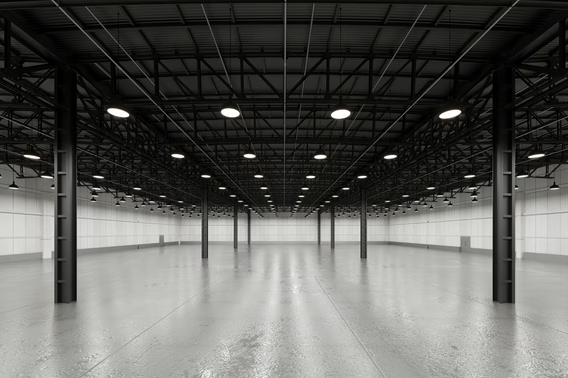

New Jersey warehouses exist because the Port of New York and New Jersey unloads here. Goods land at Port Newark and the Elizabeth terminals and have to go somewhere within a drayage turn, which is why the buildings cluster tight around the port and along the Turnpike instead of spreading out across the state. And what happens inside those buildings is the most concentrated form of bailment in the country.
A box comes off a ship. It gets stripped. The goods are broken down, re-sorted, re-palletized, staged, and held under somebody else’s name until a retailer calls for them. Between the container door and the outbound trailer, the same customer-owned freight is handled several times — and the operator owns none of it, not for a second. That is bailment at velocity, and every handling event in that sequence is a place a bailee claim can start.
The exclusion that makes this the lead coverage
Here is the fact a New Jersey operator cannot afford to learn during a claim. A standard general liability policy excludes damage to personal property in your care, custody, or control. The imported goods on your racks — the apparel, the electronics, the food, the pharmaceutical freight off the air-cargo lane — are exactly that. So the single loss you fear most is carved out of your foundation policy by the form’s own terms, and no amount of general liability limit will change it.
Warehouse legal liability is the line written to answer precisely what that exclusion removes: loss or damage to a customer’s goods while they sit in your care as a bailee. In a state where the goods pass through your hands several times a week and the building is full of other people’s import cargo, it does not sit behind the property policy. It leads the warehouse program.
The Act with “Warehousemen” in its name — and why it is not yours
New Jersey does have a statute with the word warehousemen in the title, and operators find it and worry. The Public Movers and Warehousemen Licensing Act, N.J.S.A. 45:14D-1 et seq., is administered by the Division of Consumer Affairs — and its reach is household-goods moving and storage. It is a consumer-protection statute aimed at the business that packs somebody’s living room into a truck. A contract, public, or fulfillment warehouse holding another company’s pallets is not licensed under it, and never was.
Which leaves the commercial bailee where most American warehouses live: with no general commercial public-warehouse license at all. There is no permit to lose, no regulator to appeal to, and no statutory standard of care handed to you. The warehouse receipt and the storage agreement — including the limitation-of-liability language inside them, a released-value or per-package cap limiting what you owe unless a customer declares higher value — are what a claim will actually be argued against. We read those terms against the coverage before binding, because in a state with no license, the contract is the regulation.
Where the state does draw the line: on the form itself
There is one place New Jersey names the whose-goods question out loud, and it is worth knowing. The Department of Health licenses wholesale food and cosmetic establishments, and its application asks the operator to declare whether the facility is a public or company warehouse — and whether it is refrigerated. The state is drawing the bailee/owner distinction on its own paperwork: is this your inventory, or somebody else’s? Drug and medical-device manufacturers and wholesalers register with the Department of Health rather than with a pharmacy board, which is a departure from most states and catches operators who assume the pharmacy-board pattern holds everywhere.
For a refrigerated bailee, that license comes with the trade’s most quietly ruinous loss: the temperature drifts overnight, a customer’s food is gone, and the building is untouched. No fire, no collapse, no water — nothing a property policy was written to respond to, and a total loss of somebody else’s goods.
Water at dock-door height
Ask a New Jersey underwriter what they want to know and flood comes first, before anything else. The port lowlands, the Meadowlands, and the Turnpike-adjacent industrial flats sit low and drain slowly. Tropical remnants and coastal storms have repeatedly put water into ground-level dock doors — and that is precisely the elevation at which inventory sits.
So think about whose inventory it is. A flooded New Jersey warehouse is not primarily a property event. The shell dries out. The racking gets cleaned. The customer’s cartons do not. Commercial property answers for the building, the racking, and the income that stops — the things that are yours and stay put. It does not answer for the soaked pallets, and it does not include flood, which belongs in its own placement written on purpose rather than assumed. Wind and hurricane exposure on a large roof plane is real as well; hail matters less here than it does inland, and seismic is not the New Jersey story.
FTZ 49: bonded custody as an ordinary option
Foreign-Trade Zone 49 covers the New Jersey side of the harbor, with the Port Authority of New York and New Jersey as grantee and a service area reaching across Hudson, Essex, Union, Bergen, Middlesex, Morris, Passaic, Somerset, and Monmouth counties. That combination is rare — zone status is available across the same counties where the distribution buildings already stand, which makes duty-deferred and bonded storage a routine offering rather than a special project.
For the bailee it means a second obligation on top of the first. Admit goods that have not yet been entered and you answer to the customer whose freight it is and to a customs regime that has not been paid. A shortage stops being an awkward phone call and becomes a formal event, and the reconciliation discipline in your warehouse management system becomes an underwriting topic rather than an operations one.
The dock, the aisle, and port-driven volume
Workers compensation runs through the private market in New Jersey with an assigned-risk mechanism behind it. The claim pattern is written by the throughput: powered-industrial-truck strikes and pinch injuries where lift traffic crosses pedestrian paths, falls from dock edges and trailer gaps, and repetitive lifting strain on pick lines running at port volume. The velocity that makes a transload building work is the velocity that produces its injuries.
An umbrella sits over the liability stack, and commercial auto attaches the moment your own yard tractors or delivery vehicles carry a customer’s freight beyond the gate.
What actually drives cost for a New Jersey bailee
We do not put figures on a web page. Here is what an underwriter is weighing:
- The value of the goods in your care at peak, not at average — a transload building’s worst night is the night the floor is full.
- Dock-door elevation and flood zone. This is New Jersey’s first question and it deserves a real answer.
- Handling events per unit. Deconsolidation means custody changes hands inside your walls; more touches means more claim origins.
- Bonded and FTZ posture, and how inventory is reconciled against it.
- Your storage agreements and whether a large retail customer negotiated the liability cap away.
- Claims history, which moves pricing more than almost anything else on this list.
Major New Jersey warehouse markets
Elizabeth and the marine terminals
Where the container is opened. Buildings within a drayage turn of the Elizabeth terminals exist to strip boxes, and the goods inside them belong to importers and retailers who will never set foot in the building. The custody span is short and dense: several handling events inside one facility, each of them a place a bailee claim can begin.
Port Newark
Transload space at the water, where cargo moves from an ocean box into a domestic trailer — and where the operator has care, custody, and control for a matter of hours rather than months. Brief custody is not small custody: the value passing across that dock in a week can exceed the value of the building it passes through.
Carteret and the Turnpike flats
Turnpike-adjacent industrial land that sits low and drains slowly. This is where the flood question stops being an underwriting formality — tropical remnants and coastal storms have repeatedly put water in at ground-level dock doors, which is exactly the height at which a customer’s pallets sit.
The Exit 8A corridor at Cranbury
One of the country’s recognizable distribution submarkets, built around Cranbury and Monroe. Contract warehouses here hold retailers’ and consumer-goods companies’ inventory for weeks at a stretch under long storage agreements — which makes the limitation-of-liability language in those agreements the document a claim gets argued against.
Edison and the Middlesex belt
Multi-tenant third-party space serving apparel, electronics, and consumer-goods importers. Concentration is the exposure: one fire or one roof failure in a mixed-customer building reaches many bailors simultaneously, and a warehouse legal liability limit sized against the largest single account is sized wrong.
Jersey City and Bayonne
The Global terminal and the harbor edge, with FTZ 49 available across the same counties the buildings stand in. Duty-deferred storage here is an ordinary offering rather than an exotic one — and holding goods that have not yet been entered puts a customs obligation on top of the ordinary duty of care.
Newark and the air-cargo lane
Newark Liberty puts high-value, time-critical freight into nearby buildings — pharmaceuticals, electronics, and expedited consumer goods. Air-freight bailment concentrates value in a small footprint and shortens every clock, so a delay is a claim in a way it rarely is in bulk storage.
The refrigerated import tier
Food importers land refrigerated cargo here, and the Department of Health licenses wholesale food and cosmetic establishments — with an application that asks whether the facility is a public or company warehouse and whether it is refrigerated. The state is drawing the bailee line on its own form, and a refrigerated bailee’s worst loss is a temperature drift that destroys a customer’s food while leaving the building untouched.
If the goods are yours, you are on the wrong page
An honest signpost. Everything above is written for the operator holding other people’s freight. If your New Jersey business clears a container in Elizabeth and the goods inside it become yours — an importer that is the first U.S. seller of a foreign-made product, a food or pharmaceutical distributor, a beverage wholesaler licensed by the Division of Alcoholic Beverage Control — then nothing you hold is a bailment. You sit in the products-liability chain for merchandise you did not make, and your inventory is at risk across the whole route: on the water, at the terminal, in drayage, in the building, and out to the customer. That span is what stock throughput is built for, and it has its own page: distributor and wholesaler insurance in New Jersey.
A great many New Jersey companies do both, and the seam is where programs leak. We place both sides — the distribution operation and the wholesale operation — and we map that seam before quoting either one.
New Jersey warehouse insurance FAQs
New Jersey has a Warehousemen Licensing Act — does it apply to my 3PL?
No, and this is the trap the name sets. There is a Public Movers and Warehousemen Licensing Act, N.J.S.A. 45:14D-1 et seq., administered by the Division of Consumer Affairs — but its reach is household-goods moving and storage. A contract, public, or fulfillment warehouse holding another company’s pallets is not licensed under it. New Jersey has no general commercial public-warehouse license at all. For the commercial bailee, the duty of care and the terms of the warehouse receipt do the work a license would otherwise do, which means your storage agreement is not administrative overhead — it is the entire legal perimeter around a claim.
What does “bailment at velocity” actually mean for my exposure?
It means custody changes hands repeatedly inside one building. A port-adjacent New Jersey warehouse lives on transloading and deconsolidation: a box comes off a ship, gets stripped, and the goods sit under someone else’s name until a retailer calls for them. Between the container door and the outbound trailer, the same customer-owned goods may be handled, sorted, re-palletized, and staged several times. Every one of those handling events is a place a bailee claim can start, and none of them involve goods you own. That is why warehouse legal liability leads a New Jersey program rather than sitting behind property.
Will my general liability policy cover a customer’s damaged freight?
It will not, and the reason is written into the form. A standard general liability policy excludes damage to personal property in your care, custody, or control — and the imported goods on your racks are exactly that. So the loss you fear most is carved out of your foundation policy by its own terms. Warehouse legal liability is the coverage written to answer precisely what that exclusion removes: loss or damage to a customer’s goods while they are in your care as a bailee. In a state where the goods move through your hands several times a week, that is the coverage the whole program is built around.
Why does everyone ask about flood first here?
Because the peril that defines New Jersey warehousing is water. The port lowlands, the Meadowlands, and the Turnpike-adjacent industrial flats sit low and drain slowly, and tropical remnants and coastal storms have repeatedly put water into ground-level dock doors — which is exactly the height where inventory sits. Flood is its own placement, not a property-policy afterthought, and a New Jersey operator should expect the flood question before any other. Wind and hurricane exposure on large roof planes is real too; hail is a lesser concern than it is inland, and seismic is not a New Jersey story. The thing to hold onto is whose property is on that floor: a flooded warehouse here is a bailee loss before it is a property loss.
What does FTZ 49 add to my obligations?
A second master over the same pallet. Foreign-Trade Zone 49 covers the New Jersey side of the harbor, with the Port Authority of New York and New Jersey as grantee and a service area reaching across Hudson, Essex, Union, Bergen, Middlesex, Morris, Passaic, Somerset, and Monmouth counties. That is unusual: zone status is available across the same counties where the state’s distribution buildings already stand, so duty-deferred and bonded storage is an ordinary option here rather than an exotic one. When you admit goods that have not yet been entered, you take on customs-bonded obligations on top of your ordinary duty of care to the owner — and a shortage becomes a considerably more formal event than an awkward phone call.
How is workers compensation shaped by port volume?
Workers compensation runs through the private market in New Jersey, with an assigned-risk mechanism behind it. What is distinctive is the claim pattern rather than the market: in buildings that are largely high-throughput import and fulfillment centers, the losses are dominated by the dock and the aisle. Powered-industrial-truck strikes and pinch injuries where lift traffic crosses pedestrian paths, falls from dock edges and trailer gaps, and repetitive lifting strain on pick lines that run at port-driven volume. The velocity that makes a transload building profitable is the same velocity that produces its injuries, and an underwriter will want to know how you separate people from equipment on that floor.
Get a New Jersey warehouse insurance quote
Quotes in 1–2 hours during business hours.