
States we serve · North Carolina
Distributor and wholesaler business insurance in North Carolina
For the beer and wine wholesalers, medical-device and pharmaceutical distributors, furniture and food houses, and importers who own their inventory — in a state whose goods usually arrive through somebody else’s port.
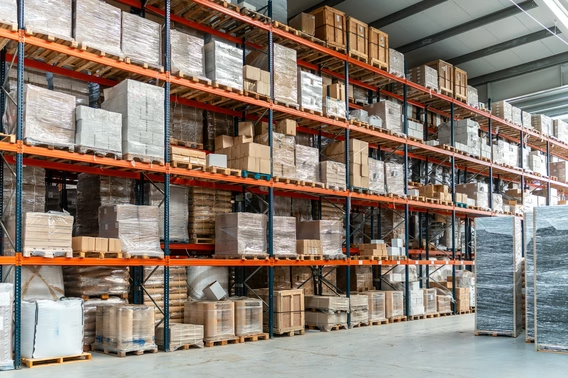

Most of what a North Carolina distributor owns did not come through a North Carolina port. It came through Savannah, or Charleston, or Norfolk, and then it drove — up I-95, across I-40, along I-85 — before it ever reached a dock the business actually controls. Wilmington and Morehead City are real gateways, and the ports authority runs an inland terminal at Charlotte to connect them to the largest metro. But the honest picture is that a great deal of this state’s import volume arrives overland, and the goods belonged to the distributor for the whole of that journey.
That single fact reorganizes the insurance program. The exposure is not concentrated where an underwriter can walk it. It is spread across a rail move, a drayage leg, a transload, and a few hundred miles of interstate — none of which is a scheduled location, and none of which a commercial property policy follows. The building matters. It is just not where the goods spend most of their vulnerable life.
The state adds two structural facts a distributor should know before anything else. The ABC Commission is the spirits wholesaler — the state occupies that tier itself — while retail runs through independent local ABC boards, not the state. And pharmaceutical distribution is licensed by an agriculture agency rather than a pharmacy board. Neither is trivia; both change who inspects you and what you can actually own.
The legs nobody schedules
Stock throughput is one marine-family policy that follows your owned goods across the whole span — the foreign supplier, the ocean crossing, the port, the inland move, the warehouse, and the customer. For a North Carolina wholesaler the important part of that list is the middle: the leg between somebody else’s port and your own dock.
Consider what the conventional structure actually does with that leg. A commercial property policy insures owned inventory while it sits in a scheduled building. A cargo policy insures it while it moves. Between them are seams — the terminal, the transload, the third-party facility where a container waited three days — and North Carolina’s freight pattern puts an unusual share of the journey inside those seams, because the journey starts in another state. Stock throughput closes them on one form. It is a largely manuscript, non-standard market rather than an off-the-shelf product, which means the wording is negotiated: an advantage when someone reads it, a liability when nobody does.
And the question that decides everything: when did the risk of loss actually pass to you? Your purchase terms may hand you ownership at the foreign supplier’s dock, at the port of loading, or on arrival. If your coverage starts at your warehouse and your risk started at a factory gate overseas, there is a very long stretch of water and highway where your own inventory was traveling uninsured by you.
A state that wholesales spirits and lets counties run the stores
North Carolina is a control state, and it is precise about where the control sits. The ABC Commission is the wholesale distributor of spirits: suppliers ship to the state warehouse, and product goes out from there. There is no private spirits wholesale tier to occupy.
But the retail end is not the state’s either. It belongs to local ABC boards — independent political subdivisions appointed by counties and cities, which operate the stores. That is a genuinely distinctive structure: a state that takes the wholesale tier for itself and hands the retail tier to local government, and it means the counterparties in the spirits chain here are public bodies at both ends.
Beer and wine are a different world entirely, and it is the world a private beverage distributor in this state actually lives in. Private licensed wholesalers buy from the producer, warehouse the product, and sell it to licensed retailers — which makes the inventory theirs at every step. That is a wholesale risk in the full sense: owned stock, on a balance sheet, on a truck, and in the products chain.
An agriculture agency licenses the drug warehouse
The Drug Program inside the Food and Drug Protection Division of the Department of Agriculture and Consumer Services licenses drug wholesalers, repackagers, reverse distributors, and third-party logistics providers — not the Board of Pharmacy, which handles pharmacy, device, and medical-equipment permits instead. The same division carries the food side. For a distributor here, the agency inspecting the warehouse is an agriculture agency.
It is worth pausing on why the 3PL gets a license of its own. It is because a 3PL warehouses drugs without taking ownership of them — the state drew the whose-goods line in a licensing scheme. Which tells you exactly where you stand if you are reading this page: you buy the product, you own it, you sell it. You are on the owner side of a line the state itself found necessary to draw.
The water does not stop at the coast
North Carolina is the state that proved inland flooding is not a coastal problem. Hurricane and tropical wind take the coastal plain and the roof planes of warehouses near Wilmington — that part everyone expects. The more instructive losses came from rainfall: first the eastern river basins, and then Helene tearing through the mountain corridor around Asheville, hundreds of miles from salt water.
The consequence for an owner of inventory is uncomfortable and simple. Flood is its own placement, everywhere in this state, and a distributor in the Piedmont or the mountains cannot treat it as a coastal problem. Water arrives at floor level, and floor level is where the pallets are. In between, convective wind, hail on wide roofs, and tornado are the routine perils, and winter ice periodically closes the I-40 and I-77 corridors. Commercial property is the right instrument for the building, the racking, the owned stock that stays put, and the business income lost while a site is down — and it is not the instrument for water that came up rather than in.
The chain reaches a seller
A distributor who never made anything can still be sued over what it sold. Products liability follows the chain of distribution, and a claim can reach a seller in that chain, not only the manufacturer.
In North Carolina the sharpest version is the imported medical device or component — the Triangle’s distribution economy is full of them — where the distributor is the first U.S. seller and the maker is overseas. General liability answers this through what the standard form calls the products-completed-operations hazard, and the honest work is sizing those limits against what the product actually does in the world rather than against a revenue figure. A device that goes into a person is not a case of building materials, and no revenue band knows the difference.
The crew, the fleet, and the limits above them
Workers’ compensation is a private-market line administered by the North Carolina Industrial Commission. The exposure is the standard warehouse set — powered-industrial-truck strikes, dock and trailer falls, racking collapse and falling stock, lifting and repetitive strain on the pick line — with a heavier furniture and appliance component around the Triad, where the unit loads are bulky and awkward and two-person handling injuries are common.
The route fleet needs commercial auto, and this trade requires a word of care: your insurance carrier is the company that writes your policy, which is not the same thing as a motor carrier or freight carrier hauling goods for hire. Confusing them in a contract discussion is expensive. And when a national customer or a landlord pushes the contract limits past the primary lines, umbrella liability is where the requirement gets satisfied — and where a serious highway loss eventually lands.
What underwriters ask a North Carolina distributor
We do not print premiums, and any site that does is guessing. Here is what actually drives the conversation:
- Where your goods enter the country, and how far they travel overland before they reach a building you control.
- Where the risk of loss passes under your purchase terms — the single most misunderstood item on the list.
- The product, and what it does — devices, consumables, and furniture are three different products conversations.
- Flood siting, in the mountains and the Piedmont as much as on the coastal plain.
- Temperature dependence in the pharmaceutical and food chains, where an excursion destroys value without damaging anything.
- Peak single-site accumulation, and the payroll split between the warehouse crew and the route drivers.
Where North Carolina’s owned inventory concentrates
Charlotte
The state’s largest metro and the inland terminal the ports authority runs to connect it to the water. Consumer and financial-sector distribution concentrates here, and a distributor’s owned stock typically arrives by rail or truck from a coastal port in another state — which means the expensive part of its journey happened before it ever reached a building an underwriter can inspect.
Greensboro and the Piedmont Triad
Where I-40 and I-85 meet, which is why the Triad became the natural crossroads for distribution space. An owner of inventory here is deliberately central rather than close to any one market, so the stock spends more of its life on the interstate than on a rack — a transit exposure that a scheduled-location property policy does not follow.
High Point
Furniture and home goods. The unit loads are bulky and awkward and the value density is deceptive — a distributor’s owned furniture inventory occupies a great deal of cube for its value, which means a fire or water loss reaches a large share of the stock at once even when the dollar concentration looked modest on the schedule.
Raleigh and Durham
The Research Triangle pulls pharmaceutical, biotech, and medical-device distribution, which is a cold-chain and high-value business. A wholesaler here can hold temperature-controlled owned stock whose value is destroyed by an excursion rather than by damage — and a distributor of an imported device is a first U.S. seller sitting directly in the products-liability chain.
Winston-Salem
Industrial, food, and consumer wholesaling in the Piedmont, where convective wind and hail on wide roof planes are the routine property loss. Hail does not level a building; it bruises a membrane, and the water arrives on the racking with an owner’s season underneath it — which is a stock loss dressed up as a roof claim.
Wilmington
The state’s container port, and an honest one: a working port rather than a mega-gateway. An importer landing goods here owns them from the foreign supplier onward, and the exposure begins wherever the purchase terms say risk of loss passed — very often at a dock on the other side of an ocean, not at this one.
Fayetteville
Coastal-plain distribution on I-95, where tropical wind and rainfall both reach a warehouse roof and a dock door. Flood is its own placement everywhere in this state, and on the coastal plain the elevation of the floor slab under a distributor’s owned inventory is a more consequential number than most owners realize.
Asheville and the mountain corridor
The reason no distributor in North Carolina can treat flood as somebody else’s problem. Helene tore through this corridor hundreds of miles from salt water, and the losses were rainfall losses. Owned inventory sitting on a warehouse floor in the mountains is exposed to a peril the property policy does not carry.
If the goods are not yours, you are on the wrong page
An honest signpost. This page is for the business that owns what it stores. If your operation holds other companies’ freight for a fee — the contract and public warehouses along I-85 and I-40, the cold houses tied to poultry and food processing in the east, or a licensed third-party logistics provider storing drugs it does not own — then your inventory is not owned stock at all. It is a bailment, and your lead line is warehouse legal liability, which turns on your storage contract and your warehouse receipt rather than on your purchase terms. That is a different risk with a different policy stack, and it has its own page: warehouse insurance in North Carolina.
Many businesses here do both — they distribute their own product and warehouse someone else’s alongside it. If that is you, we place both, and we draw the line between them before anything binds.
North Carolina distributor and wholesaler insurance FAQs
My goods come from Savannah or Norfolk, not a North Carolina port. Does that change my coverage?
It changes where the risk actually sits, which is the whole point. A North Carolina distributor is more often an inland wholesaler than a port importer, and the goods it owns tend to arrive overland from Savannah, Charleston, or Norfolk before they ever reach its dock. So the owned-inventory exposure is concentrated in the trucking and rail legs and in the warehouse itself, rather than in an ocean move the company can watch from its own window. That is a case for stock throughput, not against it: a policy that only covers your product inside a scheduled building leaves the entire inland journey uninsured by you — the drayage move off the terminal, the rail leg, the transload, and the run up I-95 or I-85. The goods were yours for all of it.
Can a private company distribute spirits in North Carolina?
No. North Carolina is a control state, but the control sits in an unusual place. The ABC Commission is the wholesale distributor of spirits: suppliers ship to the state warehouse and product goes out from there. Retail, though, is not run by the state — it is run by local ABC boards, which are independent political subdivisions appointed by counties and cities, and they operate the stores. So the state occupies the spirits wholesale tier itself while pushing retail down to local government. Beer and wine are an entirely different world, moving through private licensed wholesalers, and that is where a private beverage distributor in this state actually lives. If you are that distributor, the inventory is genuinely yours — bought, warehoused, and resold — which is why it is a stock-throughput and products exposure rather than a storage one.
Why would an agriculture department license my drug distribution business?
Because North Carolina puts pharmaceutical distribution licensing somewhere almost no other state does. The Drug Program inside the Food and Drug Protection Division of the Department of Agriculture and Consumer Services licenses drug wholesalers, repackagers, reverse distributors, and third-party logistics providers — not the Board of Pharmacy, which handles pharmacy, device, and medical-equipment permits instead. The same division carries the food side. For a distributor, the practical consequence is that the agency inspecting your warehouse is an agriculture agency. It is also a useful reminder of the line this whole page turns on: the state licenses the third-party logistics provider separately precisely because a 3PL warehouses drugs without taking ownership of them. If you own what you distribute, you are on the other side of that line.
Is flood really a concern for a warehouse in the Piedmont or the mountains?
North Carolina is the state that proved inland flooding is not a coastal problem. Hurricane and tropical wind take the coastal plain and the roof planes of warehouses near Wilmington, but the more instructive losses have come from rainfall — first the eastern river basins, and then Helene tearing through the mountain corridor around Asheville, hundreds of miles from salt water. Flood is a separate placement everywhere in this state, and a distributor in the Piedmont or the mountains cannot assume it is somebody else’s problem. For an owner of inventory the exposure is unforgiving: water arrives at floor level, and floor level is where the pallets are.
I only distribute the product. Can I still be sued over it?
Yes. Products liability follows the chain of distribution to a seller, not only to the manufacturer who made the thing — and North Carolina distributors hold a great deal of stock that somebody else built. The exposure is sharpest for an importer: a distributor of an imported medical device or component is frequently the first U.S. seller of it, and when the overseas maker is beyond the practical reach of a U.S. claim, the importer becomes the realistic target. Standard general liability answers this through the products-completed-operations hazard. The work worth doing is sizing those limits against the product you actually handle — a device implanted in a person and a case of building materials are not the same conversation — rather than against a revenue band.
What does workers compensation look like for a North Carolina distribution business?
It is written in the private market and administered by the North Carolina Industrial Commission — no state fund, no election out. The exposure is the standard warehouse set: powered-industrial-truck strikes, dock and trailer falls, racking collapse and falling stock, and lifting and repetitive strain on the pick line. The state adds one of its own around the Triad, where the furniture and appliance component means the unit loads are bulky and awkward and two-person handling injuries are common. And remember that a distribution business carries the exposure twice — the warehouse crew is one injury population and the route drivers loading and unloading all day are another.
Get a North Carolina distributor insurance quote
Quotes in 1–2 hours during business hours.