
States we serve · Tennessee
Warehouse business insurance in Tennessee
For the 3PL, contract, parcel-adjacent, and controlled-temperature operators at the Memphis inland gateway and the Nashville crossing — holding medical devices, e-commerce stock, and retail freight that belongs to companies headquartered somewhere else.
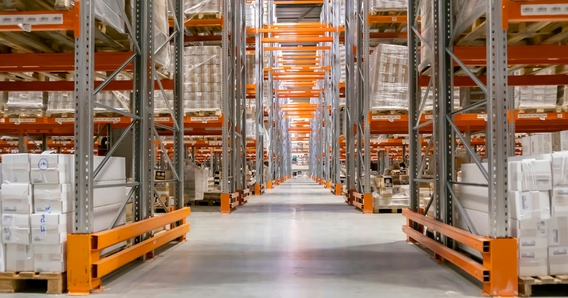

Tennessee may be the purest bailee state in the country. Not the biggest, not the busiest — the purest. The Memphis model is built, from the ground up, on holding other people’s goods: parcel and air-freight inventory, medical devices and pharmaceuticals staged for overnight national delivery, retail and e-commerce stock owned by companies headquartered somewhere else entirely. An air hub, five Class I railroads, and a working river port sit in one city, and everything that passes through them is on its way to somebody who does not live here.
There is no seaport in this state and there does not need to be. This is an inland gateway built on air, rail, river, and interstate, and a distribution center in Memphis can reach an enormous share of the country overnight by truck and effectively all of it overnight by air. Which is why the buildings filled up — and why almost nothing in them belongs to the people who run them.
Whose goods, whose policy
Taking in another company’s freight makes you a bailee. You hold property that is not yours and you answer for it while it is in your care, custody, and control. A fire in a rack aisle, a sprinkler discharge over a pallet of devices, a theft off a trailer in the yard, a temperature excursion in a controlled room — in every case the destroyed property is your customer’s, and your general liability policy will not pay for it.
That is not an oversight; it is the form working exactly as designed. A standard general liability policy excludes damage to personal property in your care, custody, or control — which is a precise description of the entire contents of a Memphis distribution building. The loss you fear most is carved out of your foundation policy by its own terms. Warehouse legal liability exists to answer precisely what that exclusion removes, and in a state this thoroughly built on custody it is not a supplementary line. It is the program.
Nothing in the Tennessee statute book will size it for you. The Department of Agriculture licenses and bonds commodity dealers and warehousemen, with the license posted at each location where the licensee buys or stores commodities — a real, functioning license tied to the state grain indemnity structure, and one that does not come near a fulfillment building. Outside commodities, the warehouse receipt and the storage agreement are the only instruments that define what you owe.
Racking on the New Madrid
Now the fact that surprises everyone who has not worked here. Memphis sits inside the New Madrid seismic zone — the most active seismic region east of the Rockies — and USGS work on Memphis specifically flags liquefaction risk on the ground along the Mississippi and the Wolf.
For a warehouse, the seismic story is not really the building. It is the racking. Tall, heavily loaded selective racking is what fails in a shake, and what it fails onto is a floor covered in somebody else’s inventory and staffed by your own people. A rack collapse is a bailee loss and a workers compensation loss in the same second, and the property damage to your steel may be the smallest of the three numbers. Earthquake is a separate placement from the commercial property policy, and in west Tennessee it is not an academic one — the rack design, the anchorage, the seismic detailing, and the load configuration are underwriting questions here in a way they simply are not one state over.
The rest of the peril map is ordinary by comparison and still consequential: Tennessee is a genuine tornado and severe-convective state through the middle, hail takes wide roof planes, and Mississippi River and flash flooding is a real and separate flood exposure at Memphis.
The statute that says “without taking ownership”
Tennessee wrote our whole business model into its pharmacy rules, and it is worth reading slowly. The Board of Pharmacy licenses third-party logistics providers separately from wholesale distributors, defines a 3PL as an operation that warehouses drugs without taking ownership of them, requires a separate license for each location, and requires the warehouse to be inspected before it may provide services. A company doing both must hold both licenses.
That definition is care, custody, and control in statutory language. The state is licensing you because the goods are not yours, it wants a license per building, and it will not let you start until an inspector has walked the floor. Cold and controlled-temperature storage tied to healthcare distribution is a real and demanding piece of the Memphis trade — and a temperature excursion in a bailee’s building spoils the customer’s product, not the operator’s. Which is the whole point of the coverage above.
The sorter, and the shift that runs at night
Tennessee has a private workers compensation market, administered by the Bureau of Workers’ Compensation inside the Department of Labor and Workforce Development. The loss set here skews toward the sortation and parcel end of the trade in a way that no other state in this region does: conveyor and sorter entanglement and pinch injuries, repetitive lifting and reaching on high-speed lines, and night-shift fatigue on hubs that run when everyone else is asleep — alongside the usual powered-industrial-truck strikes, dock falls, and stock coming down out of racking.
An operation whose peak hours fall between midnight and dawn is not a day-shift warehouse with a different roster. The injuries are different, the response times are different, and the supervision is thinner. Underwriters know it, and it is worth having an answer ready.
Duty and time on inland-held inventory
Memphis carries the state’s serious foreign-trade zone activity, and it is an air-and-river zone rather than a seaport one — the duty-deferral logic attaches to goods arriving by freighter aircraft and by barge, and to the enormous inventory of imported parts and consumer goods held in Memphis warehouses for national distribution. Zone coverage also reaches the Nashville and Chattanooga areas.
So bonded storage in Tennessee is about time and duty on inland-held inventory, not about a container yard at the ocean. Admit duty-deferred goods and you carry customs-bonded obligations on top of your ordinary duty of care to the owner: two masters over the same pallet, and a shortage that stops being an awkward phone call and becomes a formal one. That is the operating model the warehouse insurance program is built around — the building is yours, the goods are not, and sometimes the goods answer to a third party neither of you has met.
What underwriters weigh on a Tennessee bailee risk
No figures on a web page. What actually moves the placement:
- The value of customers’ goods in your care — the number that sizes the bailee limit and the one owners understate most reliably, because none of it is on their balance sheet.
- Racking, anchorage, and seismic detailing, particularly in and around Memphis, where earthquake is its own placement.
- License status — a 3PL license per location, with the floor inspected before you may provide services.
- Temperature control and its backup, where a warm room is a total loss on the customer’s side and nothing at all on yours.
- Shift structure and automation — sorters, conveyors, and a workforce running through the night.
- Claims history, which moves pricing more than most of this list combined.
Major Tennessee warehouse markets
Memphis
An air hub, five Class I railroads, and a working river port on the Mississippi, all in one city — and a foreign-trade zone that is an air-and-river zone rather than a seaport one. A bailee here holds imported parts and consumer goods for national distribution, and the duty-deferral logic attaches to goods that arrive by freighter aircraft and by barge. It is also the city sitting inside the New Madrid seismic zone, which makes the racking a structural question rather than a shelving one.
The Memphis distribution ring
Where medical devices, pharmaceuticals, and high-value time-critical stock are staged for overnight delivery. Time-definite custody is unforgiving: the customer’s damage is measured against a delivery clock, not against a replacement invoice, and a night that goes wrong in a bailee’s building becomes somebody else’s missed surgery schedule.
Nashville
Where I-40, I-65, and I-24 cross — the highway crossroads of the eastern half of the country — pulling consumer, healthcare-supply, and automotive distribution off the interchange. Mixed-customer contract buildings here hold several bailments under one roof, each with its own storage agreement and its own limitation-of-liability terms, all exposed to the same fire.
Chattanooga
I-75 traffic and the southeastern gateway, with zone coverage of its own. Custody at a rail-to-truck transfer is the ambiguous kind — the goods have already changed hands once, and the question of who held them when they were damaged is exactly the question a bailee claim turns on.
Knoxville
The I-81 and I-75 junction in the east, holding freight moving between the Southeast and the mid-Atlantic. Tornado and severe-convective wind reach this part of the state, and a wide roof plane over somebody else’s inventory is the shape those storms punish.
Murfreesboro
Automotive parts warehousing behind the assembly plants across the middle of the state. Inbound parts custody runs to a plant’s clock: a fire or a storm does not merely destroy components in your care, it stops a line, and the customer’s loss is not the value of what burned.
Jackson and Clarksville
Regional distribution between the two big markets, serving national networks rather than local consumption. A building here is chosen for its drive time, which means its customers are distant, its contracts were drafted elsewhere, and its warehouse receipt is the only document in the room that speaks for the operator.
If the goods are yours, you are on the wrong page
A signpost before the questions. This page is for the operator holding other people’s property. If your Tennessee business buys, holds, and resells its own stock — a wine and spirits wholesaler licensed by the state commission, a beer distributor answering to a patchwork of local beer boards, or an automotive parts, healthcare products, appliance, or building-products wholesaler — then your inventory is not a bailment at all. Your goods usually arrive by rail intermodal, by truck from a coastal port, or by air into Memphis, so the risk runs across the inland legs and the transloads long before your dock, which is a stock throughput conversation rather than a warehouse legal liability one — and importing a finished good through Memphis air freight often makes you the first U.S. seller in the products-liability chain. That has its own page: distributor and wholesaler insurance in Tennessee.
Plenty of Tennessee operators do both. If yours does, we place both halves — the distribution operation running your own product to market and the wholesale operation buying and reselling it — and the seam between what you hold and what you own is the first thing we map.
Tennessee warehouse insurance FAQs
Does Tennessee license public warehouses?
It licenses warehousemen in the agricultural commodity sense, and that is the whole of it. The Department of Agriculture licenses and bonds commodity dealers and warehousemen, and the license must be posted at each location where the licensee buys or stores commodities — a real, functioning warehouse license tied to the state grain indemnity structure. It does not reach general merchandise warehousing. The enormous distribution and fulfillment economy around Memphis and Nashville operates under contract and warehouse receipt, not a state warehouse license, which means the storage agreement is the only instrument defining what an operator owes for a customer’s goods.
What actually covers the goods in my building if they are not mine?
Warehouse legal liability — the bailee line, and it leads every Tennessee program. Taking in another company’s freight makes you a bailee: you hold property that is not yours and you answer for it while it is in your care, custody, and control. Your general liability policy will not do that job, because a standard form excludes damage to personal property in your care, custody, or control — which is a precise description of the entire contents of a Memphis distribution building. The loss you fear most is carved out of your foundation policy by the form’s own terms, and warehouse legal liability is written to answer exactly what that exclusion removes.
Is earthquake really a Tennessee warehouse exposure?
It is, and most people do not expect it. Memphis sits inside the New Madrid seismic zone — the most active seismic region east of the Rockies — and USGS work on Memphis specifically flags liquefaction risk on the ground along the Mississippi and the Wolf. For a warehouse the seismic story is not really the building. It is the racking: tall, heavily loaded selective racking is what fails, and what it fails onto is a floor full of somebody else’s inventory and somebody else’s employees. Earthquake is a separate placement from the property policy, and in west Tennessee that placement is not a theoretical exercise. The rack design, the anchorage, and the load configuration are underwriting questions here in a way they are not in a neighbouring state.
Tennessee licenses third-party logistics providers. What does that mean for me?
It means the state has written your job description into law. The Board of Pharmacy licenses third-party logistics providers separately from wholesale distributors, defines a 3PL as an operation that warehouses drugs without taking ownership of them, requires a separate license for each location, and requires the warehouse to be inspected before it may provide services. A company doing both must hold both licenses. Read that definition again: without taking ownership. That is care, custody, and control, in a statute — the state is licensing you precisely because the goods are not yours, and it will not let you begin until it has walked your floor.
What are the workers compensation exposures in a Tennessee warehouse?
Tennessee has a private workers compensation market, administered by the Bureau of Workers’ Compensation inside the Department of Labor and Workforce Development. The loss set here skews toward the sortation and parcel end of the trade — conveyor and sorter entanglement and pinch injuries, repetitive lifting and reaching on high-speed lines, and night-shift fatigue on hubs that run when everyone else is asleep — alongside the usual powered-industrial-truck strikes, dock falls, and stock coming down out of racking. That night-shift profile is genuinely distinctive: an operation whose peak hours are between midnight and dawn is not a day-shift warehouse with a different roster, and it does not price like one.
What does bonded storage mean in a state with no seaport?
It means time and duty on inland-held inventory, rather than a container yard at the ocean. Memphis carries the state’s serious foreign-trade zone activity, and it is an air-and-river zone: the duty-deferral logic attaches to goods arriving by freighter aircraft and by barge, and to the enormous inventory of imported parts and consumer goods held in Memphis warehouses for national distribution. Zone coverage also reaches the Nashville and Chattanooga areas. When your building admits duty-deferred goods you take on customs-bonded obligations on top of your ordinary duty of care to the owner — two masters over the same pallet, and a shortage that becomes a formal problem rather than an awkward call.
Get a Tennessee warehouse insurance quote
Quotes in 1–2 hours during business hours.