
States we serve · Texas
Warehouse business insurance in Texas
For the public, 3PL, contract, bonded, and cold-storage operators who hold other companies’ freight — from the Houston ship channel to the Laredo crossing and the distribution belt in between. The goods under your roof are not yours, and that is the whole risk.
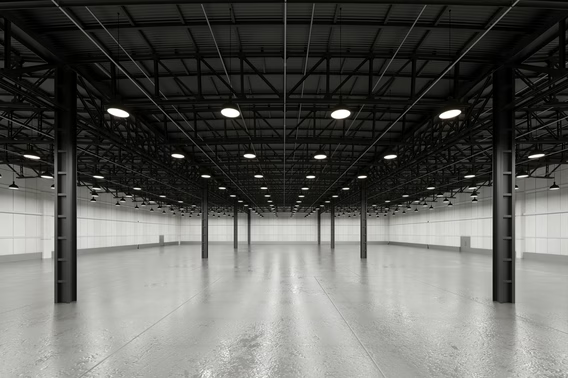

A Texas warehouse operator runs a building full of things that belong to someone else. That single fact — not the square footage, not the throughput, not the number of doors — is what your insurance program has to answer for, and Texas arranges it in a way no other state does. You are holding other companies’ freight at the mouth of a Gulf seaport, at a land border with Mexico, and along the densest inland distribution belt in the country. And you are doing it without a license.
That last part is worth sitting with, because owners routinely assume the opposite. Texas has no statewide public-warehouse license for a general-merchandise, fulfillment, or third-party logistics operation. The Texas Department of Agriculture licenses public grain warehouses, and that program is explicitly grain-only; a separate chapter reaches operators storing cotton, wheat, rye, oats, grapes, rice, or produce and sends them to the county clerk for a certificate and a bond. Neither one touches a contract warehouse in Grand Prairie or a fulfillment building in Schertz. So there is no state license to lose, no regulator to answer to, and no statutory standard of care handed to you. Your perimeter is the bailment — the warehouse receipt you issue and the storage agreement you signed — and nothing else.
Which means the paperwork is the policy. Everything below follows from it.
Warehouse legal liability: the line that answers for goods that are not yours
The defining exposure of a Texas bailee is a loss to a customer’s goods while they sit in your care, custody, and control. A fire in a rack aisle. A sprinkler head that lets go over a pallet of electronics. A theft from a trailer in the yard. A cold-chain drift that quietly ruins a produce load crossed up from the Valley. In every one of those, the damaged property belongs to your customer — and your general liability policy will not pay for it.
That is not an oversight; it is the form working as designed. A standard general liability policy excludes damage to personal property in your care, custody, or control, and the freight you store is precisely that. The loss you worry about most is carved out of your foundation policy by its own terms. Warehouse legal liability exists to answer exactly what that exclusion removes, and for a Texas operator it leads the program — ahead of the building, ahead of everything.
Because Texas hands you no statutory standard, the shape of your liability is whatever your contracts say it is. Warehouse receipts and storage agreements typically carry limitation-of-liability language — a released-value or per-package cap that limits what you owe unless the customer declares a higher value and pays for it. Whether your customers accepted that limit, negotiated it away, or never read it changes the exposure your policy is being asked to size. We read those terms against the coverage before binding, because in a state with no license, the storage contract is the regulation.
The building, the racking, and the goods that are actually yours
Set against the customers’ goods is the much smaller set of things a warehouse operator genuinely owns: the building, the racking and material-handling systems, and the business income that stops when the facility does. That is commercial property, and keeping it clean in your head is the discipline this whole trade runs on. Property covers what is yours and stays put. Warehouse legal liability covers what is theirs and sits in your care. They are not substitutes and they do not overlap, and a Texas operator who buys a generous property limit while carrying a thin bailee limit has insured the cheap half of the building.
The racking deserves its own sentence. A rack collapse is a property loss and a bailee loss in the same instant — your steel, someone else’s inventory on the floor underneath it — and the two lines answer separately for the two halves of the same event. This is the operating model we build the warehouse insurance program around: the building is yours, the goods are not, and the program has to know the difference.
The non-subscriber decision, on a floor full of forklifts
Texas is the national exception on workers compensation: it is elective for most private employers. An employer that declines it becomes a non-subscriber, must tell its employees, and must report injuries to the Division of Workers’ Compensation. Owners hear “optional” and think “savings.” The trade-off is severe, and on a warehouse floor it is close to reckless to make casually.
A non-subscriber gives up the common-law defenses that would otherwise blunt an injury suit — contributory negligence, assumption of risk, and the fellow-employee defense. Now look at what actually happens in your building: a powered industrial truck strikes a picker, someone falls from racking, a load shifts on a dock plate, a picker tears a shoulder in a pick module. Inside the comp system those are claims in a no-fault channel. Outside it, they are negligence lawsuits against your business, argued to a jury, with your defenses stripped away before you start. Subscribing keeps injuries in the comp channel. Not subscribing puts the warehouse itself in front of a jury — and many of your 3PL customers will require comp regardless of what the state lets you do.
Bonded and foreign-trade-zone custody: answering to two masters
Texas is a double gateway, and its foreign-trade zones show it. The Houston zone, granted to the Port of Houston Authority, anchors seaborne and petrochemical cargo. The Laredo zone, granted to the City of Laredo, anchors the land border, where goods cross by truck and rail rather than by ship. Zones also serve Dallas–Fort Worth, San Antonio, El Paso, and Corpus Christi.
For a bailee this is not a trivia item. When you admit duty-deferred goods, you take on customs-bonded obligations on top of your ordinary duty of care to the owner. Over the same pallet you now answer to two masters: the customer whose freight it is, and a customs regime that has not yet been paid. A shortage that would be an unhappy phone call in an ordinary warehouse becomes something considerably more formal when the goods were never entered.
The one place Texas does license the building is food. The Texas Department of State Health Services licenses food manufacturers, food wholesalers, and warehouse operators — so a food-grade warehouse is a licensed premises even though a general warehouse across the street is not. A cold-storage bailee holding food is therefore holding regulated goods on someone else’s behalf, which is a meaningfully different posture from holding dry consumer freight.
What actually drives the cost of warehouse coverage in Texas
We do not quote numbers on a web page, and any site that does is guessing. What we can tell you is what underwriters actually look at for a Texas bailee, roughly in order:
- The value of the goods in your care — not your own assets. This is the number that sizes your warehouse legal liability limit, and it is the one owners most often understate because the inventory is not on their balance sheet.
- What you store, and at what temperature. Dry consumer goods, high-theft electronics, food under refrigeration, and bonded import cargo are four different risks in the same building shell.
- Your contracts. The limitation-of-liability language in your warehouse receipt, and whether your 3PL agreements have negotiated it away.
- Where the building sits. Coastal wind at Houston or Corpus Christi, hail through the I-35 corridor and Dallas–Fort Worth, and flood proximity near the ship channel are three separate conversations.
- The comp decision and your material-handling payroll — subscriber or non-subscriber, and how the forklift and dock exposure is managed.
- Claims history over the last several years, which moves pricing more than almost anything else on this list.
Major Texas warehouse markets
Houston and the ship channel
The deep-water seaport and the petrochemical export complex, where the foreign-trade zone granted to the Port of Houston Authority puts duty-deferred cargo inside private warehouses. A bailee here holds bonded goods and project cargo, so a customs obligation sits on top of the ordinary duty of care — and a named storm arriving off the Gulf threatens a large uplift surface with a customer’s freight underneath it.
Laredo and the land border
The crossing where truck and rail freight from Mexico enters the United States, under a zone granted to the City of Laredo. Cross-border consolidation and deconsolidation is its own trade: goods land in a warehouse that never owns them, are broken down, re-sorted, and pushed north. Custody changes hands repeatedly, and every handoff is a place a bailee claim can start.
Dallas–Fort Worth
Where I-35 splits and I-20, I-30, and I-45 converge alongside Class I intermodal yards and heavy air cargo. It is the densest contract- and third-party-warehouse cluster in the state — and it sits in the hail belt, which is the quieter and more expensive peril: hail does not level a building, it bruises an entire membrane roof plane, and the water afterwards finds the racking and the goods below.
San Antonio and the I-35 corridor
The inland consolidation belt between the border and the metroplex, where cross-border manufacturing staging turns into national replenishment space. Warehouses here take custody of freight mid-journey rather than at either end, which puts the storage agreement and its limitation-of-liability language — not a state license — at the center of any claim.
El Paso
The far-west crossing on I-10, a second land-border gateway with its own foreign-trade zone activity. A bailee operating here is holding goods that are mid-import for a customer who owns them, and the customs-bonded obligations attach to the warehouse that admits them.
Corpus Christi and the coastal bend
Energy and project-cargo storage on the Gulf, where industrial freight is held for others and named-storm wind and surge are underwriting facts rather than abstractions. Flood belongs in its own placement here, not in the property policy — a distinction that matters when the goods on the floor belong to a customer.
Austin
A fast-growing consumer population driving e-commerce fulfillment and regional replenishment space north of the I-35 split. Fulfillment bailment is high-velocity and unit-level: thousands of small customer-owned items moving daily, where the loss is rarely one catastrophic event and often an accumulation of shrink, mis-ships, and handling damage.
The Rio Grande Valley
Produce and food crossing north into cold storage, tying the border trade to the cold chain. Refrigerated bailment fails differently from dry: the building never burns, the temperature simply drifts, and a customer’s perishable load is a total loss with the racking untouched.
If the goods are yours, you are on the wrong page
One honest signpost before the questions. This page is written for the operator who holds other people’s freight. If your business buys, holds, and resells its own product — a beverage or food distributor working under a Texas Alcoholic Beverage Commission permit, a merchant wholesaler, or an importer bringing owned stock across at Laredo — then your inventory is not a bailment at all, and your program leads from stock throughput and products liability rather than from warehouse legal liability. That is a genuinely different risk with a genuinely different policy stack, and it has its own page: distributor and wholesaler insurance in Texas.
Plenty of Texas businesses do both. If yours does, we place both sides — the distribution operation that runs your own product to market and the wholesale operation that buys and resells it — and the seam between them is the first thing we map.
Texas warehouse insurance FAQs
Does Texas require a license to operate a public warehouse?
No — and it is a genuinely useful negative. Texas has no statewide public-warehouse license for a general-merchandise, fulfillment, or third-party logistics operation. What the state licenses is agricultural: the Texas Department of Agriculture licenses public grain warehouses, and that program is explicitly grain-only. A separate chapter covering operators who store cotton, wheat, rye, oats, grapes, rice, or produce routes them to the county clerk for a certificate and a bond rather than to a state license. So an ordinary Texas warehouse holds no state warehouse license at all, and the duty of care is set by the bailment and by your warehouse receipt and storage contract — not by a license the state could suspend.
If the goods in my warehouse are not mine, what actually covers them?
Warehouse legal liability — the bailee line, and the reason this page leads with it. When you take in a customer’s freight you become a bailee: you hold property that is not yours and you answer for it while it is in your care. Your general liability policy will not do this job, because a standard form excludes damage to personal property in your care, custody, or control, and the customers’ goods you store are exactly that. The loss a Texas warehouse worries about most — a fire, a sprinkler discharge, a theft, or a cold-chain failure in someone else’s inventory — is carved out of general liability by that exclusion, and warehouse legal liability is written precisely to answer for it.
Is workers compensation required for a Texas warehouse?
Texas is the national exception: workers compensation is elective for most private employers, and an employer that declines it — a non-subscriber — must tell its employees and report injuries to the Division of Workers’ Compensation. The trade-off is severe and often misunderstood. A non-subscriber loses the common-law defenses that would otherwise blunt an injury suit, including contributory negligence, assumption of risk, and the fellow-employee defense. On a warehouse floor that matters enormously, because the routine injuries here — a powered industrial truck striking a picker, a fall from racking, a load shifting on a dock plate, a lifting strain in a pick module — stop being claims inside a no-fault system and become negligence lawsuits against the business.
What does bonded or foreign-trade-zone storage add to my exposure?
Texas is a double gateway, and its zones show it: the Houston zone granted to the Port of Houston Authority anchors seaborne cargo, and the Laredo zone granted to the City of Laredo anchors the land border, with zones also serving Dallas–Fort Worth, San Antonio, El Paso, and Corpus Christi. Bonded storage is not a theoretical category in this state — duty-deferred goods sit in Texas warehouses on both the ocean side and the border side. A warehouse that admits them takes on customs-bonded obligations alongside its ordinary duty of care to the owner of the goods. You are answering to two masters over the same pallet: the customer whose freight it is, and the customs regime that has not yet been paid.
Do the limitation-of-liability terms on my warehouse receipt actually protect me?
They are the perimeter around a claim, which is exactly why they deserve reading before a loss rather than during one. Because Texas licenses no general public warehouse, your exposure is contractual and common-law rather than regulatory: the warehouse receipt, the storage agreement, and the limitation of liability inside it are what a claim for a customer’s damaged goods will be argued against. Those terms and the coverage you buy are one decision, not two. We do not quote a figure here, because the limits live in your contracts rather than in any rule of thumb — the point is that a limitation your customers have accepted, or refused, changes the exposure your policy is being asked to size.
Which Texas perils actually threaten a warehouse building?
Texas stacks perils that each attack a distribution facility differently. The Gulf coast — Houston, Beaumont, Corpus Christi — carries named-storm wind and surge, and a big-box roof is a large uplift surface with very little to break the wind. Inland, the hail belt through Dallas–Fort Worth and the I-35 corridor is the quieter and more expensive story: a hailstorm bruises an entire membrane roof plane over a warehouse full of goods, and the water finds the racking afterwards. Tornado exposure runs across the north of the state, and hard statewide freezes stress sprinkler piping and cold-chain rooms at once — a cargo loss and a property loss in the same event. Flood belongs in its own placement rather than the property policy, and near the ship channel that placement is not optional in practice.
Get a Texas warehouse insurance quote
Quotes in 1–2 hours during business hours.