
States we serve · Virginia
Distributor and wholesaler business insurance in Virginia
For the importers, merchant wholesalers, and food and building-products distributors who take title to goods arriving through Norfolk and carry them the length of the Commonwealth before anyone buys them.
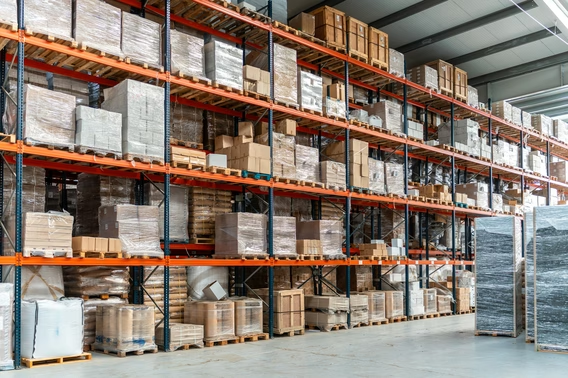

A Virginia distributor is very often an importer, and an importer owns its inventory for a very long time before anybody pays for it.
Follow the arc. You buy from a supplier overseas. Depending on your purchase terms, the goods may become your risk at the factory gate — weeks before a ship leaves. They cross an ocean. They land at a Norfolk or Portsmouth terminal at the Port of Virginia, one of the East Coast’s serious import gateways, with on-dock rail moving boxes west. They may go by rail to the Virginia Inland Port at Front Royal, a U.S. Customs-designated port of entry in its own right, sitting where I-81 meets I-66 — where an importer can clear customs and hold cargo in a duty-deferred posture in the Shenandoah Valley rather than at the water. They wait in a building. They run north on I-81 or south down I-95 to a customer.
Every single stage of that arc is your inventory. Not a warehouse’s, not a shipper’s — yours, on your balance sheet, the entire way. And a commercial property policy, which is what most distributors think of first, would have covered exactly one stage of it.
Duty status changes. Ownership does not.
Virginia is unusually well set up for bonded and duty-deferred storage, and it is worth understanding why that is an insurance fact and not just a customs one. The Port of Virginia is itself the foreign-trade zone grantee for the zone at the water — a tighter link between the port and duty-deferred storage than most states have. Front Royal extends the same idea inland by rail. Bonded and FTZ warehousing here is a mainstream tool, not an exotic one.
What none of it does is change whose goods these are. Zone status defers the duty; it does not defer the ownership. Whether your container is cleared at the terminal or held in a duty-deferred posture up the Shenandoah, the pallet inside it is yours and the loss is yours. The customs posture and the coverage posture are answered on different pieces of paper, and confusing the two is how a distributor ends up assuming that a bonded building is somehow insuring the goods inside it. It is not.
Stock throughput: one form for the whole arc
Stock throughput is the lead line for an owner of inventory in this state, and the arc above is the argument for it. It is a single marine-family policy that covers your owned product from the supplier, through ocean cargo on the water, across the terminal, through the inland move, into the warehouse, and out to the customer. The alternative is a patchwork: a property policy that reaches inventory only while it sits in a scheduled building, plus a cargo policy that reaches it only while it moves — with seams between them where a loss falls.
The question the form forces is the one importers most often answer by accident: when does the risk of loss actually pass to you? Your terms of sale may hand you ownership at the foreign supplier’s dock, at the port of loading, or on arrival. Whichever it is, that is the moment your exposure begins — and if your coverage begins when the goods reach your Virginia warehouse, there is an ocean’s worth of your own inventory traveling uninsured by you. We read the purchase terms alongside the policy, because that seam is invisible right up until it is a claim.
The first U.S. seller, and the chain that reaches them
A distributor who never made anything can still be sued over what it sold. Products liability follows the chain of distribution, and a claim over a product that injures someone or damages property can reach a seller in that chain — not only the manufacturer.
The Virginia importer is the textbook case. You brought the product into the country; you are the first U.S. seller; and when the maker sits beyond the practical reach of a U.S. claim, you are the realistic defendant for a design you had no part in. General liability answers this through what the standard form calls the products-completed-operations hazard, and the sizing of those limits against your actual product mix — building products, food, consumer goods, defense and industrial supply — is the real work. It is also the sharpest line between the two halves of this trade: a warehouse operator storing that same defective product for its owner is largely outside the chain, because the goods were never theirs to sell. A wholesaler who bought it and resold it is squarely inside it.
What the Commonwealth owns, and what you own
Virginia is a control state, and it controls both tiers for spirits. Virginia ABC is the exclusive wholesaler of distilled spirits and also the retailer, selling through state-operated ABC stores — a fuller form of control than the neighboring model to the south, where retail runs through local boards. Beer and wine are a different world: private wholesalers licensed by the same authority distribute them, and Virginia law does not permit wineries to self-distribute, which makes that licensed middle tier a real business rather than a formality.
The upshot for an owner is clean. A private beverage distributor in Virginia is a beer-and-wine business by definition, and every case in that building is owned stock — bought, carried, and resold on your own account. The spirits inventory belongs to the Commonwealth, and no private wholesaler is going to hold it.
Virginia licenses a warehouser by name — and you are not one
Here is a piece of Virginia law that says out loud what this entire site is organized around. On the drug side, the Board of Pharmacy issues permits not only to wholesale distributors and third-party logistics providers but to a distinct category the regulations call a warehouser — with nonresident registrations mirroring each — and no permit issues until the facility itself has been inspected and meets storage requirements. The responsible party must have verifiable experience running drug storage and shipment.
In other words: the Commonwealth formally distinguishes between the operator that owns and sells the goods and the operator that only holds them. If you are a wholesale distributor, you are on the owner side of that line, and your program starts from the goods. On the food side, the Department of Agriculture and Consumer Services permits and inspects food storage warehouses under the Virginia Food and Drink Law — it is unlawful to run one without a permit, and that reaches a lot of cold and dry space. Notably, there is no general public-warehouse licensing statute in Virginia; the Commonwealth regulates the contents rather than the act of warehousing.
Water at the dock, and a season of your goods behind it
Hampton Roads is the exposure that defines Virginia, and it is a water exposure more than a wind one. Norfolk and Portsmouth sit on low ground that floods from tide, storm, and rainfall, and relative sea level there is rising faster than on most of the East Coast because the land is also sinking — which means a port-adjacent warehouse has a flood problem that gets worse over time. Hurricanes and nor’easters bring the wind and the surge.
Commercial property is the right instrument for the building, the racking, and the owned stock that stays put, along with the business income lost while a site cannot ship. Flood, though, is a separate placement and is never simply absorbed by the property form — which matters enormously when the goods on the floor are on your balance sheet and the import DCs at Suffolk and Chesapeake are holding a whole seasonal book at once. Inland, the perils are ordinary convective wind and hail on wide roofs plus winter ice on the I-81 corridor.
The crew, the fleet, and a threshold that catches people
Virginia’s workers’ compensation market is private, and the Virginia Workers’ Compensation Commission administers the system. The mandate itself is tied to an employee-count threshold, which catches small distribution operations by surprise more often than it should — a growing wholesaler can cross into the requirement without noticing. In the buildings, the injuries are forklift and reach-truck strikes, falls off dock edges and out of trailers, hand and foot crush injuries during unloading, and the shoulders and backs of a pick line. Port-adjacent buildings in Hampton Roads add container and heavy-unit handling on top.
Commercial auto answers the route and final-mile fleet — and a note on language this trade cannot avoid: your insurance carrier is the company that writes your policy, which is an entirely different thing from a motor carrier or freight carrier that hauls goods for hire. Umbrella liability sits above the primary lines and is usually what a national customer, a landlord, or a federal contract actually demands. On pricing, we publish no premiums: what drives the conversation is inventory value and concentration, the product mix behind your products exposure, whether you import and where risk of loss passes, how much of the arc you own, fleet and route profile, and claims history.
Where Virginia distributors and wholesalers concentrate
Norfolk
Deep-water container terminals and the point at which most Virginia owned inventory becomes visible — though rarely the point at which it becomes yours. If your purchase terms passed the risk of loss at the foreign supplier’s dock, the goods have already been your exposure for weeks of ocean before a Virginia crane ever touched the box.
Portsmouth
The other side of the harbor, and the same water problem. Low ground that floods from tide, storm, and rainfall — with relative sea level rising faster than most of the East Coast because the land is also sinking. Flood is a separate placement, and for a port-adjacent building holding owned stock it is a problem that gets worse with time, not better.
Suffolk and Chesapeake
Where the import distribution centers cluster to take containers straight off the terminal. This is owned-inventory concentration at its most literal: a single building can hold a distributor’s entire seasonal book, arriving faster than it sells, which is a catastrophe-accumulation question before it is a logistics one.
Front Royal
The Virginia Inland Port — a U.S. Customs-designated port of entry sitting where I-81 meets I-66, far up the Shenandoah from any water. An importer can clear customs and hold cargo in a duty-deferred posture here rather than at the terminal. The duty status changes; the ownership never does.
The I-81 corridor and Winchester
One of the busiest freight corridors in the East, and where distribution goes when it wants to serve the whole Northeast without paying Northeast land prices. Owned stock spends real hours on this road, and winter ice on I-81 is a transit exposure rather than a building one.
Richmond
The consumer belt along I-95 and the tie between the port and the interior. Food, grocery, and consumer-goods wholesalers hold fast-turning owned inventory here — and fast turns quietly understate the exposure, because the annual product volume passing through the chain of distribution is far larger than any snapshot of the racking.
Northern Virginia
Population, government, and defense in one market — which pulls fulfillment and grocery distribution alongside a specialized supply and equipment wholesaling economy. A distributor selling into federal and defense channels carries contract limit requirements that push straight into the umbrella layer.
If the containers belong to your customers, this is the wrong page
An honest signpost. Around Hampton Roads there is a large third-party warehousing economy doing import staging — contract and public warehouses holding retailers’ and importers’ containers for a fee, often in a bonded or FTZ posture. If that is your business, the goods are not owned stock. They are a bailment, and none of the above is your lead exposure: your program starts from warehouse legal liability, the bailee line for goods in your care, custody, and control, and it turns on your storage contract and your warehouse receipt rather than on your purchase terms. That is a different risk with a different policy stack, and it has its own page: warehouse insurance in Virginia.
A good many Virginia businesses do both — import and resell their own goods while warehousing someone else’s alongside them. If that is you, we place both, and we draw the line between the two before anything binds.
Virginia distributor and wholesaler insurance FAQs
Virginia is a control state. What can a private beverage distributor actually own here?
Beer and wine. Virginia controls both tiers for spirits: the Virginia Alcoholic Beverage Control Authority is the exclusive wholesaler of distilled spirits and also the retailer, selling through state-operated ABC stores. That is a fuller form of control than the neighboring model to the south, where retail runs locally. Beer and wine, by contrast, are distributed by private wholesalers licensed by that same authority — and Virginia law does not permit wineries to self-distribute, so the licensed wholesale tier is a genuine business rather than a formality. A private beverage distributor in the Commonwealth is therefore a beer-and-wine business by definition, and that owned book of inventory is what a program has to be built around. The spirits inventory belongs to the Commonwealth.
What is stock throughput, and why does a Virginia importer need it?
Stock throughput is one marine-family policy that follows your owned product across the entire arc it travels — foreign supplier, ocean leg, terminal, the drayage or rail move inland, the warehouse, and out to the customer. A Virginia importer needs it because that arc is unusually long here. Goods can be yours at a factory gate on the far side of the world, spend weeks on the water, sit at a Norfolk terminal, move by rail to Front Royal, wait in a Shenandoah building, and then run north on I-81 — and a commercial property policy would have covered exactly one of those stages. Stock throughput closes the seams by insuring the goods on one form for the whole journey. It is largely a manuscript, non-standard market rather than an off-the-shelf form, which means the wording is negotiated — an advantage if someone reads it, a liability if nobody does.
Does clearing customs at Front Royal instead of the terminal change my coverage?
It changes where duty is paid. It does not change who owns the goods. The Virginia Inland Port at Front Royal is a U.S. Customs-designated port of entry in its own right, sitting where I-81 and I-66 meet, so an importer can clear customs and hold cargo in a duty-deferred posture in the Shenandoah Valley rather than at the water. The Port of Virginia is itself the foreign-trade zone grantee for the zone at the terminal — a tighter link between port and duty-deferred storage than most states have. Bonded and FTZ warehousing is a mainstream tool here rather than an exotic one. But customs status is a tax posture, and your exposure is a coverage question: the pallet is yours through every one of those states, and the policy has to be written to follow it, not to follow the paperwork.
I import but did not manufacture. Am I exposed to a products claim?
Yes, and in Virginia the exposure is a mainstream one rather than an edge case. Products liability follows the chain of distribution, and a claim over a product that injures someone or damages property can reach a seller in that chain — not only the manufacturer who made it. It is sharpest for the importer, who as the first U.S. seller becomes the realistic target when the foreign maker sits beyond the practical reach of a U.S. claim. A very large share of Virginia distributors are exactly that: importers taking title to goods arriving through Norfolk. General liability answers this through the products-completed-operations hazard, and how those limits are sized against the products you actually handle — rather than against a generic revenue band — is most of the work.
What does Virginia require of a food or drug distributor specifically?
More than most states, and it is worth knowing before you sign a lease. The Virginia Department of Agriculture and Consumer Services permits and inspects food storage warehouses under the Virginia Food and Drink Law — it is unlawful to operate one without being inspected and permitted, and the agriculture department separately licenses grain dealers and handlers. On the drug side Virginia writes the warehouse role into the licensing scheme more explicitly than almost anywhere: the Board of Pharmacy issues permits not only to wholesale distributors and third-party logistics providers but to a distinct category the regulations call a warehouser, with nonresident registrations mirroring each, and no permit issues until the facility itself has been inspected and meets storage requirements. The responsible party must have verifiable experience running drug storage and shipment.
My warehouse is near the port. How should I be thinking about flood?
As a separate placement, and as a trend rather than an event. Hampton Roads is the exposure that defines Virginia, and it is a water exposure more than a wind one. Norfolk and Portsmouth sit on low ground that floods from tide, storm, and rainfall, and relative sea level there is rising faster than on most of the East Coast because the land is also sinking — so a port-adjacent warehouse has a flood problem that gets worse over time. Hurricanes and nor’easters bring the wind and the surge. Flood is not simply absorbed by the property form; it belongs in its own placement, and that matters enormously when the goods on the floor are on your balance sheet. Inland, in the Shenandoah and the Piedmont, the perils are ordinary convective wind and hail on wide roofs plus winter ice on the I-81 corridor.
Get a Virginia distributor insurance quote
Quotes in 1–2 hours during business hours.