

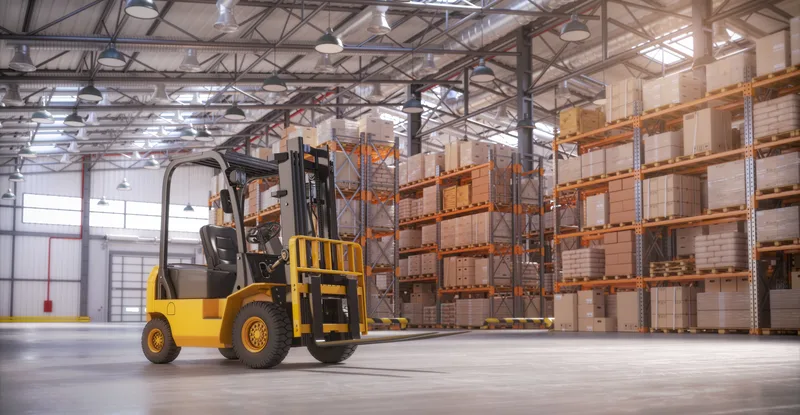
Ask what a distributor pays in Arizona and the honest first answer is a question back: which Arizona?
Because this state runs two distribution economies at once, and they barely resemble each other. In metro Phoenix, the play is a big-box build-out selling itself as the affordable way to serve Southern California — a lower-cost, buildable, one-day-truck alternative to a market on the other side of I-10. In Nogales, produce imported from Mexico comes north through the Mariposa land port into warehousing, repacking, inspection, consolidation, and cold storage before it heads out across the country.
An owner of inventory in the first Arizona and an owner of inventory in the second Arizona are not filling out the same submission. Their dominant drivers are different, their failure modes are different, and their prices are built from different things.
<text x="350" y="30" text-anchor="middle" font-family="Inter, sans-serif" font-size="15" font-weight="600" fill="#0F4C5C">One state, two distributor economies</text>

<rect x="255" y="50" width="190" height="42" rx="6" fill="#E2F4F3" stroke="#0F4C5C"/>
<text x="350" y="76" text-anchor="middle" font-family="Inter, sans-serif" font-size="13" font-weight="600" fill="#0F4C5C">You own the goods</text>

<path d="M350 92 L350 112" stroke="#0F4C5C" stroke-width="2" fill="none"/>
<path d="M170 112 L530 112" stroke="#0F4C5C" stroke-width="2" fill="none"/>
<path d="M170 112 L170 138" stroke="#0F4C5C" stroke-width="2" fill="none"/>
<path d="M530 112 L530 138" stroke="#0F4C5C" stroke-width="2" fill="none"/>

<rect x="45" y="138" width="250" height="140" rx="8" fill="#ffffff" stroke="#0F4C5C"/>
<text x="170" y="164" text-anchor="middle" font-family="Inter, sans-serif" font-size="13" font-weight="600" fill="#0F4C5C">The Phoenix wholesaler</text>
<text x="170" y="190" text-anchor="middle" font-family="Inter, sans-serif" font-size="12" fill="#3F5B64">dry goods, deep racking</text>
<text x="170" y="212" text-anchor="middle" font-family="Inter, sans-serif" font-size="12" fill="#3F5B64">a very large roof plane</text>
<text x="170" y="234" text-anchor="middle" font-family="Inter, sans-serif" font-size="12" fill="#3F5B64">monsoon wind, dust, hail</text>
<text x="170" y="258" text-anchor="middle" font-family="Inter, sans-serif" font-size="12" font-weight="600" fill="#0F4C5C">priced on accumulation</text>

<rect x="405" y="138" width="250" height="140" rx="8" fill="#ffffff" stroke="#0F4C5C"/>
<text x="530" y="164" text-anchor="middle" font-family="Inter, sans-serif" font-size="13" font-weight="600" fill="#0F4C5C">The Nogales importer</text>
<text x="530" y="190" text-anchor="middle" font-family="Inter, sans-serif" font-size="12" fill="#3F5B64">perishable owned stock</text>
<text x="530" y="212" text-anchor="middle" font-family="Inter, sans-serif" font-size="12" fill="#3F5B64">a land border, then a cooler</text>
<text x="530" y="234" text-anchor="middle" font-family="Inter, sans-serif" font-size="12" fill="#3F5B64">a food-products chain</text>
<text x="530" y="258" text-anchor="middle" font-family="Inter, sans-serif" font-size="12" font-weight="600" fill="#0F4C5C">priced on temperature</text>

<rect x="40" y="300" width="620" height="52" rx="9" fill="#C8935A" stroke="#0F4C5C"/>
<text x="350" y="324" text-anchor="middle" font-family="Inter, sans-serif" font-size="14" font-weight="600" fill="#1A1A1A">Same state. Two entirely different submissions.</text>
<text x="350" y="343" text-anchor="middle" font-family="Inter, sans-serif" font-size="12" font-weight="600" fill="#1A1A1A">A quote built for one of them is wrong for the other.</text>The Nogales importer: owned produce, a border, and a clock
Start on the branch that is most distinctive, because it is also the one most often underwritten badly.
The Arizona distributor is an importer far more often than distributors in most states. A produce importer who is the first U.S. seller of goods crossing at Nogales owns that inventory from the moment it comes north — through the port, through the cold storage, through the repack, out to the customer. That is not a warehouse exposure with some transit attached. That is one continuous supplier-to-customer span, and it is exactly the span stock throughput was built to follow: a marine-family form that keeps following owned goods across land transit and a land border just as readily as it follows them across water.
Two things sit on top of that span.
The first is the clock. Produce is perishable, and the failure mode is temperature rather than impact. The customs infrastructure at Mariposa includes temperature-controlled inspection space precisely because this is what crosses there — and a refrigeration failure, a delayed release, or a power interruption can turn a full cooler into a write-off without a mark on the building. Cold-chain and bonded storage in Arizona are the same conversation, and both are ordinary here rather than exotic: the foreign-trade zone bench in this state is deep and border-shaped, with grantees at Phoenix, Mesa, Tucson, Nogales–Santa Cruz County, Naco, and Yuma-area San Luis.
The second is the products chain, which is covered below and applies to a head of lettuce exactly as it applies to a semiconductor.
And behind both sits the question importers most often answer by accident:
When does the risk of loss actually pass to you?
Your purchase terms may hand you ownership at the grower’s dock in Mexico, at the crossing, or on arrival at your cooler. Whichever it is, that is when your exposure begins. If risk passes early and coverage starts late, there is a stretch of highway where your own inventory is traveling uninsured by you.
The Phoenix wholesaler: a very large roof, and a monsoon under it
The other branch has a different physics.
Phoenix sits where I-10 meets I-17, with I-8 running to Yuma and I-19 dropping straight from Tucson to the Mexico line — which makes it the natural place to break a coastal load for the interior Southwest. Companies warehouse here specifically so they can serve Southern California without paying to warehouse in it, and consumer-goods, electronics, and semiconductor-supply distributors have stacked owned inventory into the metro accordingly.
That concentrates value under a very large horizontal roof plane, which is precisely what Arizona’s weather goes looking for. The monsoon brings violent seasonal thunderstorms, damaging outflow winds, and dust storms that scour a roof; hail is less frequent than in the Plains but entirely real on the big flat roofs of the Phoenix DC corridor. Flash flooding hits washes and low ground, and flood is its own placement rather than a property-form peril — which matters a great deal when the goods on the floor are on your balance sheet.
Commercial property does a bounded job here: the building, the racking, and the owned inventory while it sits in a scheduled location, plus the income lost when that location cannot ship. It stops at the walls.
Heat, which is an exposure and not a mood
Extreme, sustained heat is the Arizona baseline, and it belongs in the underwriting file rather than in the small talk. It stresses roofing membranes. It stresses refrigeration equipment at exactly the moment that equipment is least able to fail. And it stresses the people on the dock: a metal-roofed warehouse in a Phoenix summer, and especially an open dock, is a genuine heat-illness risk for the crew working it.
For an owner of inventory, the heat exposure has a particular and unfair shape. A refrigeration failure in an Arizona summer is a total loss of your own goods, in a building that is otherwise undamaged. No fire, no water, no wind — and the whole holding gone. Standby power that is tested, refrigeration maintenance that is documented, and temperature monitoring that produces a record are the three things that separate a defensible submission from a hopeful one.
Peak, when the peak is a harvest
The number that sizes a limit is not the comfortable annual average. It is the maximum value of owned product concentrated in one place on one day, and a loss does not wait for a convenient month.
In produce that peak follows a harvest and a border schedule rather than a shopping season, which means the coolers are fullest at exactly the moment the business is least able to absorb a hit. In the Phoenix dry-goods economy the peak follows a retail calendar and an arrival schedule. Either way, a limit set to your quiet month is a limit that fails you in the one you built for — and seasonality on an Arizona distributor’s submission is close to the center of the document, not a note in the margin.
The product, and the chain that comes back to a seller
Here is the driver distributors are most surprised by, because it has nothing to do with the building or the trucks.
You sit in the chain of distribution, and a products-liability claim can follow that chain to a seller — not only to the manufacturer or the grower. You did not plant it, you did not assemble it; you bought it and you sold it, and that is enough to be named. General liability answers it through what the standard form calls the products-completed-operations hazard, and a food product with an ingestion profile is a different severity conversation than a case of fasteners. When the actual producer is on the other side of an international line and beyond the practical reach of a U.S. claim, the importer becomes the realistic defendant.
Arizona splits the regulatory side in a way that trips people up: the Department of Agriculture carries food safety on the production, processing, and warehousing side, while the Department of Health Services and the counties handle retail food establishments. So a food distributor or a food-grade warehouse deals with agriculture, not the restaurant regulator — a split with real weight in Nogales. Prescription drugs run through the Arizona State Board of Pharmacy, which issues a wholesaler permit and requires a designated representative with genuine drug-distribution qualifications behind it.
Series 4, the license that names your building
If you distribute beverages, Arizona’s structure is unusually legible. The Department of Liquor Licenses and Control runs a numbered license series, and the wholesaler sits at Series 4. That license lets the holder buy spirituous liquor — the state’s term covers beer, wine, and distilled spirits alike — from licensed in-state and out-of-state producers, sell it to licensed Arizona retailers and to other licensed wholesalers, and expressly maintain facilities for the storage and distribution of that product.
The detail worth knowing: the license attaches to a specific person at a specific location and does not travel. A wholesaler that moves its warehouse is dealing with the department, not just a landlord. That is a real operating cost sitting alongside the premium — and it confirms the insurance posture, because the inventory in that licensed building is genuinely yours at every step, which is why it prices as a stock throughput exposure rather than as somebody else’s goods in your care.
The crew, the fleet, and the loss runs
Workers compensation in Arizona is a private-market line; the state has a competitive fund in the market alongside private insurers, which is not a monopolistic arrangement. A distributor carries two injury exposures, not one — the crew lifting and picking, and the route drivers loading, unloading, and working a lift gate — and Arizona adds the heat exposure on top of both.
Commercial auto prices unit count, radius, what you haul, and above all who drives. A note on language this trade cannot escape: your insurance carrier is the company that writes your policy, which is not the same thing as a motor carrier or a freight carrier hauling goods for hire.
And an underwriter reads a distributor’s claims history for shape, not count. A spoilage event, a cargo loss on the road north, and a drip of at-fault fleet accidents are three different stories about three different parts of the operation, and they price accordingly. Carry an umbrella where the customer contracts demand one.
The honest summary
An Arizona distributor is priced on which Arizona it is in. If the product is perishable and it crossed a border, the program is a temperature program with a products chain attached. If the product is dry and it sits under a big roof, the program is an accumulation program with a monsoon over it. Both own what they sell, and both live under a sun that will find any weakness in the refrigeration.
If you want the coverage mechanics rather than the cost drivers, stock throughput is the line this guide orbits, our wholesaling business insurance page covers the broader program, and the full Arizona distributor and wholesaler insurance page goes deeper on the exposures. And if the goods in your cooler belong to your customers rather than to you, none of the above is your program — you want the Arizona warehouse cost guide instead.