

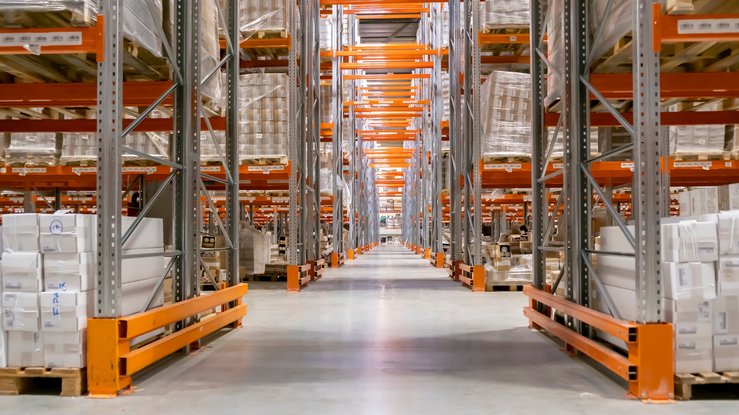
There is no published price for distributor or wholesaler insurance in Florida, and any number quoted before an underwriter has seen the operation is a guess. An insurance carrier builds the cost from what you own and where it is — and in Florida that second half of the sentence has an answer most states do not give.
A very large share of what a Florida distributor owns is not going to a Florida customer at all.
Goods that enter, pause, and leave
Florida is the country’s re-export shelf. The state is the U.S. staging ground for Latin America and the Caribbean, and a great deal of what sits in a Miami-area warehouse is on its way somewhere else. Bonded and foreign-trade-zone storage is ordinary business here rather than an exotic option, precisely because duty deferral on cargo that never formally enters U.S. commerce is the whole economic point.
For an owner of inventory, that changes the fundamental shape of the exposure. Your goods are not sitting. They are pausing — mid-journey, between an ocean leg and another ocean leg, owned by you the entire time. The building is a comma in the sentence, not the end of it.
That is why commercial property does a real but bounded job for a Florida distributor and should be understood as such: it covers your building, your racking, and your owned inventory while it sits in a scheduled location, plus the income you lose when that location goes down. It stops at the walls. If most of your product’s exposed life happens outside them, then most of your risk is outside the policy that owners assume is the main one.
The line that actually matches this operation is stock throughput — a marine-family form that follows the goods from the supplier through ocean cargo, the terminal, the drayage move, the warehouse, and back out again, rather than a property-plus-cargo patchwork with seams in it. In a re-export economy, the seams are where the losses live.
The peak, not the average
The number that sizes that limit is the one owners get wrong most reliably.
They answer with an annual average. The underwriter is asking for the maximum value of owned product concentrated in one place on one day, because a loss does not wait for a convenient month. Florida sharpens the question in a way few states do: the resident and visitor consumer base has to be restocked constantly, the produce and perishable trade runs to a growing calendar, and the transshipment business builds and clears in waves. When those overlap, the building is full, and the value on the floor is at its high-water mark.
A limit set to a quiet stretch is a limit that fails you in a busy one. Seasonality is close to the center of a distributor’s submission, not a footnote on it.
The roof, the water, and what a hurricane actually costs you
Hurricane is Florida’s defining peril, and it is worth being precise about what it does to a distributor, because the popular picture is wrong.
It does not usually level a distribution building. It hits the building where it is weakest — the wide, low-slope roof plane. Uplift peels membrane and deck, and once the roof opens, the event becomes a water loss on stacked inventory rather than a wind loss on a structure. The building gets repaired. The season of owned product that got wet does not. For an owner of stock, the hurricane loss is a stock loss, and it lands on your balance sheet rather than your landlord’s.
Storm surge and rainfall flooding near the ports and along the coastal industrial strips are a separate placement — a flood policy, not the property policy — and Florida warehouses are frequently sited exactly where the flood zone runs, because they are sited near the freight. Tornadoes spun up by landfalling systems and severe-thunderstorm wind are the secondary story. Hail matters less here than in the interior South.
<text x="350" y="32" text-anchor="middle" font-family="Inter, sans-serif" font-size="15" font-weight="600" fill="#0F4C5C">The wind hits the roof. The loss lands on the inventory.</text>

<rect x="30" y="60" width="180" height="78" rx="8" fill="#ffffff" stroke="#C3DEDE"/>
<text x="120" y="90" text-anchor="middle" font-family="Inter, sans-serif" font-size="13" font-weight="600" fill="#0F4C5C">uplift</text>
<text x="120" y="114" text-anchor="middle" font-family="Inter, sans-serif" font-size="12" fill="#3F5B64">on a wide flat roof</text>

<path d="M216 99 L254 99" stroke="#0F4C5C" stroke-width="2" fill="none"/>
<path d="M254 99 l-12 -6 l0 12 z" fill="#0F4C5C"/>

<rect x="260" y="60" width="180" height="78" rx="8" fill="#ffffff" stroke="#C3DEDE"/>
<text x="350" y="90" text-anchor="middle" font-family="Inter, sans-serif" font-size="13" font-weight="600" fill="#0F4C5C">the roof opens</text>
<text x="350" y="114" text-anchor="middle" font-family="Inter, sans-serif" font-size="12" fill="#3F5B64">membrane and deck go</text>

<path d="M446 99 L484 99" stroke="#0F4C5C" stroke-width="2" fill="none"/>
<path d="M484 99 l-12 -6 l0 12 z" fill="#0F4C5C"/>

<rect x="490" y="60" width="180" height="78" rx="8" fill="#E2F4F3" stroke="#0F4C5C"/>
<text x="580" y="90" text-anchor="middle" font-family="Inter, sans-serif" font-size="13" font-weight="600" fill="#0F4C5C">water on your stock</text>
<text x="580" y="114" text-anchor="middle" font-family="Inter, sans-serif" font-size="12" fill="#3F5B64">your balance sheet</text>

<path d="M350 138 L350 176" stroke="#0F4C5C" stroke-width="2" fill="none" stroke-dasharray="5 4"/>
<rect x="200" y="176" width="300" height="60" rx="8" fill="#ffffff" stroke="#C3DEDE"/>
<text x="350" y="202" text-anchor="middle" font-family="Inter, sans-serif" font-size="13" font-weight="600" fill="#0F4C5C">surge and rainfall flood</text>
<text x="350" y="224" text-anchor="middle" font-family="Inter, sans-serif" font-size="12" fill="#3F5B64">a separate placement, not this policy</text>

<rect x="40" y="264" width="620" height="56" rx="9" fill="#C8935A" stroke="#0F4C5C"/>
<text x="350" y="290" text-anchor="middle" font-family="Inter, sans-serif" font-size="14" font-weight="600" fill="#1A1A1A">The building gets repaired. The wet season of product does not.</text>
<text x="350" y="310" text-anchor="middle" font-family="Inter, sans-serif" font-size="12" font-weight="600" fill="#1A1A1A">Make the flood decision on purpose, not after a landfall.</text>The importer’s position, and where your risk starts
Florida is where an importer takes title. A distributor bringing product in through PortMiami, Port Everglades, or JAXPORT is very often the first U.S. seller of goods made somewhere else — and when the actual manufacturer sits beyond the practical reach of a U.S. claim, the importer becomes the realistic target for a products claim on merchandise it never made.
You sit in the chain of distribution, and a products-liability claim over something that causes injury or damage can follow that chain to a seller, not only to the maker. That is the driver distributors are most surprised by, because they did not design or assemble the item at all. General liability answers it through the products-completed-operations hazard, and in Florida the product mix makes the sizing genuinely variable: perishable produce and imported food carry an ingestion profile; imported flowers and fish move through refrigerated space; marine goods and building products are a different severity picture again.
And there is the question importers answer by accident more often than any other:
When does the risk of loss actually pass to you?
Your purchase terms may hand you title at the foreign supplier’s dock, at the port of loading, or on arrival. Whichever it is, that is when your exposure begins — not when the container clears the gate. If risk passes early and coverage starts late, there is a stretch of ocean where your own inventory is traveling uninsured by you, and nobody discovers it until there is a claim.
The licensed tier, and the regulator that is not where you would look
If beverages are your book, Florida is a license state, not a control state. The Division of Alcoholic Beverages and Tobacco, inside the Department of Business and Professional Regulation, licenses private distributors, and the state itself never takes title to the product. The division sorts the trade into manufacturers, distributors, and vendors, and a company generally may not stand in more than one tier at once — so a beverage distributor here holds the middle rung on its own account.
The insurance consequence is direct: a Florida beverage wholesaler owns a deep inventory it must warehouse and insure itself, which is exactly why it is a stock-throughput exposure rather than a bailment.
Florida does one other thing that catches new operators out. Prescription drug wholesale distribution is licensed not by a pharmacy board but by the Division of Drugs, Devices and Cosmetics — also inside the Department of Business and Professional Regulation — under Chapter 499 of the Florida Statutes, and each permitted establishment must name a certified designated representative. And on the produce side, the agriculture department’s dealer licensing and bonding program sits over the trade so growers get paid, which is a real weight in a state that grows and re-ships perishables year round. In every case, the state is regulating you on the goods you own.
The fleet, the crew, the claims, and the limits
A distribution business moves its own product. Commercial auto prices unit count, radius, what is hauled, and above all who drives — and a Florida fleet runs I-4 congestion, coastal urban traffic, and long peninsula hauls in the same week. One note on the language this trade cannot avoid: your insurance carrier is the company that writes your policy, which is an entirely different thing from a motor carrier or a freight carrier that hauls goods for hire.
On workers compensation, Florida runs a private market. A distributor carries two injury exposures rather than one: the warehouse crew on powered industrial trucks, dock edges, and the pick line, and the route drivers loading and unloading. Heat is a live aggravator in buildings that are not conditioned, and it belongs in the conversation rather than in the fine print.
Claims history is read for shape: cargo in transit, shrinkage in the building, and at-fault fleet losses are three different stories about three different parts of the operation. Limits and retention are the lever entirely in your hands — absorb the routine handling damage, and spend the money on a stock throughput limit sized to the peak, a products limit sized to what you truly sell, and an umbrella sitting over the tail rather than the noise.
What it comes down to in Florida
A Florida distributor is priced on goods that keep moving, a roof that has to survive a season, a flood decision it cannot make by accident, and a products position it inherited by being first in line on this side of the water.
If you want the coverage mechanics rather than the cost drivers, stock throughput is the line this guide orbits, the distribution businesses pillar covers how these programs get assembled, and the Florida distributor and wholesaler insurance page goes deeper on the exposures. If the goods in your building belong to your customers rather than to you — an importer’s stock, a consolidator’s freight — this is not your program, and the warehouse cost guide is. Otherwise, ask us for a quote and we will rate the operation you actually run.