

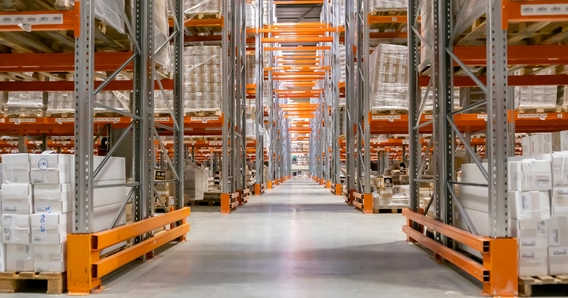
The roof over a Florida warehouse belongs to the operator. Almost nothing underneath it does.
Hold those two facts together and the whole Florida cost picture falls into place. Hurricane is the peril everyone leads with, and it deserves the billing — but the reason it drives a warehouse premium is not the reason it drives a homeowner’s. Wind does not destroy your inventory. It opens your roof, and then water destroys your customers’ inventory. The building is the door the loss comes through; the loss itself lands on somebody else’s balance sheet, and you are the one who has to answer for it.
That is the Florida bailee’s whole problem, and it is why the drivers below sit in the order they do.
What the storm actually costs you
A distribution building is a wide, low-slope roof plane and not much else. Uplift peels membrane and deck, and the moment the roof opens, the event stops being a wind loss on a structure and becomes a water loss on stacked pallets. Commercial property answers for the roof, the racking, the material-handling systems and the income you lose while the site is down — and that is a real conversation, priced on construction, roof condition and attachment, building age, and where on the peninsula you sit.
But an underwriter is running a second calculation at the same time: how much of somebody else’s freight was under that roof when it opened? Because that part is not a property claim at all.
The limit that has to survive a landfall
The value and the nature of the customers’ goods in your care is what sizes your warehouse legal liability limit, and Florida operators understate it more reliably than most, for a simple reason: that inventory never appears in their accounts.
Value is the maximum amount of customer-owned freight under your roof on the worst day, not on an average one — and in Florida the worst day and the storm day are frequently the same day, because cargo backs up when a port closes. Nature is the input that gets missed: a Doral building staging imported electronics for onward shipment and a Lakeland building holding building products can be identical square footage with identical racking and price nothing alike, because the amount at risk per pallet position is different by an order of magnitude — and so is what a thief will bother to take.
Flood does not come with the property policy
This has to be said plainly, because it is the most expensive misunderstanding in the state. Flood is a separate placement. It is not inside the property form, and Florida warehouses are sited, over and over, exactly where the flood zone runs — near the terminals at Miami, Everglades, Jacksonville and Tampa, along the coastal industrial strips, and on low ground where a stalled rain band has nowhere to drain.
Surge and rainfall put water across a floor that is holding other companies’ pallets. The customer whose consignment was ruined will not be interested in which form did or did not respond. If your dock-door elevation is the thing standing between a customer’s inventory and the water, it belongs at the front of the conversation.
The re-export shelf, and the duty stacked on top of the duty
Florida is dense with foreign-trade-zone coverage because it is dense with ports, and a great deal of what sits in a South Florida warehouse is not going to a Florida customer at all. It is staged for Latin America and the Caribbean, and duty deferral on cargo that never formally enters U.S. commerce is the entire economic logic of holding it here.
That is a magnificent business and it is a compounded duty. While bonded or zone freight is on your floor it is under customs control as well as in your care, custody, and control. Over one pallet you now answer to two masters — the government and the owner — and an underwriter prices the accumulation, not the average.
The geography compounds it again. Zone coverage attaches at Port Everglades, PortMiami, JAXPORT and Port Tampa Bay, and Miami International moves the perishable and high-value air freight alongside them — which means the consolidator’s building near the airport can be holding, simultaneously, a customer’s duty-deferred consumer goods and a customer’s pharmaceuticals on a temperature clock. Those are two different severities under one roof, and the operator owns neither of them.
And there is a second engine filling the same racking for entirely different reasons. Florida’s resident and visitor population has to be restocked constantly, which pulls grocery and fulfillment distribution into the corridor through Orlando and Lakeland — a market where the freight is going to a Florida customer, dwells shorter, and gets handled more. A building serving both trades is running two loss profiles at once, and it is worth telling an underwriter which one is actually dominant rather than letting them guess.
Cold, and the loss that never involves fire
Refrigerated space is real and specific in Florida: imported produce, cut flowers and fish move through cold facilities near Miami on a very short clock. Cold-chain bailment fails in a way dry space never does. Nothing burns. The temperature drifts, or the power fails, and a customer’s perishable load is a total loss with your racking untouched.
That is a distinct severity profile with distinct controls — redundancy, alarms, monitoring, a generator that has actually been tested — and it is underwritten as one.
<text x="350" y="30" text-anchor="middle" font-family="Inter, sans-serif" font-size="15" font-weight="600" fill="#0F4C5C">Everything an underwriter sees is wrapped around one pallet</text>

<circle cx="350" cy="215" r="150" fill="#ffffff" stroke="#C3DEDE"/>
<circle cx="350" cy="215" r="108" fill="#ffffff" stroke="#C3DEDE"/>
<circle cx="350" cy="215" r="64" fill="#C8935A" stroke="#0F4C5C"/>

<text x="350" y="208" text-anchor="middle" font-family="Inter, sans-serif" font-size="13" font-weight="600" fill="#1A1A1A">The customer’s pallet</text>
<text x="350" y="228" text-anchor="middle" font-family="Inter, sans-serif" font-size="11" font-weight="600" fill="#1A1A1A">Not yours. Not on your books.</text>

<text x="350" y="145" text-anchor="middle" font-family="Inter, sans-serif" font-size="12" font-weight="600" fill="#0F4C5C">The duty of care you accepted</text>
<text x="350" y="162" text-anchor="middle" font-family="Inter, sans-serif" font-size="11" fill="#3F5B64">Answered by warehouse legal liability</text>

<text x="350" y="102" text-anchor="middle" font-family="Inter, sans-serif" font-size="12" font-weight="600" fill="#0F4C5C">Customs control, if it is bonded or in zone</text>
<text x="350" y="119" text-anchor="middle" font-family="Inter, sans-serif" font-size="11" fill="#3F5B64">Staged for re-export, and answerable twice</text>

<text x="350" y="300" text-anchor="middle" font-family="Inter, sans-serif" font-size="12" font-weight="600" fill="#0F4C5C">The hurricane and the flood zone</text>
<text x="350" y="317" text-anchor="middle" font-family="Inter, sans-serif" font-size="11" fill="#3F5B64">They reach the pallet through your roof</text>
<text x="350" y="334" text-anchor="middle" font-family="Inter, sans-serif" font-size="11" fill="#3F5B64">and across your floor. Flood is placed separately.</text>

<text x="350" y="386" text-anchor="middle" font-family="Inter, sans-serif" font-size="12" font-style="italic" fill="#3F5B64">You own the roof and the racking — and none of the value in the middle.</text>Florida licenses the food, not the warehouse
There is no general state public-warehouse licensing statute here. A warehouse storing goods for hire is not licensed as a warehouse; what Florida licenses sits closer to the product than to the building — the agriculture department permits food establishments including storage facilities and licenses and bonds dealers in agricultural products so growers get paid.
For a general-merchandise or consolidation warehouse, that absence is a cost driver, not a footnote. Because the state writes you no standard of care, your warehouse receipt and storage agreement are the entire perimeter around a claim. An underwriter reads them. Whether your customers accepted a limitation-of-liability or released-value clause, negotiated it away, or handed you a contract that quietly assumed a far broader form than a bare legal-liability policy provides, changes the exposure being priced. Where there is no license, the contract is the regulation.
The floor crew, and the heat
Workers compensation scales with material-handling payroll, and the classifications you actually run matter as much as the figure. The loss picture is the familiar one — powered-industrial-truck strikes and tip-overs, falls off dock edges, product coming down from high racking, and the slow lifting and repetitive-motion injuries of a pick line.
Florida adds one aggravator that gets underplayed: heat, in buildings that are not conditioned, in a state where the season is long. It shows up in fatigue, in judgment, and then in the incident report.
Claims history, limits, and the retention you choose
Loss history moves pricing more than almost anything else on this list — not merely whether you have had losses, but what they say about how the building actually runs. A cluster of small handling-damage claims tells an underwriter something quite different from one large one.
Limits and retention are a real choice: you are deciding how much of the routine damage you fund yourself in exchange for a better price on the part you could never absorb. In a wind state, an operator who buys a serious warehouse legal liability limit and puts an umbrella above it is buying in the right order.
The honest summary
A Florida warehouse is priced on custody, exposed by weather, and complicated by customs. The storm decides how the loss arrives; the freight on your racking decides how big it is; and the contract you signed decides who pays for it.
If you want to understand the coverage rather than the cost, begin with warehouse legal liability, see how we work with warehouse businesses, or read the full Florida warehouse insurance page. And if you own the inventory you store rather than holding it for other companies, none of the above is your program — you want the Florida distributor cost guide.