

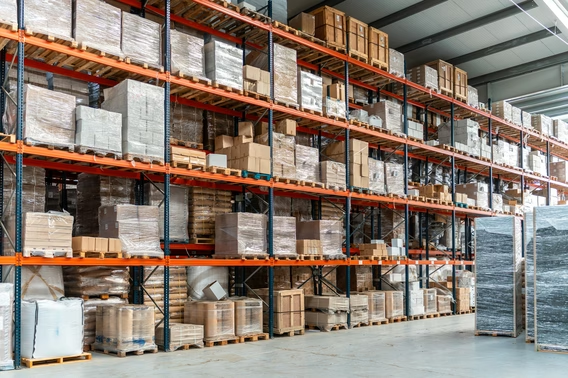
An Illinois distributor’s inventory has usually been on a long trip before anyone in Illinois lays eyes on it.
A box is discharged at a coastal port, railed into the Chicago intermodal complex — the largest inland container gateway on the continent, and the place where the western and eastern railroads meet — and then trucked out to a building in Will County to be broken down and re-shipped across the eastern half of the country. Somewhere in that sequence, the goods became yours. Very often it happened before the ship sailed.
That is the fact that shapes what a distributor pays here, and it is why there is no published price. An insurer builds the number from the operation, and for a business that owns what it sells, the conversation starts with where the goods were when the risk of loss passed — and with how much of them stand in one building on the fullest day of your year.
The rail leg almost nobody insures properly
Commercial property covers your building, your racking, and your owned inventory while it sits in a scheduled location, plus the business income lost when that location goes down. It stops at the walls. That is a perfectly good policy doing a perfectly bounded job — and in Illinois, the bounded part is the problem.
Your product spent weeks on the water, then days on a rail car, then hours on a drayman’s chassis. All of it owned by you. None of it inside a scheduled location.
Stock throughput is written for exactly that span: one marine-family form following the goods from the supplier, through ocean cargo, across the port, along the rail leg, into the transload building, and out on the delivery truck — instead of a property-plus-cargo patchwork with seams in it. The name misleads people in a landlocked market. It should not: the form follows the goods, not the water, and the rail and inland-transit legs are exactly where an Illinois owner is most exposed.
Which raises the question importers most often answer by accident:
When does the risk of loss actually pass to you?
Purchase terms may hand you ownership at the foreign supplier’s dock, at the port of loading, or on arrival. Whichever it is, that is when your exposure begins — not when the box reaches the ramp. Risk that passes early with coverage that starts late leaves a stretch of ocean, rail, and highway where your inventory is traveling uninsured by you. Zone status across the Chicago-area foreign-trade zone reaches the intermodal corridor itself, so duty-deferred storage is a mainstream option here rather than a port-only specialty — and a loss on zone-status goods can touch duty as well as value.
The peak a transload market builds
Once the goods are in the building, the question becomes how much of them are in it at once.
Owners answer with a comfortable annual average. Underwriters are asking: what is the maximum value of owned product concentrated in one place on one day? Because a loss does not wait for a convenient month. It arrives in the season you built up for.
A transload market widens that gap. An entire season’s worth of goods can land, get staged in one Will County building, and wait there to be re-shipped — which means the peak is not a modest bump above the average, it is a different order of number. A limit set to the quiet season is a limit that fails you in the busy one. Seasonality belongs near the center of an Illinois distributor’s submission.
A license that reaches into the warehouse
If you distribute beverages, Illinois writes your building into your license.
This is a license state with a strict middle tier. The Liquor Control Commission issues the distributor license, and that license is what permits a business to purchase, store, warehouse, and resell alcoholic liquor at wholesale — the statutory language reaches the warehouse directly, rather than treating it as incidental to the trade. Distributors also file brand registration statements naming the trademark and the territory in which they may resell it.
Read that carefully, because it says something unusual about the stock on your rack: an Illinois beverage wholesaler’s owned inventory is tied to specific brands in a specific geography, not freely tradable. It is yours — genuinely yours, at every step, which is exactly why it prices as a stock-throughput exposure rather than a bailment — but it is yours under a license that defines what you may do with it and where. The compliance obligation is a real operating cost sitting alongside the premium.
What you sell, and why it prices differently
Here is the driver distributors are most surprised by, because it has nothing to do with the building or the trucks. It is the goods themselves.
You sit in the chain of distribution, and a products-liability claim over something that causes injury or damage can follow that chain to a seller — not only to the manufacturer who made it. You did not design it. You did not assemble it. You bought it and you sold it, and that is enough to be named.
So an insurance carrier prices what you handle. Industrial supply and hard goods are one conversation. Food and beverage — anything with an ingestion or contact profile — are a very different one, and anything reaching children is different again. General liability answers this through what the standard form calls the products-completed-operations hazard, and sizing that limit against what you actually move, rather than against a revenue band, is most of the work on a distributor’s submission. Because an importer here is frequently the first U.S. seller of a foreign-made product, and the actual maker often sits beyond the practical reach of a claim in this country, the exposure lands on the Illinois company directly.
Wind across acres of roof
The Illinois peril profile for a distribution building is dominated by severe convective storms: tornadoes across the central and northern corridors, hail on acres of low-slope roof, and the straight-line wind events that periodically run the length of the state and strip membrane and rooftop equipment across an entire park at once.
For an owner of inventory the sequence is what matters. Wind and hail do not usually level a distribution building. They open it — the membrane goes, the rooftop unit shifts, and then the water comes down onto the racking with your season underneath it. Rooftop equipment anchorage, membrane condition, and drainage are underwriting facts, not maintenance trivia.
Add snow and drift load on long clear-span roofs, deep freezes that threaten wet sprinkler systems and cold-chain refrigeration, and riverine flooding along the Illinois, Mississippi, and Des Plaines, which is a separately placed peril and stays out of the property form.
The fleet, the crew, and a litigious comp environment
A distribution business moves its own product, and in Illinois it moves it through a corridor that never stops. Commercial auto prices the fleet on unit count, radius, what is hauled, and above all who drives. One note on language this trade cannot avoid: your insurance carrier is the company that writes your policy, which is an entirely different thing from a motor carrier or a freight carrier hauling goods for hire.
Workers compensation runs through the private market here, but Illinois is a jurisdiction with a well-developed body of comp litigation — which means the discipline around a warehouse claim file matters more than it does in a quieter state. The exposures themselves are the standard high-throughput set: powered-industrial-truck contact on a congested dock, workers struck by product coming out of racking, falls from dock plates and order pickers, and cumulative lifting and reaching injuries. A distributor carries two of those exposures, not one — the warehouse crew and the route drivers.
What the distributor license actually covers
<text x="350" y="32" text-anchor="middle" font-family="Inter, sans-serif" font-size="15" font-weight="600" fill="#0F4C5C">One license, three verbs — and the middle one is your building</text>

<rect x="40" y="56" width="180" height="60" rx="7" fill="#ffffff" stroke="#C3DEDE"/>
<text x="130" y="82" text-anchor="middle" font-family="Inter, sans-serif" font-size="13" font-weight="600" fill="#0F4C5C">purchase</text>
<text x="130" y="102" text-anchor="middle" font-family="Inter, sans-serif" font-size="11" fill="#3F5B64">from the producer</text>

<rect x="260" y="56" width="180" height="60" rx="7" fill="#E2F4F3" stroke="#0F4C5C" stroke-width="2"/>
<text x="350" y="82" text-anchor="middle" font-family="Inter, sans-serif" font-size="13" font-weight="600" fill="#0F4C5C">store and warehouse</text>
<text x="350" y="102" text-anchor="middle" font-family="Inter, sans-serif" font-size="11" fill="#3F5B64">named in the statute itself</text>

<rect x="480" y="56" width="180" height="60" rx="7" fill="#ffffff" stroke="#C3DEDE"/>
<text x="570" y="82" text-anchor="middle" font-family="Inter, sans-serif" font-size="13" font-weight="600" fill="#0F4C5C">resell at wholesale</text>
<text x="570" y="102" text-anchor="middle" font-family="Inter, sans-serif" font-size="11" fill="#3F5B64">to licensed retailers</text>

<path d="M40 132 L40 144 L660 144 L660 132" stroke="#0F4C5C" stroke-width="2" fill="none"/>
<text x="350" y="166" text-anchor="middle" font-family="Inter, sans-serif" font-size="12" font-weight="600" fill="#0F4C5C">the distributor license spans all three</text>

<rect x="120" y="188" width="200" height="52" rx="7" fill="#ffffff" stroke="#C3DEDE"/>
<text x="220" y="212" text-anchor="middle" font-family="Inter, sans-serif" font-size="12" font-weight="600" fill="#0F4C5C">registered by brand</text>
<text x="220" y="230" text-anchor="middle" font-family="Inter, sans-serif" font-size="11" fill="#3F5B64">the trademark is named</text>

<rect x="380" y="188" width="200" height="52" rx="7" fill="#ffffff" stroke="#C3DEDE"/>
<text x="480" y="212" text-anchor="middle" font-family="Inter, sans-serif" font-size="12" font-weight="600" fill="#0F4C5C">confined by territory</text>
<text x="480" y="230" text-anchor="middle" font-family="Inter, sans-serif" font-size="11" fill="#3F5B64">where you may resell it</text>

<rect x="40" y="262" width="620" height="62" rx="9" fill="#C8935A" stroke="#0F4C5C"/>
<text x="350" y="286" text-anchor="middle" font-family="Inter, sans-serif" font-size="14" font-weight="600" fill="#1A1A1A">The stock is not freely tradable — but it is genuinely yours,</text>
<text x="350" y="306" text-anchor="middle" font-family="Inter, sans-serif" font-size="14" font-weight="600" fill="#1A1A1A">at every step, which is why it prices as owned goods and not a bailment.</text>Losses, limits, and the order you buy in
An underwriter reads a distributor’s losses for shape, not just for count. Cargo losses in transit, shrinkage inside the building, and at-fault fleet accidents are three different stories about three different parts of the operation, and one large transit claim reads very differently from a steady drip of driver incidents.
Limits and retention are the decision that is genuinely yours: how much of the routine to fund yourself in exchange for a better price on the part that could end the business. A distributor that absorbs ordinary shrinkage and handling damage, then buys a stock throughput limit sized to the real peak and an umbrella above a products limit sized to what it truly sells, is buying its insurance in the right order.
The honest summary
An Illinois distributor is priced on goods that were already traveling before they were anywhere near Illinois, on how many of them stand in one building on the fullest day of the year, on what happens if the product causes harm, and on how well the roof holds when the wind runs the length of the state.
If you want the coverage mechanics rather than the cost drivers, stock throughput is the line this guide orbits, the Illinois distributor and wholesaler insurance page goes deeper on the exposures, and our distribution businesses pillar covers the operating shape. And if the goods in your building belong to your customers rather than to you, none of this is your program — you want the warehouse cost guide instead.