

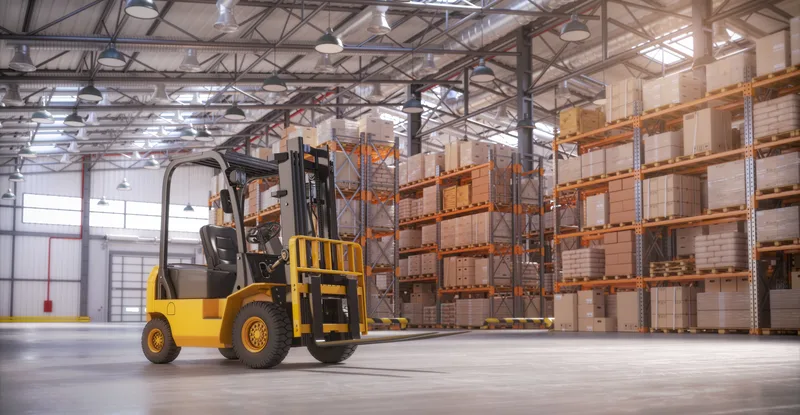
Kentucky’s logistics identity is written in the air, and that single fact reorganizes how an owner of inventory should think about cost.
Louisville is the site of the Worldport global air hub. Cincinnati/Northern Kentucky, on the Kentucky side of the river, hosts a global superhub and an air-cargo hub of its own. Three global air-cargo operations in one state is a genuinely rare concentration, and its practical consequence is famous in the trade: a warehouse near Louisville or the Northern Kentucky airport can accept an order later in the evening than a warehouse almost anywhere else in the country and still make next-day delivery.
Then, in the same state, there are buildings holding product that will not be sold for years.
Kentucky owns inventory at both ends of the clock, and the two ends produce completely different insurance conversations.
<text x="350" y="32" text-anchor="middle" font-family="Inter, sans-serif" font-size="15" font-weight="600" fill="#0F4C5C">How long does your inventory actually stand still?</text>

<path d="M60 150 L640 150" stroke="#0F4C5C" stroke-width="3" fill="none"/>
<path d="M60 142 L60 158" stroke="#0F4C5C" stroke-width="3" fill="none"/>
<path d="M640 142 L640 158" stroke="#0F4C5C" stroke-width="3" fill="none"/>

<text x="90" y="180" text-anchor="middle" font-family="Inter, sans-serif" font-size="12" font-weight="600" fill="#0F4C5C">hours</text>
<text x="610" y="180" text-anchor="middle" font-family="Inter, sans-serif" font-size="12" font-weight="600" fill="#0F4C5C">years</text>

<circle cx="110" cy="150" r="9" fill="#0F4C5C"/>
<rect x="30" y="72" width="180" height="56" rx="6" fill="#ffffff" stroke="#0F4C5C"/>
<text x="120" y="94" text-anchor="middle" font-family="Inter, sans-serif" font-size="12" font-weight="600" fill="#0F4C5C">It leaves by air tonight</text>
<text x="120" y="114" text-anchor="middle" font-family="Inter, sans-serif" font-size="11" fill="#3F5B64">exposure lives in transit</text>

<circle cx="350" cy="150" r="9" fill="#3F5B64"/>
<rect x="258" y="200" width="184" height="56" rx="6" fill="#ffffff" stroke="#C3DEDE"/>
<text x="350" y="222" text-anchor="middle" font-family="Inter, sans-serif" font-size="12" font-weight="600" fill="#0F4C5C">It turns with a season</text>
<text x="350" y="242" text-anchor="middle" font-family="Inter, sans-serif" font-size="11" fill="#3F5B64">exposure peaks and falls</text>

<circle cx="590" cy="150" r="9" fill="#0F4C5C"/>
<rect x="492" y="72" width="180" height="56" rx="6" fill="#ffffff" stroke="#0F4C5C"/>
<text x="582" y="94" text-anchor="middle" font-family="Inter, sans-serif" font-size="12" font-weight="600" fill="#0F4C5C">It ages where it stands</text>
<text x="582" y="114" text-anchor="middle" font-family="Inter, sans-serif" font-size="11" fill="#3F5B64">exposure is concentration</text>

<rect x="40" y="286" width="620" height="56" rx="9" fill="#C8935A" stroke="#0F4C5C"/>
<text x="350" y="311" text-anchor="middle" font-family="Inter, sans-serif" font-size="14" font-weight="600" fill="#1A1A1A">Both ends of this line are owned stock.</text>
<text x="350" y="331" text-anchor="middle" font-family="Inter, sans-serif" font-size="12" font-weight="600" fill="#1A1A1A">Both are priced on the most value in one place at one moment.</text>The long end: owned stock that will not be sold for years
A Kentucky distributor that owns its inventory frequently owns it for a very long time. The distilling economy is the clearest case: a producer or a non-distilling brand owner holds barrels that will not be sold for years, so owned-stock exposure here can mean a maturing asset sitting in a rickhouse, not a pallet turning in a month. Kentucky also carries a very large stock of federally bonded distilled-spirits premises — bourbon aging warehouses are bonded storage in the literal sense.
That changes the shape of the underwriting question in ways owners routinely miss.
- The accumulation grows without anybody moving anything. A limit that fit the inventory when it went into the building may not fit it several years later, and nothing about the operation will announce the change. This is a valuation conversation that needs to be revisited, not set once.
- Concentration is the whole risk. A turning inventory is spread across time; a maturing one is not. It is all in the building, all at once, for years.
- Business income does not behave normally. If the building goes down, there is no quick replacement of the lost stock, because the lost stock was time.
Commercial property does its bounded job here — the building, the racking, the owned goods while they sit in a scheduled location, and the income lost when that location cannot operate — but the limit is only as good as the valuation behind it, and on an aging asset the valuation is a moving target.
The short end: goods that move by air
Now the other extreme, and it produces the opposite exposure.
Because parcels leave Kentucky by air overnight, an enormous amount of e-commerce fulfillment, high-value electronics, medical-device, and pharmaceutical distribution has been pulled into the state. For a distributor that owns that stock, the practical consequences are specific:
- Less of the exposed life is on a highway. The goods move in an aircraft, which is a different transit exposure and a different conversation with an underwriter.
- The value density is high. Devices, electronics, and pharmaceuticals concentrate a great deal of money into very little cube — the accumulation problem does not need a big building to be serious.
- The cut-off is set by a departure, not by a dock. A physical loss inside the building is not only damage to your inventory; it is a missed flight and a missed delivery promise, and that is a business-income and customer-contract problem as much as a property one.
Stock throughput is the form that copes with this, because it is written to follow owned goods across whatever legs they actually use — supplier, ocean or air, inland, warehouse, customer — rather than a property policy that stops at the walls and a transit policy that begins somewhere else with a seam in between. And an importer landing high-value product by air and being the first U.S. seller of it is running exactly the exposure the form was designed for.
Bonded and zone-status storage is unusually live here for the same reason: the Louisville and Jefferson County Riverport Authority is grantee of the Louisville zone, which sponsors sites across a wide swath of the Commonwealth, and Greater Cincinnati FTZ, Inc. holds the Boone County zone serving the northern Kentucky airport area. Goods can land at a Kentucky air hub, sit in a zone-status building, and be released to the domestic market only when they are sold — which is a cash-flow tool, and also a fact about where your owned inventory legally sits.
Peak, seasonal or cumulative
The number that sizes a limit is not the comfortable annual average an owner instinctively quotes. It is the maximum value of owned product concentrated in one place on one day, because a loss does not wait for a convenient month.
Kentucky is unusual in producing that maximum two different ways. The parcel-driven distributor peaks with a shopping season, and the peak is visible on a calendar. The aging-inventory owner peaks by simply getting older, and the peak is visible on nobody’s calendar at all. Either way, a limit set to the quiet number is a limit that fails you at the moment of maximum exposure.
The product, and the chain that comes back to a seller
Here is the driver distributors are most surprised by, because it has nothing to do with the building or the trucks.
You sit in the chain of distribution, and a products-liability claim can follow that chain to a seller, not only to the manufacturer who made the thing. You did not design it. You bought it and you sold it, and that is enough to be named. That matters acutely for the Kentucky importer taking delivery by air: a high-value electronics or medical-products importer is very often the first U.S. seller, and when the actual manufacturer sits beyond the practical reach of a U.S. claim, the importer becomes the accessible defendant. General liability answers this through what the standard form calls the products-completed-operations hazard, and sizing that limit against what you actually move is most of the work on the submission.
The regulatory weight follows the goods. The Kentucky Board of Pharmacy licenses wholesale distributors of prescription drugs and requires a separate license for each facility that distributes into the Commonwealth, regardless of common ownership. Food distribution and food storage answer to the Cabinet for Health and Family Services food-safety program. Given how much air-cargo pharmaceutical and medical-device distribution clusters around Louisville, drug-distribution licensing has real operational weight here rather than nominal weight — and it is a real operating cost sitting alongside the premium.
The licensed middle tier, unusually close to its producers
If you distribute beverages, Kentucky is a license state: the Department of Alcoholic Beverage Control licenses private wholesalers and distributors and keeps the three tiers formally separate, with interlocking interests between tiers restricted. Brands sold in the state are registered through the department’s product registry, and both suppliers and wholesalers participate in it.
The wrinkle worth naming is that Kentucky is also a producing state on a scale no other state matches, so its middle tier sits unusually close to the distillers it buys from. That proximity is commercial, not legal — the tiers remain apart — but it shapes what the middle tier looks like here.
The insurance consequence is direct: the product in that licensed warehouse is genuinely yours at every step, which is why it prices as a stock throughput exposure and not as somebody else’s goods in your care.
The building, and the weather that reaches it
Kentucky sits in a high-frequency severe convective corridor and has seen violent tornado outbreaks in the western part of the state. For a distribution building the practical exposures are hail and straight-line wind across a wide low-slope roof, damage to rooftop equipment, and the business-interruption consequence of a building that cannot ship — which, in a state whose entire value proposition is a late cut-off and a next-day promise, is a heavier consequence than the same outage would be elsewhere. Ice storms and heavy wet snow load large roofs in the north and east, and freeze threatens wet sprinkler systems above stored goods. Flooding along the Ohio River and the eastern river valleys has repeatedly been severe, and flood is its own placement, not a property-form peril.
The crew, the fleet, and the loss runs
Workers compensation is a private-market line here, and the exposure is shaped by what these buildings actually do: high-velocity sortation and fulfillment near the air hubs, where injuries come from conveyor and sortation equipment, repetitive lifting on a fast line, and forklift traffic on congested docks; and heavy manual handling in the barrel warehouses, where workers move heavy barrels on ricks at height. A distributor carries two injury exposures, not one — the crew and the route drivers.
Commercial auto prices unit count, radius, what you haul, and above all who drives, and a Kentucky wholesaler on I-65, I-64, and I-75 is buying real radius. A note on language this trade cannot avoid: your insurance carrier is the company that writes your policy, which is not the same thing as a motor carrier or a freight carrier hauling for hire.
An underwriter reads a distributor’s claims history for shape, not count — a cargo loss in transit, shrinkage in the building, and at-fault fleet accidents are three different stories about three different parts of the operation. Limits are a real decision: fund the routine yourself and buy a serious stock throughput limit sized to the true peak plus a products limit sized to what you actually sell, with an umbrella where the customer contracts demand it.
The honest summary
A Kentucky distributor is priced on where its owned goods spend their time. If they leave by air tonight, the exposure is a high-value transit exposure with a products chain attached and a delivery promise riding on the building staying up. If they sit for years, the exposure is a concentration that grows quietly and a valuation nobody has revisited. Most Kentucky businesses are one or the other, and almost nobody is priced correctly for the one they are.
If you want the coverage mechanics rather than the cost drivers, stock throughput is the line this guide orbits, our wholesaling business insurance page covers the broader program, and the full Kentucky distributor and wholesaler insurance page goes deeper on the exposures. And if the goods in your building belong to your customers rather than to you, none of the above is your program — you want the Kentucky warehouse cost guide instead.