

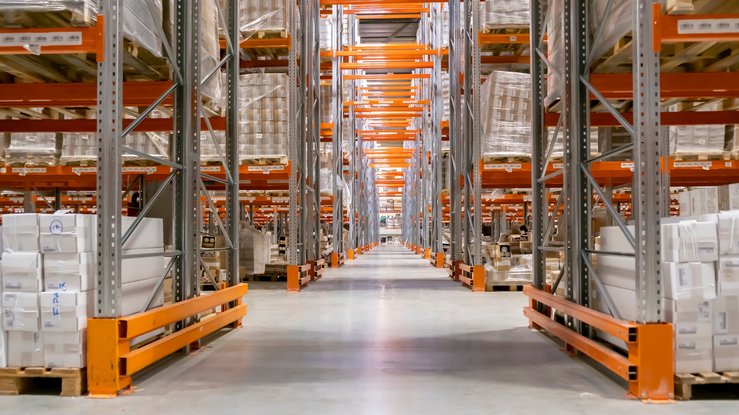
Two pallets stand side by side in a Twin Cities warehouse. They occupy identical positions, they cost the same to rack, and they look the same on a floor plan. One holds ordinary consumer goods. The other holds medical devices, and it is worth more than a truckload of its neighbor.
That gap is wider in Minnesota than in almost any other state, because of what Minnesota distributes: a large medical-device and healthcare-products cluster in the Twin Cities, sitting alongside food, dairy, and agricultural products and an industrial economy underneath both. And it is the reason a Minnesota distributor cannot describe its exposure in square footage. A limit answers for value, not for floor space.
There is no published price for the insurance. An insurance carrier builds the number from what you own, where it is, and what happens if it causes harm. Here is how that goes here.
Value density, and why square footage tells an underwriter nothing
Ask a distributor how big its operation is and you will get an answer in square feet. Ask an insurer what it is insuring and the answer is in dollars concentrated in one place — and those two numbers can diverge by an order of magnitude in this state.
A high-value healthcare book means the accumulation problem arrives long before the building is physically full. It also means the other exposures scale differently: shrinkage on a high-value pallet is a serious loss rather than an annoyance, transit theft is a live concern rather than a theoretical one, and the temperature and traceability requirements attached to the product are underwriting facts in their own right.
Say what the goods are worth. Then say where they stand. In that order.
Value at peak, not value on a quiet Tuesday
This is the number that sizes a stock throughput limit, and it is the routine mistake that costs the most money.
Owners answer the inventory question with a comfortable annual average. Underwriters are asking: what is the maximum value of owned product concentrated in one place on one day? Because a loss does not wait for a convenient month. It arrives in the season you built up for, when the building is fullest and the value on the floor is at its high-water mark.
A limit set to the quiet season is a limit that fails you in the busy one. Seasonality is close to the center of a distributor’s submission, not a footnote on it.
The building is named in the license
If you distribute beverages, Minnesota does something unusual twice over.
First, the regulator sits in an unexpected place: the Alcohol and Gambling Enforcement Division inside the Department of Public Safety, rather than a revenue or commerce agency. Second — and this is the part that touches your program — the division defines a wholesaler as a business selling alcoholic beverage products to retailers from its licensed warehouse. The building is written into the license. It is not incidental to the trade; it is part of the credential.
And the customer list is unlike anywhere else. Many Minnesota cities own and run their own municipal liquor stores, so a beverage wholesaler here sells to city governments alongside private retailers — a contractual counterparty with its own insurance and indemnity requirements, which is worth knowing before you sign rather than after.
The insurance consequence of the licensed middle tier is direct: the stock in that named warehouse is genuinely yours at every step, which is exactly why it prices as a stock-throughput exposure rather than a bailment.
What is actually on the pallet
Here is the driver distributors are most surprised by, because it has nothing to do with the building or the trucks.
You sit in the chain of distribution, and a products-liability claim over something that causes injury or damage can follow that chain to a seller — not only to the manufacturer who made it. You did not design it. You did not assemble it. You bought it and you sold it, and that is enough to be named.
In Minnesota that lands with unusual weight, because of what is on the racks. Healthcare and medical supplies carry a severity picture that industrial hard goods do not. Food and dairy carry an ingestion profile — and the state licenses wholesale food handlers by name through its agriculture department, the license class written for businesses that hold, store, and distribute food to other businesses. General liability answers all of this through what the standard form calls the products-completed-operations hazard, and sizing that limit against what you actually move, rather than against a revenue band, is most of the work on the submission. Supplier documentation and traceability are not paperwork here; they are your defense.
Snow, drift, and a long cold
Commercial property does a bounded job for a distributor: your building, your racking, and your owned inventory while it sits in a scheduled location, plus the business income you lose when that location goes down. It stops at the walls.
Snow load is the structural question for any large Minnesota roof, and the failure mode is drifting — against parapets, roof steps, and the rooftop refrigeration units that a cold-storage building carries. Extreme and prolonged cold is a peril in its own right: sprinkler systems in unheated bays, refrigeration and ammonia plant that cannot be allowed to fail, and frozen service lines. Every one of those failures ends the same way for a distributor — water or temperature reaching the racking, and the goods on the racking are yours.
Severe convective storms bring hail across the southern and western parts of the state, tornado exposure is real on the prairie side, and spring flooding along the Red, Minnesota, and Mississippi rivers is a separate placement.
A very wide territory
Minnesota is the upper-Midwest distribution hub for a very large, thinly populated region — the Twin Cities where I-94, I-35, and I-90 converge with Class I rail, and Duluth on Lake Superior at the far end of the Seaway.
For an owner of inventory, the consequence is transit. Owned goods here arrive by rail and truck rather than off a container ship, and they leave across a territory that reaches deep into the Dakotas and Wisconsin. A Minnesota distributor’s inventory spends real time in motion, and a property policy does not follow it there. Stock throughput does: a marine-family form that follows the goods across land transit and rail exactly as it follows them across water, under one wording rather than a property-plus-cargo patchwork. If you import components through a duty-deferred zone site, the same rule applies as everywhere — your exposure begins when the risk of loss passes under your purchase terms, not when the pallet lands.
The fleet, and a crew that works in winter
Commercial auto prices the fleet on unit count, radius, what is hauled, and above all who drives — and a Minnesota route runs on winter surfaces for a long stretch of the year. One note on language this trade cannot avoid: your insurance carrier is the company that writes your policy, which is an entirely different thing from a motor carrier or a freight carrier hauling goods for hire.
Workers compensation is a private-market line here. The exposures carry a cold-weather overlay that lasts much of the year — iced dock aprons and yard surfaces, slips on tracked-in snow at the dock door, and freezer work in a substantial refrigerated base — layered on top of the universal forklift strikes, falls from racking and mezzanines, and lifting and repetitive-reach strain of a pick-and-pack operation. A distributor carries two injury exposures, not one: the warehouse crew and the route drivers.
Same footprint, different exposure
<text x="350" y="32" text-anchor="middle" font-family="Inter, sans-serif" font-size="15" font-weight="600" fill="#0F4C5C">Same floor position. Not remotely the same limit.</text>

<rect x="90" y="60" width="180" height="120" rx="6" fill="#ffffff" stroke="#C3DEDE"/>
<rect x="118" y="88" width="124" height="64" rx="4" fill="#E2F4F3" stroke="#C3DEDE"/>
<text x="180" y="126" text-anchor="middle" font-family="Inter, sans-serif" font-size="12" font-weight="600" fill="#0F4C5C">consumer goods</text>
<text x="180" y="202" text-anchor="middle" font-family="Inter, sans-serif" font-size="12" font-weight="600" fill="#0F4C5C">one pallet position</text>
<text x="180" y="222" text-anchor="middle" font-family="Inter, sans-serif" font-size="11" fill="#3F5B64">the floor plan cannot tell</text>
<text x="180" y="239" text-anchor="middle" font-family="Inter, sans-serif" font-size="11" fill="#3F5B64">these two apart</text>

<rect x="430" y="60" width="180" height="120" rx="6" fill="#ffffff" stroke="#0F4C5C" stroke-width="2"/>
<rect x="458" y="88" width="124" height="64" rx="4" fill="#E2F4F3" stroke="#C3DEDE"/>
<text x="520" y="120" text-anchor="middle" font-family="Inter, sans-serif" font-size="12" font-weight="600" fill="#0F4C5C">healthcare and</text>
<text x="520" y="138" text-anchor="middle" font-family="Inter, sans-serif" font-size="12" font-weight="600" fill="#0F4C5C">medical product</text>
<text x="520" y="202" text-anchor="middle" font-family="Inter, sans-serif" font-size="12" font-weight="600" fill="#0F4C5C">one pallet position</text>
<text x="520" y="222" text-anchor="middle" font-family="Inter, sans-serif" font-size="11" fill="#3F5B64">worth more than a truckload</text>
<text x="520" y="239" text-anchor="middle" font-family="Inter, sans-serif" font-size="11" fill="#3F5B64">of the pallet on the left</text>

<path d="M290 120 L410 120" stroke="#0F4C5C" stroke-width="2" stroke-dasharray="6 4"/>
<text x="350" y="112" text-anchor="middle" font-family="Inter, sans-serif" font-size="11" font-weight="600" fill="#0F4C5C">identical</text>
<text x="350" y="146" text-anchor="middle" font-family="Inter, sans-serif" font-size="11" fill="#3F5B64">footprints</text>

<rect x="40" y="270" width="620" height="56" rx="9" fill="#C8935A" stroke="#0F4C5C"/>
<text x="350" y="294" text-anchor="middle" font-family="Inter, sans-serif" font-size="14" font-weight="600" fill="#1A1A1A">A stock throughput limit answers for VALUE, not for floor space.</text>
<text x="350" y="314" text-anchor="middle" font-family="Inter, sans-serif" font-size="14" font-weight="600" fill="#1A1A1A">Describe your building in square feet and you have said nothing.</text>
The honest summary
A Minnesota distributor is priced on the value of what it owns at the moment it owns the most of it, on how far that value travels across a very wide territory, on what happens if the product it sold causes harm, and on how well the roof handles a winter that will not be reasoned with.
If you want the coverage mechanics rather than the cost drivers, stock throughput is the line this guide orbits, the Minnesota distributor and wholesaler insurance page goes deeper on the exposures, and our wholesaling businesses pillar covers the operating shape. And if the goods in your building belong to your customers rather than to you, none of this is your program — you want the warehouse cost guide instead.