

Every warehouse owner in the country eventually asks the same question, usually in a slightly annoyed tone: does the state actually make me carry this?
In forty-six states the answer is no. In Minnesota the answer is yes — and it is written down.
The statute names the coverage
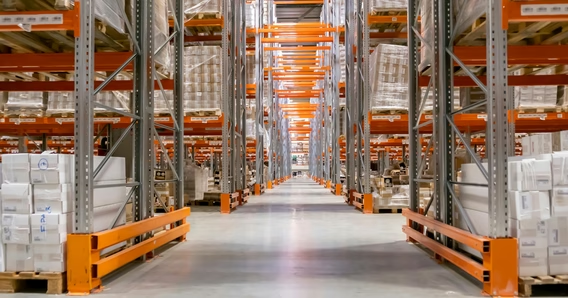
Minnesota has something almost no other state has: a real, general, merchandise-reaching public-warehouse licensing statute. Under the Minnesota Warehouse Act, anyone who stores goods, wares, records, or merchandise for compensation must hold a warehouse operator license from the state agriculture department. This is not a grain program wearing a general name — grain is a separate regime, and household goods warehouse operators are licensed in their own class. This one covers general merchandise warehousing.
And then it does the thing that makes it the most interesting licensing statute in this trade. The license carries a security requirement, and that requirement can be satisfied by either a bond or proof of warehouse operator’s legal liability insurance.
Read that again from a bailee’s side of the desk. Warehouse legal liability — the coverage that answers when a customer’s goods are destroyed in your custody, the coverage most owners in most states have never heard of until something burns — is named in a Minnesota licensing statute as a way to satisfy the state. The state is not merely aware the coverage exists. The state will accept it in place of a bond.
What the statute does not do
It does not tell you how much to buy. And that is the whole cost conversation.
A licensing statute can compel you to have the coverage. It cannot know what is on your racking tonight. The value and the nature of the customers’ goods in your care is what actually sizes the limit, and it remains the number Minnesota operators — like operators everywhere — most often understate, because that inventory never appears in their own accounts.
Value is the maximum, not the average: what is the most customer-owned freight that has ever been under this roof at once? A limit set to a comfortable Tuesday is a limit that fails in the busiest week of the year.
Nature is the driver that gets missed, and Minnesota illustrates it better than almost any state. The Twin Cities carry a large medical-device and healthcare-products cluster, and the value in a single pallet position of that freight can exceed a truckload of ordinary consumer goods. Two buildings, identical square footage, identical rack, identical sprinkler design — and nothing alike in the limit they need. Add theft attractiveness and traceability obligations and the profile shifts again.
So the license gets you to the starting line. The limit conversation is still yours to have honestly.
The state already inspected what the underwriter is about to ask
Here is the practical gift Minnesota gives an operator, and most of them never collect on it.
The warehouse operator license is conditioned on a facility inspection — fire protection, floor capacity, aisle clearance, pest control — it requires warehouse receipts, and it is tied to the specific city and buildings named in the application. A new building is a licensing event, not merely an operational one.
Now look at a warehouse submission. What does an underwriter want to know? Fire protection and whether the sprinkler design matches what you actually store and how high you stack it. Floor and rack capacity. Aisle layout. Housekeeping and pest control. The receipts and records that prove how the building runs.
<text x="350" y="30" text-anchor="middle" font-family="Inter, sans-serif" font-size="15" font-weight="600" fill="#0F4C5C">Two readers. One building. The same questions.</text>

<rect x="24" y="48" width="310" height="190" rx="10" fill="#ffffff" stroke="#C3DEDE"/>
<text x="179" y="72" text-anchor="middle" font-family="Inter, sans-serif" font-size="13" font-weight="600" fill="#0F4C5C">What the state inspects for the license</text>
<text x="179" y="100" text-anchor="middle" font-family="Inter, sans-serif" font-size="12" fill="#3F5B64">Fire protection</text>
<text x="179" y="124" text-anchor="middle" font-family="Inter, sans-serif" font-size="12" fill="#3F5B64">Floor capacity</text>
<text x="179" y="148" text-anchor="middle" font-family="Inter, sans-serif" font-size="12" fill="#3F5B64">Aisle clearance</text>
<text x="179" y="172" text-anchor="middle" font-family="Inter, sans-serif" font-size="12" fill="#3F5B64">Pest control</text>
<text x="179" y="196" text-anchor="middle" font-family="Inter, sans-serif" font-size="12" fill="#3F5B64">Warehouse receipts, city and buildings named</text>
<text x="179" y="222" text-anchor="middle" font-family="Inter, sans-serif" font-size="11" font-style="italic" fill="#3F5B64">A condition of operating at all</text>

<rect x="366" y="48" width="310" height="190" rx="10" fill="#ffffff" stroke="#C3DEDE"/>
<text x="521" y="72" text-anchor="middle" font-family="Inter, sans-serif" font-size="13" font-weight="600" fill="#0F4C5C">What the underwriter asks</text>
<text x="521" y="100" text-anchor="middle" font-family="Inter, sans-serif" font-size="12" fill="#3F5B64">Sprinkler design against what you store</text>
<text x="521" y="124" text-anchor="middle" font-family="Inter, sans-serif" font-size="12" fill="#3F5B64">Rack and floor loading</text>
<text x="521" y="148" text-anchor="middle" font-family="Inter, sans-serif" font-size="12" fill="#3F5B64">Aisle layout and traffic separation</text>
<text x="521" y="172" text-anchor="middle" font-family="Inter, sans-serif" font-size="12" fill="#3F5B64">Housekeeping and contamination control</text>
<text x="521" y="196" text-anchor="middle" font-family="Inter, sans-serif" font-size="12" fill="#3F5B64">Records that show how the building runs</text>
<text x="521" y="222" text-anchor="middle" font-family="Inter, sans-serif" font-size="11" font-style="italic" fill="#3F5B64">A condition of a good price</text>

<path d="M179 238 L320 274" stroke="#0F4C5C" stroke-width="1.5" fill="none"/>
<path d="M521 238 L380 274" stroke="#0F4C5C" stroke-width="1.5" fill="none"/>

<rect x="90" y="278" width="520" height="66" rx="9" fill="#C8935A" stroke="#0F4C5C"/>
<text x="350" y="304" text-anchor="middle" font-family="Inter, sans-serif" font-size="14" font-weight="600" fill="#1A1A1A">The same building facts, read twice</text>
<text x="350" y="328" text-anchor="middle" font-family="Inter, sans-serif" font-size="12" font-weight="600" fill="#1A1A1A">Minnesota already made you assemble the file. Use it.</text>

<text x="350" y="368" text-anchor="middle" font-family="Inter, sans-serif" font-size="12" font-style="italic" fill="#3F5B64">This is not a price. It is the paperwork a price is built on.</text>
The state has already made you produce all of it. A Minnesota operator who treats the license file as an underwriting file — current, documented, honest about what changed since the last inspection — walks into a submission holding evidence that an operator in a no-license state has to build from scratch. That is a real, unglamorous, entirely available advantage, and it is worth more than most of the things owners think will move their premium.
Cold, and the loss that leaves the racking untouched
Minnesota runs a substantial public refrigerated warehousing sector on the back of its food and agricultural economy, and cold-chain bailment fails on a different axis than dry storage. The building never burns. The temperature simply drifts, and a customer’s perishable load is a total loss with the rack, the roof, and the walls perfectly intact.
That is a distinct severity profile and it is priced as one — on the controls. Alarms. Redundancy. Backup power. Monitoring you can produce after the fact rather than describe from memory. Refrigeration and ammonia plant on a cold-storage building is an exposure in its own right.
And the state adds a compliance layer the dry warehouse does not carry: Minnesota licenses wholesale food handlers, the class written for businesses that hold, store, and distribute food to other businesses, packaged-food warehouses included. The pharmacy board separately licenses drug wholesalers and registers third-party logistics providers — and its own guidance notes the state defines a third-party logistics provider around products rather than drugs, which pulls a broader set of warehousing operations into that regime than in many states. If you warehouse for someone else in Minnesota, it is worth checking which of these reaches you before an underwriter asks.
The roof, the cold, and what they reach
Commercial property covers your structure, your racking and material-handling systems, and the income you lose while the building cannot ship. In Minnesota it is a winter document.
Snow load is the structural question for any large roof here — and the way a long-span distribution roof actually gets into trouble is drift: against parapets, against roof steps, against rooftop refrigeration units, rather than uniform accumulation. Extreme and prolonged cold is a peril in its own right, reaching sprinkler systems in unheated bays and freezing service lines. Severe convective storms bring damaging hail across the southern and western parts of the state, tornado exposure is real on the prairie side, and spring flooding along the major rivers is a separate placement.
Trace any of those to its end and you reach the same place: the roof or the pipe lets go, the water finds the racking, and the racking is holding somebody else’s goods.
Bonded freight, inland-style
Minnesota is not a container seaport state, so zone use here looks different from a coastal one — imported components and finished goods held duty-deferred at a Twin Cities distribution building or a manufacturer’s subzone rather than at a marine terminal. If you admit that freight, you take on customs obligations on top of your ordinary duty of care to the owner of the goods. Over the same pallet you now answer to two masters, and an underwriter prices the accumulation of both.
Your crew, and a five-month yard
Workers compensation is a private-market line in Minnesota and it scales with material-handling payroll and the classifications you actually run.
The universal warehouse claim set is here — forklift strikes, falls from racking and mezzanines, lifting and repetitive-reach strain on a pick-and-pack line — with a cold-weather overlay that lasts a large part of the year: iced dock aprons and yard surfaces, slip-and-fall on tracked-in snow at the dock door, and freezer work in the state’s refrigerated storage base.
There is a quieter Minnesota effect worth naming. A licensed warehouse operator’s obligations to the goods are formal, inspected, and on file. That tends to sharpen operating discipline inside the building — and operating discipline is the thing that shows up in a loss run three years later.
Claims, limits, and retention
Claims history moves pricing more than almost anything else on this page, and not merely whether you have had losses. Several small handling-damage claims say something different about how a building runs than one large one does.
Limits and retention are the genuine choice. You are deciding how much of the routine damage you fund yourself in exchange for a better price on the part you cannot afford to fund at all. An operator who absorbs ordinary handling damage and buys a serious warehouse legal liability limit against the fire and the temperature excursion is buying insurance in the right order — and in Minnesota, buying the line the statute already named.
The honest summary
Minnesota is the one state in this series where the law and the coverage are looking at each other. The Warehouse Act makes you a licensed bailee, inspects the building an underwriter would inspect, and accepts warehouse operator’s legal liability insurance as security in place of a bond.
What it will not do is tell you the number. That still comes from the freight on your beams that belongs to somebody else, on the worst night of the year — and from a contract, a sprinkler, a roof, and a temperature alarm.
If you want the coverage itself rather than the cost, start with warehouse legal liability, read the Minnesota warehouse insurance page, or see how we build a program for warehouse businesses. You can request a quote whenever you like. And if you own the goods you store rather than holding them for a customer, the license and this whole guide are the wrong frame — read the Minnesota distributor cost guide instead.