

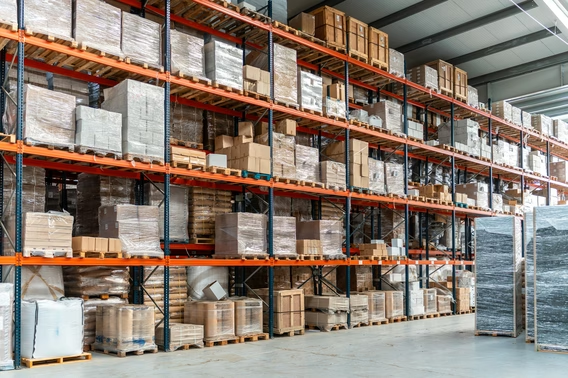
A Montana wholesaler’s inventory does not live in a warehouse. It lives on a truck.
That is only a slight exaggeration, and it is the fact a distributor here has to build its insurance around. Somebody has to hold the food, beverage, building materials, agricultural inputs, veterinary product, and equipment parts that supply towns hundreds of miles from any metro, and the wholesaler in Billings or Missoula doing that work is running distances that would cross three states almost anywhere east of here. At any given hour, an unusual share of the goods that business owns are not on a rack. They are somewhere between Billings and a customer who is a long way from Billings.
There is no published price for the insurance, and any number quoted before an underwriter has seen the operation is a guess. What an insurer actually does is build the cost from what you own, where it is, and what happens if it hurts somebody. Here is how that goes in Montana.
Goods in motion, goods at rest
Commercial property is a good policy and it does exactly one job for a distributor: it covers the building, the racking, and the owned inventory while it sits in a scheduled location, plus the business income lost when that location goes down. It stops at the walls.
In a dense state, that limitation is a modest gap. In Montana it is not modest at all, because so much of the value you own is between places. Owned goods in motion belong to a marine-family form — stock throughput — which follows the product from the supplier, through transit, into the building, and back out to the customer under one wording rather than a property-plus-cargo patchwork with seams in it.
And the absence of an ocean changes nothing about that. Montana has no seaport and no container gateway; its foreign-trade zone presence is a small northern-border and air-cargo affair, and most Montana warehousing has nothing to do with customs. The marine-family form follows goods across land transit and rail just as readily as across water, and it is the honest answer for a wholesaler whose product spends its life on I-90 and I-15.
The fullest day, not the typical one
This is the number that sizes the limit, and it is the routine mistake that costs the most money.
Owners answer the inventory question with a comfortable annual average. An underwriter is asking: what is the maximum value of owned product concentrated in one place on one day? A loss does not wait for a convenient month. It arrives when the building is fullest — for a Montana wholesaler, typically when stock is built ahead of a hard winter or a short construction season, and the shelves and the yard are both loaded.
A limit set to the quiet season is a limit that fails you in the busy one. Say the peak out loud, and let the placement answer for it.
The state’s own warehouse
If you distribute beverages, the shape of the business is decided before you open the doors.
Montana is a control state at the wholesale tier for spirits, and only there — a narrower arrangement than some of its neighbors. Distilleries, in-state and out, must ship the spirits they intend to sell here to the state liquor warehouse; the Alcoholic Beverage Control Division inside the Department of Revenue runs that warehouse and does the wholesale distribution out of it, and the agency liquor stores that sell the product at retail are privately operated. Beer and table wine move through licensed private distributors in the ordinary way.
So the state is not merely a licensor here — it runs a distribution warehouse of its own, and there is no private spirits middle tier to enter. What a private Montana beverage distributor builds is a beer and wine book. The insurance consequence is direct: that inventory is genuinely yours at every step, which is exactly why it prices as a stock-throughput exposure rather than a bailment.
Private label, imports, and the chain of distribution
Here is the driver distributors are most surprised by, because it has nothing to do with the building or the trucks.
You sit in the chain of distribution, and a products-liability claim over something that causes injury or damage can follow that chain to a seller — not only to the manufacturer who made it. A regional wholesaler that never made anything can still be named. Put your own private label on a product, or import one and become the first U.S. seller of it, and the exposure sharpens further: when the actual maker sits beyond the practical reach of a claim, the seller becomes the realistic target.
General liability answers this through what the standard form calls the products-completed-operations hazard, and sizing that limit against what you actually move — beverage, food, veterinary and animal-health product, building materials, equipment parts — rather than against a revenue band, is most of the work on a distributor’s submission.
Owned inventory in its most literal form
There is a kind of Montana distributor whose entire balance sheet is inventory, and it is worth naming because it does not look like a wholesaler at all.
A commodity dealer licensed by the state agriculture department buys grain on its own account. Not stored for a farmer, not held on somebody else’s behalf — bought, owned, and carried until it is sold. That is owned stock in the most literal form the trade offers, and it prices accordingly: the exposure is the value of the commodity, its concentration, and its movement, rather than a custody duty owed to a customer.
Elsewhere in the state, licensing follows the goods rather than the building. A food distributor or food-grade warehouse deals with a wholesale food establishment license from the state health department, with the pre-licensing inspection done by the local sanitarian before the state issues it — a county-level inspector and a state agency, both, just to open the doors. And the Board of Pharmacy licenses wholesale drug distributors and logistics providers annually, requiring a separate license for every location where drugs are stored, a rule aimed squarely at warehouses. Each of those is a compliance cost that sits alongside the premium rather than inside it.
Winter, wildfire, and the roof over your stock
Winter is the governing peril, and for an owner of inventory the consequence is direct: the goods under that roof are yours.
Sustained deep cold and heavy accumulated snow on a wide-span, low-slope roof is a genuine structural load problem in this state. Hard freeze reaches sprinkler piping, dock seals, and any product that cannot take it — freeze damage to stored goods is a real loss cause in Montana in a way it simply is not in the Southwest. Wildfire is the summer counterpart, and it carries a subtlety worth knowing: smoke and ash can contaminate stored product without a flame ever reaching the property, and a contaminated pallet is a total loss of something you paid for. High wind loads a large roof plane, and hail turns up on the eastern plains. Flood is its own placement.
The fleet, the crew, and the miles
The fleet is not a side item in a Montana distribution business — it is the business, spread across the map.
Commercial auto prices it on unit count, radius, what is hauled, and above all who drives, and in a state of long, empty, weather-exposed routes, the driver-hiring and training file is read hard. One note on language this trade cannot avoid: your insurance carrier is the company that writes your policy, which is an entirely different thing from a motor carrier or a freight carrier hauling goods for hire.
Workers compensation is a private-market line here. Montana has a competitive state fund that sits in the market alongside private insurers — not a monopolistic fund, and not the arrangement in place next door — so comp is genuinely marketed. A distributor carries two injury exposures rather than one: the warehouse crew, and the route drivers loading, unloading, and working a lift gate all day. Ice in the yard is a frequency driver for half the year.
Where a Montana distributor’s value actually sits
<text x="350" y="32" text-anchor="middle" font-family="Inter, sans-serif" font-size="15" font-weight="600" fill="#0F4C5C">Your stock is in two places at once</text>

<path d="M350 60 L350 96" stroke="#0F4C5C" stroke-width="2"/>
<path d="M150 96 L550 96" stroke="#0F4C5C" stroke-width="2"/>
<path d="M150 96 L150 122" stroke="#0F4C5C" stroke-width="2"/>
<path d="M550 96 L550 122" stroke="#0F4C5C" stroke-width="2"/>

<rect x="52" y="122" width="196" height="96" rx="8" fill="#E2F4F3" stroke="#C3DEDE"/>
<text x="150" y="150" text-anchor="middle" font-family="Inter, sans-serif" font-size="13" font-weight="600" fill="#0F4C5C">at rest, on the rack</text>
<text x="150" y="174" text-anchor="middle" font-family="Inter, sans-serif" font-size="11" fill="#3F5B64">in the Billings or Missoula</text>
<text x="150" y="190" text-anchor="middle" font-family="Inter, sans-serif" font-size="11" fill="#3F5B64">building you actually lease</text>
<text x="150" y="210" text-anchor="middle" font-family="Inter, sans-serif" font-size="11" font-weight="600" fill="#0F4C5C">the property policy answers</text>

<rect x="452" y="122" width="196" height="96" rx="8" fill="#ffffff" stroke="#0F4C5C" stroke-width="2"/>
<text x="550" y="150" text-anchor="middle" font-family="Inter, sans-serif" font-size="13" font-weight="600" fill="#0F4C5C">in motion, on the route</text>
<text x="550" y="174" text-anchor="middle" font-family="Inter, sans-serif" font-size="11" fill="#3F5B64">hours between stops, across</text>
<text x="550" y="190" text-anchor="middle" font-family="Inter, sans-serif" font-size="11" fill="#3F5B64">a state that takes all day</text>
<text x="550" y="210" text-anchor="middle" font-family="Inter, sans-serif" font-size="11" font-weight="600" fill="#0F4C5C">the property policy does not</text>

<rect x="40" y="242" width="620" height="86" rx="9" fill="#C8935A" stroke="#0F4C5C"/>
<text x="350" y="270" text-anchor="middle" font-family="Inter, sans-serif" font-size="14" font-weight="600" fill="#1A1A1A">In a state of long routes, much of what you own is between places.</text>
<text x="350" y="292" text-anchor="middle" font-family="Inter, sans-serif" font-size="14" font-weight="600" fill="#1A1A1A">A marine-family form is the only one that follows it there —</text>
<text x="350" y="314" text-anchor="middle" font-family="Inter, sans-serif" font-size="14" font-weight="600" fill="#1A1A1A">and it works over land and rail, not only over water.</text>
The honest summary
Montana is not a fulfillment-corridor state, and there is no point pretending otherwise. It is a distance business, and its distributors are priced on what they own, how far that stuff has to travel, what the winter does to the roof above it, and what happens if the product causes harm.
If you want the coverage mechanics rather than the cost drivers, stock throughput is the line this guide orbits, the Montana distributor and wholesaler insurance page goes deeper on the exposures, and our wholesaling businesses pillar covers the operating shape. And if the goods in your building belong to your customers rather than to you, none of this is your program — you want the warehouse cost guide instead.