

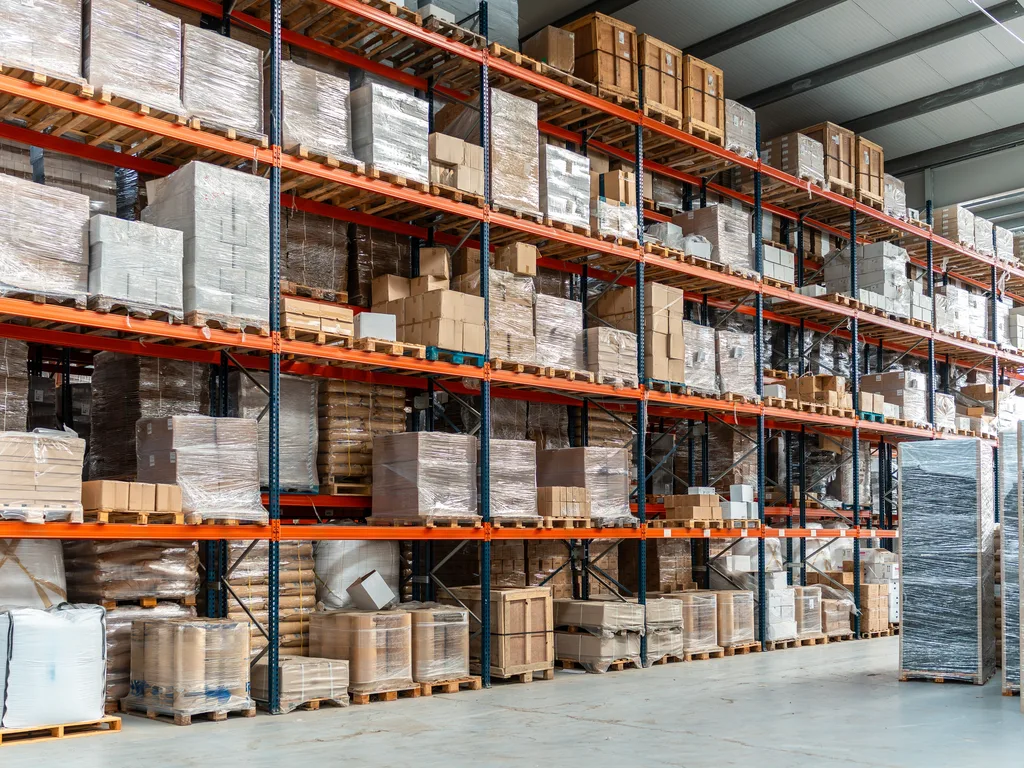
Montana produces a warehouse loss that most of the country never sees. The building does not burn. The rack does not fall. The heat fails on a February night, or a roof panel lifts in a wind event and the cold gets in, and by morning a customer’s goods are worth nothing at all — sitting on undamaged pallets, under an undamaged roof, in a building that looks entirely fine.
That is a bailee loss in its purest form, and it explains more about what a Montana warehouse pays than square footage ever will.
The loss that does not burn
<text x="350" y="32" text-anchor="middle" font-family="Inter, sans-serif" font-size="15" font-weight="600" fill="#0F4C5C">Nothing burned. Everything was lost.</text>

<rect x="24" y="56" width="190" height="86" rx="9" fill="#ffffff" stroke="#C3DEDE"/>
<text x="119" y="86" text-anchor="middle" font-family="Inter, sans-serif" font-size="13" font-weight="600" fill="#0F4C5C">The heat fails</text>
<text x="119" y="108" text-anchor="middle" font-family="Inter, sans-serif" font-size="11" fill="#3F5B64">A deep freeze, a power cut,</text>
<text x="119" y="126" text-anchor="middle" font-family="Inter, sans-serif" font-size="11" fill="#3F5B64">a bay that was never heated</text>

<path d="M214 99 L246 99" stroke="#0F4C5C" stroke-width="1.5" fill="none"/>
<path d="M240 94 L248 99 L240 104 Z" fill="#0F4C5C"/>

<rect x="252" y="56" width="190" height="86" rx="9" fill="#ffffff" stroke="#C3DEDE"/>
<text x="347" y="86" text-anchor="middle" font-family="Inter, sans-serif" font-size="13" font-weight="600" fill="#0F4C5C">The building is fine</text>
<text x="347" y="108" text-anchor="middle" font-family="Inter, sans-serif" font-size="11" fill="#3F5B64">Roof intact. Rack intact.</text>
<text x="347" y="126" text-anchor="middle" font-family="Inter, sans-serif" font-size="11" fill="#3F5B64">Your property form sees nothing.</text>

<path d="M442 99 L474 99" stroke="#0F4C5C" stroke-width="1.5" fill="none"/>
<path d="M468 94 L476 99 L468 104 Z" fill="#0F4C5C"/>

<rect x="480" y="56" width="196" height="86" rx="9" fill="#C8935A" stroke="#0F4C5C"/>
<text x="578" y="86" text-anchor="middle" font-family="Inter, sans-serif" font-size="13" font-weight="600" fill="#1A1A1A">Their goods are gone</text>
<text x="578" y="108" text-anchor="middle" font-family="Inter, sans-serif" font-size="11" font-weight="600" fill="#1A1A1A">A total loss to property</text>
<text x="578" y="126" text-anchor="middle" font-family="Inter, sans-serif" font-size="11" font-weight="600" fill="#1A1A1A">that was never yours</text>

<rect x="60" y="170" width="580" height="76" rx="9" fill="#ffffff" stroke="#C3DEDE"/>
<text x="350" y="196" text-anchor="middle" font-family="Inter, sans-serif" font-size="13" font-weight="600" fill="#0F4C5C">Warehouse legal liability answers for the whole chain</text>
<text x="350" y="218" text-anchor="middle" font-family="Inter, sans-serif" font-size="12" fill="#3F5B64">Heat, backup power, alarms, and monitoring are the controls that price it</text>
<text x="350" y="238" text-anchor="middle" font-family="Inter, sans-serif" font-size="12" fill="#3F5B64">A wildfire smoke plume runs the same chain by a different route</text>

<text x="350" y="278" text-anchor="middle" font-family="Inter, sans-serif" font-size="12" fill="#3F5B64">The cheapest Montana claim to prevent is the one where the building never fails.</text>
<text x="350" y="302" text-anchor="middle" font-family="Inter, sans-serif" font-size="12" font-style="italic" fill="#3F5B64">This is not a price. It is the loss a price is built to answer.</text>Heat, backup power, alarms, and monitoring are therefore underwriting questions here, not housekeeping ones. And wildfire runs the same chain by a different route — smoke and ash can contaminate stored goods without a flame reaching the property, which is a total loss to a customer’s inventory in a building that was never on fire.
Both of those are warehouse legal liability claims. Neither is a property claim.
What you are holding, and what it is worth
The lead driver in every warehouse program is the same, and it is the one owners consistently get wrong: the value and the nature of the goods in your care. Your own building and racking sit on your balance sheet, so you know exactly what they cost. The goods you are storing for someone else do not appear in your accounts at all — and they are the loss you are most likely to have.
In Montana that inventory has a distinctive character. It is food and beverage waiting to go out to towns hours away, animal-health and veterinary product, building materials, agricultural inputs, and equipment parts. A pallet of one of those and a pallet of another can occupy the same rack position and represent wildly different money. Value sets the limit; nature sets how badly a loss hurts. Both belong in the conversation before anyone talks about square footage.
Two kinds of Montana warehouse, and only one has a license
The state draws a hard line here, and it matters for how your exposure is defined.
If you store commodities — an elevator, a mill, a grain storage facility paid to hold or handle a producer’s crop — you are a state-licensed commodity warehouse. That regime is real: a surety requirement stands behind the operation, records of everything stored and shipped are mandatory, and the warehouse receipt is a state form that must declare on its face that the warehouse operates under a state license. Facilities licensed under the federal warehouse act are not separately state-licensed. It is a bailment with a license and a bond wrapped around it, and the state has told you, in writing, what your obligations to the depositor are.
If you store anything else, you have none of that. There is no general public-warehouse licensing statute in Montana for merchandise or fulfillment warehousing, so a regional third-party building in Billings, Missoula, or Great Falls holding inventory for an owner who lives nowhere near the state is running on its bailment and its storage agreement, full stop. The receipt is the whole of the operator’s legal position.
That absence is a cost driver. Where the state supplies no standard of care, your storage agreement supplies all of it — and an underwriter reads it. Whether your customers accepted a limitation-of-liability or released-value clause, negotiated it out, or signed something that quietly assumes you carry far more than a bare legal-liability form provides, changes the exposure the policy is being asked to size.
The roof, and what it is carrying
Commercial property covers the structure, the racking, and the income lost while the building cannot ship. In Montana the property conversation is mostly a winter conversation.
Sustained deep cold and heavy accumulated snow on a wide-span, low-slope roof is a genuine structural load problem, and the way a big roof actually gets into trouble is drift — against parapets, against roof steps, against rooftop units — rather than uniform snowfall. Hard freeze reaches sprinkler piping and dock seals. High wind loads a large roof plane. Hail turns up on the eastern plains. Flood belongs in its own placement, as it does everywhere.
And follow every one of those to its conclusion: the roof lets go, the water or the cold finds the racking, and the racking is holding a customer’s goods.
Distance is a business-income problem
One more Montana fact, and it is the one that gets left out of every generic quote.
Montana’s warehousing demand comes from distance, not density. Somebody has to hold the food, beverage, building materials, agricultural inputs, and equipment parts that supply towns hours from any metro — and that means when a Billings or Missoula building cannot ship, the customers it serves have no nearby alternative to switch to. There is no second warehouse across the industrial park.
So the business-income conversation in this state is not a formality. How long you are down, how quickly you can get a roof closed in February, and whether you can move a customer’s goods somewhere heated are all real, priced questions — for you and for the owner of the goods sitting in your building while you answer them.
Your crew on an icy apron
Workers compensation here is a private-market line. Montana does have a state fund, but it is a competitive one that sells alongside private insurers — not a monopolistic fund, and not the arrangement in place across the Wyoming line.
The warehouse claim set is the usual one: powered-industrial-truck contact, dock and trailer falls, product coming off racking, and lifting strain. What Montana adds is the yard. Ice on a dock apron generates slip-and-fall claims for five or six months of the year, and cold-room and freezer work in a food-distribution building has its own injury pattern on top of that.
The honest summary
Montana does not have a distribution corridor and there is no point pretending it does. What it has is distance — somebody has to hold the goods that supply towns hundreds of miles from a metro — and a climate that produces a specific, expensive, and preventable loss to freight that belongs to someone else.
Price that loss honestly, in a contract that says what it means, and the rest of the program follows. If you want the coverage instead of the cost, start with warehouse legal liability, read the Montana warehouse insurance page, or see how we build a program for warehouse businesses. You can request a quote any time. And if you own the inventory you store rather than holding it for a customer, this is the wrong guide — read the Montana distributor cost guide instead.