

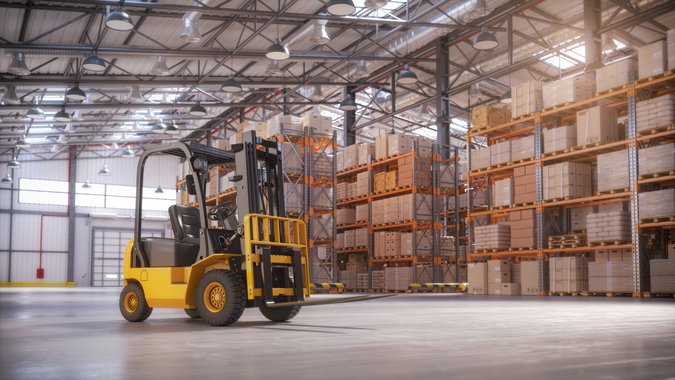
Nevada is the only place in this trade where the tax code and the underwriter are quietly working against each other, and an owner of inventory ought to know that before renewal rather than after it.
Here is the mechanism. Nevada does not tax inventory. There is no corporate income tax and no personal income tax either, but for a business that stacks owned goods, the inventory tax is the one that actually decides where the pallets go. A wholesaler can hold deep owned stock here without a carrying penalty for holding it — which is precisely the incentive that has concentrated owned goods into Reno–Sparks and North Las Vegas instead of into the coastal states those buildings serve.
That is an excellent commercial decision. It is also, straightforwardly, a bigger number for an underwriter to price. The feature that brought you to Nevada raises your maximum.
The state does not tax the depth — the limit still has to cover it
Everything a distributor sells, it owned first. And the number that sizes a stock throughput limit is not the comfortable annual average an owner instinctively quotes. It is the maximum value of owned product concentrated in one place on one day — because a loss does not wait for a convenient month, and it does not offer a discount for the fact that the stock was there for tax reasons.
Nevada distributors carry more depth than their peers in states that tax the holding. That is the whole point of being here. The failure comes when the insurance program was built around a mental model of inventory borrowed from a shallower operation somewhere else — an average that made sense in California, applied to a building in Fernley that is deliberately fuller. A limit set to the quiet season is a limit that fails in the busy one; a limit set to somebody else’s tax posture fails in every season.
The building comes before the license
If your product is beverage, Nevada does something no other state does, and it is a concrete rule with a direct cost consequence.
Start with the regulator, which is not what you expect: Nevada has no separate alcoholic beverage control agency at all. The Department of Taxation licenses the importer and wholesaler tier as part of the liquor excise-tax framework. The three-tier lines are still drawn hard — a supplier may sell only to a Nevada-licensed importer or wholesaler, the wholesaler may sell only to retailers and never at retail, and a retailer may buy only from a wholesaler.
Now the clause that matters to a warehouse owner. An applicant for the importer and wholesaler license must first have a warehouse located within Nevada, and must agree to maintain sufficient warehouse space to hold product.
Read the order of operations there. You do not get licensed and then find a building. In Nevada, the building comes before the license.
<text x="350" y="32" text-anchor="middle" font-family="Inter, sans-serif" font-size="15" font-weight="600" fill="#0F4C5C">The order the state insists on</text>

<rect x="34" y="76" width="178" height="80" rx="7" fill="#E2F4F3" stroke="#0F4C5C"/>
<text x="123" y="108" text-anchor="middle" font-family="Inter, sans-serif" font-size="13" font-weight="600" fill="#0F4C5C">A Nevada warehouse</text>
<text x="123" y="130" text-anchor="middle" font-family="Inter, sans-serif" font-size="11" fill="#3F5B64">it has to exist first</text>

<path d="M212 116 L256 116" stroke="#0F4C5C" stroke-width="3" fill="none"/>
<path d="M248 110 L258 116 L248 122 Z" fill="#0F4C5C"/>

<rect x="262" y="76" width="178" height="80" rx="7" fill="#ffffff" stroke="#0F4C5C"/>
<text x="351" y="102" text-anchor="middle" font-family="Inter, sans-serif" font-size="13" font-weight="600" fill="#0F4C5C">Then the license</text>
<text x="351" y="124" text-anchor="middle" font-family="Inter, sans-serif" font-size="11" fill="#3F5B64">issued by the tax agency,</text>
<text x="351" y="140" text-anchor="middle" font-family="Inter, sans-serif" font-size="11" fill="#3F5B64">not by a liquor board</text>

<path d="M440 116 L484 116" stroke="#0F4C5C" stroke-width="3" fill="none"/>
<path d="M476 110 L486 116 L476 122 Z" fill="#0F4C5C"/>

<rect x="490" y="76" width="178" height="80" rx="7" fill="#E2F4F3" stroke="#0F4C5C"/>
<text x="579" y="108" text-anchor="middle" font-family="Inter, sans-serif" font-size="13" font-weight="600" fill="#0F4C5C">Then the inventory</text>
<text x="579" y="130" text-anchor="middle" font-family="Inter, sans-serif" font-size="11" fill="#3F5B64">and it is all yours</text>

<path d="M560 196 L150 196" stroke="#3F5B64" stroke-width="2" fill="none" stroke-dasharray="6 5"/>
<path d="M158 190 L148 196 L158 202 Z" fill="#3F5B64"/>
<path d="M330 182 L370 210" stroke="#0F4C5C" stroke-width="3" fill="none"/>
<path d="M370 182 L330 210" stroke="#0F4C5C" stroke-width="3" fill="none"/>
<text x="350" y="234" text-anchor="middle" font-family="Inter, sans-serif" font-size="12" font-weight="600" fill="#0F4C5C">you cannot run it backwards</text>

<rect x="40" y="266" width="620" height="56" rx="9" fill="#C8935A" stroke="#0F4C5C"/>
<text x="350" y="291" text-anchor="middle" font-family="Inter, sans-serif" font-size="14" font-weight="600" fill="#1A1A1A">In Nevada, the building comes before the license.</text>
<text x="350" y="311" text-anchor="middle" font-family="Inter, sans-serif" font-size="12" font-weight="600" fill="#1A1A1A">Which means the accumulation inside it was never optional either.</text>
The insurance consequence follows immediately. The state has, in effect, legislated owned beverage inventory into an in-state building — so the accumulation is not something you can structure your way out of. And the goods on that rack are genuinely yours at every step, which is exactly why they price as a stock throughput exposure and not as somebody else’s property in your care.
The product, and the chain that finds a seller
Here is the driver distributors are most surprised by, because it has nothing to do with the building or the trucks. It is the goods themselves.
You sit in the chain of distribution, and a products-liability claim can follow that chain to a seller — not only to the manufacturer who made the item. You did not design it. You bought it and you sold it, and that is enough to be named. General liability answers this through what the standard form calls the products-completed-operations hazard, and a food or beverage line with an ingestion profile is a very different severity picture from a case of hard goods.
The licensing follows the goods, and Nevada reorganized it recently in a way worth knowing: food-establishment permitting moved from the state public-health division to the Nevada Department of Agriculture, which now runs the state food programs and separately licenses dairy distributors — so a food warehouse or food distributor now answers to agriculture. Prescription drugs run through the Nevada State Board of Pharmacy, which licenses wholesale distribution into the state, requires the license before any wholesale drug distribution occurs, and backs it with a surety bond. Those are operating costs sitting alongside the premium, and they move when your product mix moves.
Your stock landed at somebody else’s port
Nevada is an inland consolidation play, and that is the honest description of its import posture.
Bonded and duty-deferred storage here — the zone in the south held by the Las Vegas Global Economic Alliance, the Reno zone held by the Economic Development Authority of Western Nevada — is the storage side of goods that landed at a California or Pacific Northwest seaport and were trucked or railed inland. The zone is a cost tool inside a warehouse strategy, which is exactly what Nevada sells.
For an owner of inventory, that geography has one implication that matters more than the zone paperwork. An importer who is the first U.S. seller of goods landed at a coastal port and railed into a Nevada warehouse owns those goods the entire way — the water, the terminal, the drayage, the rail move, and only then the rack. When the actual manufacturer sits beyond the practical reach of a U.S. claim, that importer is also the realistic defendant for a products claim on something it never made.
Which raises the question importers most often answer by accident:
When does the risk of loss actually pass to you?
Whatever your purchase terms say, that is when your exposure begins — not when the container reaches Fernley. If risk passes early and coverage starts late, there is a stretch of ocean, highway, and rail where your own inventory is traveling uninsured by you. Stock throughput exists to close exactly that span in a single marine-family form, following owned goods from the supplier through every leg into the building and out to the customer — rather than a property-plus-cargo patchwork with a seam at every handoff.
The hospitality channel, which does not forgive
Las Vegas adds a demand base that is permanent, enormous, and utterly unforgiving: the resort economy buys food, beverage, and supply through distributors, and it does not accept a late delivery graciously.
For a distributor that owns the stock, that changes the business-income conversation. A building that cannot ship is not merely a property loss; it is a customer relationship with a contractual shape to it. Sizing business income against the real consequence of an outage — and carrying an umbrella where those customer contracts demand one — is part of the program rather than an upsell.
Fire you cannot see, heat you cannot escape, racking that has to hold
Commercial property covers the building, the racking, and the owned inventory while it sits in a scheduled location, plus the income lost when that location goes down. It stops at the walls. And Nevada tests it three ways.
Wildfire, in the north, where the Reno–Sparks industrial base sits close to open range and foothill fuel — and the loss owners forget is not flame at all: smoke and ash can foul stored goods without a fire ever touching the property, which totals your holding in an undamaged building. Extreme, sustained heat, in the south, stressing roofing, refrigeration, and the people on a North Las Vegas dock at the worst possible moment. And seismic, which is real in the west of the state and which, for a warehouse, is a racking problem rather than an architectural one: selective and drive-in rack that racks over, anchorage that pulls out of the slab, pallets off the beams, and your own high-value stock on the floor of an aisle. High desert wind loads a large roof plane and its rooftop equipment; monsoon flash flooding hits washes and low ground, and flood is its own placement rather than a property-form peril.
Deep, densely racked buildings full of owned goods are exactly the geometry that punishes weak rack anchorage — and in a no-inventory-tax state, those buildings are deliberately deeper.
The crew, the fleet, and the loss runs
Workers compensation here is a private-market line; Nevada moved off a monopolistic system decades ago, and an employer buys comp from private insurers. The exposure is heavy: the DC clusters in Reno–Sparks and North Las Vegas are where the jobs are, and a distributor carries two injury exposures, not one — the crew working forklifts, order-pickers, mezzanines, and automation pinch points at high velocity, and the route drivers loading, unloading, and working a lift gate. Peak-season hiring surges put the newest people into the busiest buildings at the busiest moment, which is exactly what a loss run tends to show.
Commercial auto prices unit count, radius, what you haul, and above all who drives, and this state runs on two spines — I-80 east–west through Reno and Sparks, and I-15 through Las Vegas and North Las Vegas straight to and from Southern California. A note on language this trade cannot avoid: your insurance carrier is the company that writes your policy, which is an entirely different thing from a motor carrier or a freight carrier hauling goods for hire.
And an underwriter reads a distributor’s claims history for shape, not count. A cargo loss on the inbound rail leg, shrinkage inside a very deep building, and at-fault fleet accidents on I-15 are three different stories about three different parts of the operation, and they price accordingly.
The honest summary
A Nevada distributor is priced on depth. The state removed the penalty for holding stock, so you hold more of it — and the maximum value standing in one building on one day is the number the limit has to answer for, whatever the tax code says about it. Then the product, the inbound leg from a port in another state, the smoke, the heat, the racking, and the drivers.
If you want the coverage mechanics rather than the cost drivers, stock throughput is the line this guide orbits, our wholesaling business insurance page covers the broader program, and the full Nevada distributor and wholesaler insurance page goes deeper on the exposures. And if the goods in your building belong to your customers rather than to you, none of the above is your program — you want the Nevada warehouse cost guide instead.