

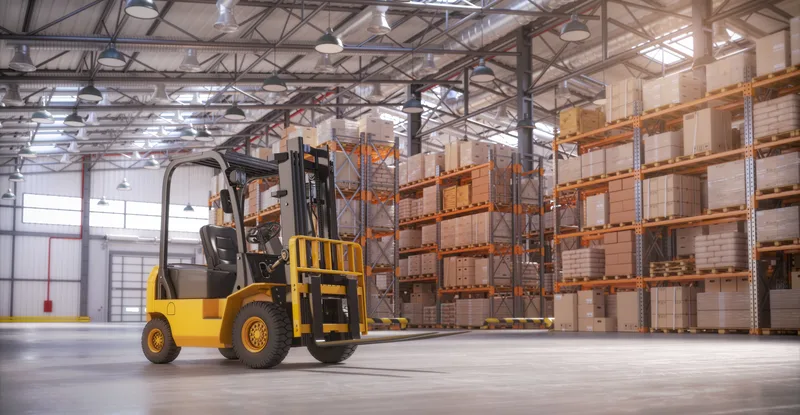
New Jersey is the state where the container is opened. Its warehouses exist because ships unload at Port Newark, at the Elizabeth terminals, at Bayonne and Jersey City — and everything in the state’s logistics arranges itself around that fact, from the Turnpike to the tight ring of buildings that sit within a drayage turn of the gate.
For a distributor, that has a very particular consequence. New Jersey is the place a great deal of imported inventory first becomes somebody’s owned stock. And the moment goods become yours is the moment your exposure begins — which is why a New Jersey cost conversation does not start where most cost conversations start. It does not start with how much you hold. It starts with when it became yours.
There is no published price for the insurance. An insurer builds the number from the operation. Here is what actually moves it.
When does the risk of loss actually pass?
Most importers answer this question by accident.
Your purchase terms may hand you ownership at the foreign supplier’s dock, at the port of loading, or on arrival. Whichever it is, that is when your exposure starts — not when the pallet lands in your building. If risk passes early and your coverage starts late, there is a stretch of ocean and highway where your own inventory is traveling uninsured by you, and that gap is invisible right up until it is a claim.
This is precisely the span stock throughput is written for: one marine-family form following the goods from the supplier, through ocean cargo, across the marine terminal, into drayage, onto the rack, and back out to the customer — instead of a property-plus-cargo patchwork with seams in it. It is largely a manuscript, non-standard market, which means the wording is negotiated rather than assumed. That is an advantage when somebody actually reads it.
Read your purchase terms before your renewal. It is the cheapest thing on this list and one of the most valuable.
How much stands in one building at once
Once the goods are yours, the next question is how much of them stand in one place at once.
Owners answer with a comfortable annual average. Underwriters are asking something sharper: what is the maximum value of owned product concentrated in one building on one day? Because a loss does not wait for a convenient month. It arrives in the season you built up for.
New Jersey widens that gap more than most states, because arrivals here are lumpy. A container lands, gets stripped, and its contents sit in a building near the port until a retailer calls for them — and a pre-season build can put an entire quarter’s inventory under one roof at one time. A limit set to the quiet season is a limit that fails you in the busy one. Seasonality is not a footnote on a distributor’s submission here; it is close to the center of it.
The product you never made
Here is the driver distributors are most surprised by, because it has nothing to do with the building or the trucks. It is the goods themselves.
You sit in the chain of distribution, and a products-liability claim over something that causes injury or damage can follow that chain to a seller — not only to the manufacturer who made it. You did not design it. You did not assemble it. You bought it and you sold it, and that is enough to be named.
For a New Jersey importer this is not a theoretical exposure, it is the central one. When you are the first U.S. seller of goods made abroad, and the actual maker sits beyond the practical reach of a claim in this country, you are the realistic target — for a product you never designed, and often one you cannot fully inspect. General liability answers this through what the standard form calls the products-completed-operations hazard, and sizing that limit against what you actually import — apparel, electronics, food, beverage, pharmaceuticals, anything with an ingestion, contact, or child-use profile — is most of the work on the submission. Supplier documentation, testing files, and the contractual position you hold upstream are what turn a defensible file into a defended one.
Water at the dock door
Commercial property does a bounded job for a distributor: it covers the building, the racking, and the owned inventory while it sits in a scheduled location, plus the business income lost when that location goes down. It stops at the walls.
The peril that actually defines New Jersey warehousing is water. The port lowlands, the Meadowlands, and the Turnpike-adjacent industrial flats sit low and drain slowly, and tropical remnants and coastal storms have repeatedly put water into ground-level dock doors — which is exactly the height at which inventory sits. For an owner of goods that is not an inconvenience; it is the destruction of the thing you paid for. Flood is its own placement, not a property-policy afterthought, and a New Jersey distribution owner should expect the flood question first rather than last.
Wind on large roof planes is real. Hail is a lesser concern than it is inland. Seismic is not part of the story here.
The bonded option, and what it adds to a loss
New Jersey gives an importer something most states do not: zone status is available across the same counties where the distribution buildings already stand — Hudson, Essex, Union, Bergen, Middlesex, and their neighbors, under the port authority’s foreign-trade zone. Duty-deferred and bonded storage is therefore an ordinary option here rather than an exotic one.
It is worth understanding what that does to a loss. When goods sit in a bonded or zone-status posture, a loss can touch duty as well as value — the exposure is not simply the wholesale cost of the product. That is a conversation to have with the placement in front of you rather than after a claim, and it is one reason a manuscript stock throughput wording earns its keep in this state.
The fleet, the crew, and the congestion
A distribution business moves its own product, and in New Jersey it moves it through some of the most congested freight geography in the country — the Turnpike, I-78, I-80, and the drayage runs into and out of the terminals.
Commercial auto prices the fleet on unit count, radius, what is hauled, and above all who drives. A note on language this trade cannot avoid: your insurance carrier is the company that writes your policy, which is an entirely different thing from a motor carrier or a freight carrier hauling goods for hire.
Workers compensation runs through the private market here, with an assigned-risk mechanism behind it. In buildings that run at port-driven volume, the claim pattern is dominated by the dock and the aisle: powered-industrial-truck strikes and pinch injuries where lift traffic crosses pedestrian paths, falls from dock edges and trailer gaps, and repetitive lifting strain on pick lines that never slow down. A distributor carries two injury exposures rather than one — the warehouse crew and the route drivers — and an underwriter will look at both.
The gap you insure by accident
<text x="350" y="32" text-anchor="middle" font-family="Inter, sans-serif" font-size="15" font-weight="600" fill="#0F4C5C">Two dates that are supposed to be the same date</text>

<path d="M50 132 L650 132" stroke="#0F4C5C" stroke-width="2"/>

<path d="M110 108 L110 156" stroke="#0F4C5C" stroke-width="3"/>
<text x="110" y="96" text-anchor="middle" font-family="Inter, sans-serif" font-size="12" font-weight="600" fill="#0F4C5C">risk of loss passes</text>
<text x="110" y="178" text-anchor="middle" font-family="Inter, sans-serif" font-size="11" fill="#3F5B64">at the supplier’s dock</text>
<text x="110" y="195" text-anchor="middle" font-family="Inter, sans-serif" font-size="11" fill="#3F5B64">the goods are yours</text>

<rect x="110" y="118" width="360" height="28" rx="4" fill="#E2F4F3" stroke="#C3DEDE"/>
<text x="290" y="137" text-anchor="middle" font-family="Inter, sans-serif" font-size="12" font-weight="600" fill="#0F4C5C">ocean · terminal · drayage</text>

<path d="M470 108 L470 156" stroke="#0F4C5C" stroke-width="3"/>
<text x="470" y="96" text-anchor="middle" font-family="Inter, sans-serif" font-size="12" font-weight="600" fill="#0F4C5C">a four-walls policy starts</text>
<text x="470" y="178" text-anchor="middle" font-family="Inter, sans-serif" font-size="11" fill="#3F5B64">at your dock door</text>
<text x="470" y="195" text-anchor="middle" font-family="Inter, sans-serif" font-size="11" fill="#3F5B64">weeks too late</text>

<text x="290" y="226" text-anchor="middle" font-family="Inter, sans-serif" font-size="13" font-weight="600" fill="#0F4C5C">everything in this stretch is owned by you</text>
<text x="290" y="245" text-anchor="middle" font-family="Inter, sans-serif" font-size="12" fill="#3F5B64">and insured by nobody</text>

<rect x="40" y="266" width="620" height="62" rx="9" fill="#C8935A" stroke="#0F4C5C"/>
<text x="350" y="290" text-anchor="middle" font-family="Inter, sans-serif" font-size="14" font-weight="600" fill="#1A1A1A">The gap is invisible until it is a claim. A marine-family form</text>
<text x="350" y="310" text-anchor="middle" font-family="Inter, sans-serif" font-size="14" font-weight="600" fill="#1A1A1A">closes it by following the goods from the day they become yours.</text>Claims history, limits, and retention
An underwriter reads a distributor’s losses for shape, not just for count. Cargo losses in transit, shrinkage inside the building, and at-fault fleet accidents are three different stories about three different parts of the operation, and one large ocean-transit claim reads very differently from a steady drip of driver incidents.
Limits and retention are the decision that is genuinely yours: how much of the routine to fund yourself in exchange for a better price on the part that could actually end the business. A distributor that absorbs ordinary shrinkage and handling damage, then buys a stock throughput limit sized to the real peak and an umbrella above a products limit sized to what it actually imports, is buying its insurance in the right order.
The honest summary
A New Jersey distributor is priced on when its goods became its own, how much of them stand in one building at once, what happens if the product it sold hurts somebody, and how high the water can get. The port made this market, and the port shapes every one of those answers.
If you want the coverage mechanics rather than the cost drivers, stock throughput is the line this guide orbits, the New Jersey distributor and wholesaler insurance page goes deeper on the exposures, and our distribution businesses pillar covers the operating shape. And if the goods in your building belong to your customers rather than to you, none of this is your program — you want the warehouse cost guide instead.