

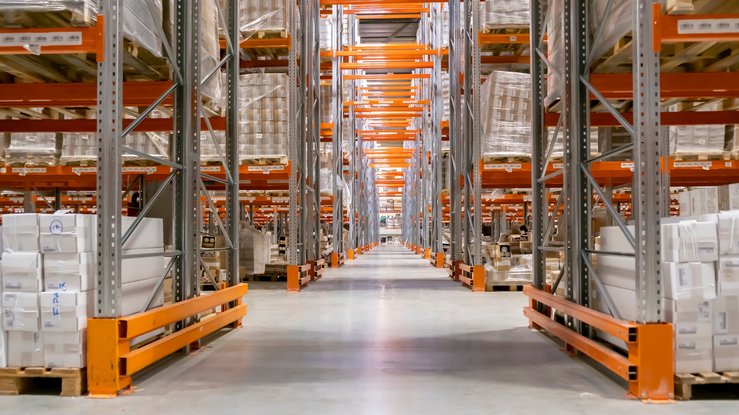
Most cost guides for distributors quietly assume a warehouse that empties out. Product comes in, product goes out, the building breathes. Price the average, adjust for the season, done.
Oklahoma does not breathe like that.
The owned stock here tends to be heavy, technical and slow-moving: oilfield and energy supply, industrial and aerospace parts, agricultural inputs, protein. It is expensive per pallet. It sits for long periods. And it moves in and out of the state on barge and rail as much as by truck. So the two assumptions a generic program is built on — that the building is usually half empty, and that the goods are only at risk while they are in it — are both wrong here, and the second one is expensive.
There is no published price for this coverage. Any figure quoted before an underwriter has understood the shape of your inventory is a guess.
The pallet that does not move
Start with dwell time, because it changes everything downstream.
A fast-turning retail warehouse hits its maximum value briefly and then relaxes. A building holding drilling equipment, aerospace parts, or a season of agricultural inputs sits near its maximum for long stretches. The peak is not a seasonal spike to be smoothed away. It is close to the normal condition.
And the value density is different too. Dense industrial goods carry far more value per pallet than cartons do — a single rack bay of technical inventory can be worth what an aisle of consumer product is worth. So the value at risk in one event is higher than the square footage suggests, and it is higher more of the time.
Both facts land in the same place: the number that sizes a stock throughput limit is not your average. It is the maximum value of owned product concentrated in one place on one day — and in Oklahoma, that day is most days.
Barge, rail, and an inland zone instead of a dock
Oklahoma sits where the country’s two great freight axes cross — I-35 running north–south, I-40 running east–west — and that is a crossroads, not a gateway. But the state has something most landlocked states do not: the Tulsa Port of Catoosa is the head of navigation on the McClellan–Kerr Arkansas River Navigation System, so barge cargo reaches Oklahoma from the Mississippi without ever touching a seaport.
The foreign-trade zones follow that logic. The Tulsa zone sits with the port authority at Catoosa; the Oklahoma City zone serves a wide region around the capital. These are inland zones, and duty-deferred storage here serves distributors staging goods well inland rather than a port throughput trade.
What does not change is the exposure. Owned goods traveling by barge, by rail, and by truck are owned goods traveling — and a policy that begins at the warehouse door starts covering them somewhere in the middle of their most vulnerable stretch. This is precisely the span a marine-family form is written for. The word “marine” throws people in a state with no coastline, but the form follows goods across land transit, rail and inland movement exactly as readily as across an ocean.
Which raises the question importers most often answer by accident:
When does the risk of loss actually pass to you?
Your purchase terms may hand you ownership at the supplier’s dock, at the point of loading, or on arrival. Whichever it is, that is when your exposure begins — not when the goods reach Catoosa. If risk passes early and coverage starts late, there is a long inland stretch where your own inventory is traveling uninsured by you.
The part that fails in service
Here is the driver distributors are most surprised by, because it has nothing to do with the building or the trucks.
You sit in the chain of distribution, and a products-liability claim over something that causes injury or damage can follow that chain to a seller — not only to the manufacturer who made it. You did not design it. You did not machine it. You bought it and sold it, and that is enough to be named.
Oklahoma makes the point sharply, because of what its distributors hold. A component that fails in an energy or aerospace application is a severity conversation in a league of its own — the consequences of a failure are not measured in the price of the part. Protein and food distribution carries an ingestion profile that industrial goods do not, and it is regulated on the goods themselves: meat and poultry distributors register with the Department of Agriculture, Food and Forestry, and prescription-drug wholesalers license with the state pharmacy board.
General liability answers this through what the standard form calls the products-completed-operations hazard, and sizing that limit against what your goods actually do in service — rather than against a generic revenue band — is most of the work on an Oklahoma submission.
The ABLE license, and the order things happen in
If you distribute beverages, Oklahoma is a license state with a comparatively modern middle tier — the system was rewritten not long ago, and the distributor tier that came out of it is privately held.
The ABLE Commission licenses manufacturers, wholesalers, retailers and the people who serve. The sequencing is the part worth knowing: wholesalers must hold the appropriate license before they can even register the brands they intend to carry, which makes brand registration a downstream consequence of the license rather than a parallel step. A beverage wholesaler buys from producers, warehouses the product, and delivers to licensed retail — never to the public.
The insurance consequence is direct rather than incidental: the inventory in that warehouse is genuinely yours at every step, which is exactly why it is a stock-throughput exposure and not a bailment. The compliance obligations of a licensed middle tier are a real operating cost sitting alongside the premium, not inside it.
Wind and hail on the biggest surface in the state
Commercial property does a bounded job: your building, your racking, and your owned goods while they sit still, plus the income you lose when the location goes down. It stops at the walls.
Oklahoma is a wind and hail state before it is anything else, and a distribution center is an unfortunate shape for both. Tornado exposure is genuine and severe, and a large-footprint building cannot be sited out of it. But hail is the more frequent loss: a supercell bruises an entire membrane roof at once, and the water that follows reaches the racking and the stored goods long before anyone gets a repair crew up there. Straight-line wind does comparable damage without the headline. Winter brings ice loading and hard freezes that stress sprinkler piping. Flood is a localized, riverine problem here rather than a statewide one — and where it applies, it belongs in its own placement.
The fleet, the crew, and freight that does not behave like cartons
A distribution business moves its own product, which puts trucks on the crossroads. Commercial auto prices the fleet on unit count, radius, what is hauled, and above all who drives. And a word this trade uses two ways: your insurance carrier writes your policy; a motor carrier or freight carrier hauls freight for hire.
Workers compensation is a private-market line here — no state monopoly, and no opt-out like the one across the river in Texas. The warehouse claim profile is the standard one and none the milder for it: powered industrial truck strikes and tip-overs, falls from racking and mezzanines, loads coming down during putaway, dock-plate and trailer-creep injuries, and the repetitive lifting strain that quietly produces the most lost time in any distribution center. What Oklahoma adds is the freight itself: heavy agricultural, energy and manufacturing supply chains push denser, more awkward material through these buildings than a purely retail state would — and dense freight injures people differently than cartons do.
What the underwriter is actually pricing
<text x="350" y="32" text-anchor="middle" font-family="Inter, sans-serif" font-size="15" font-weight="600" fill="#0F4C5C">Not all owned inventory behaves the same way</text>

<rect x="36" y="54" width="290" height="216" rx="8" fill="#ffffff" stroke="#C3DEDE"/>
<text x="181" y="80" text-anchor="middle" font-family="Inter, sans-serif" font-size="13" font-weight="600" fill="#0F4C5C">light and fast</text>
<rect x="76" y="98" width="40" height="20" rx="2" fill="#ffffff" stroke="#C3DEDE"/>
<rect x="130" y="98" width="40" height="20" rx="2" fill="#ffffff" stroke="#C3DEDE"/>
<rect x="184" y="98" width="40" height="20" rx="2" fill="#ffffff" stroke="#C3DEDE"/>
<text x="181" y="146" text-anchor="middle" font-family="Inter, sans-serif" font-size="12" fill="#3F5B64">cartons, consumer goods</text>
<text x="181" y="172" text-anchor="middle" font-family="Inter, sans-serif" font-size="12" fill="#3F5B64">modest value per pallet</text>
<text x="181" y="198" text-anchor="middle" font-family="Inter, sans-serif" font-size="12" fill="#3F5B64">the building empties often</text>
<text x="181" y="234" text-anchor="middle" font-family="Inter, sans-serif" font-size="12" font-weight="600" fill="#0F4C5C">the peak is brief</text>

<rect x="374" y="54" width="290" height="216" rx="8" fill="#E2F4F3" stroke="#0F4C5C"/>
<text x="519" y="80" text-anchor="middle" font-family="Inter, sans-serif" font-size="13" font-weight="600" fill="#0F4C5C">dense and slow</text>
<rect x="446" y="94" width="60" height="28" rx="2" fill="#ffffff" stroke="#0F4C5C"/>
<rect x="532" y="94" width="60" height="28" rx="2" fill="#ffffff" stroke="#0F4C5C"/>
<text x="519" y="146" text-anchor="middle" font-family="Inter, sans-serif" font-size="12" fill="#3F5B64">energy, aerospace, ag supply</text>
<text x="519" y="172" text-anchor="middle" font-family="Inter, sans-serif" font-size="12" fill="#3F5B64">high value per pallet</text>
<text x="519" y="198" text-anchor="middle" font-family="Inter, sans-serif" font-size="12" fill="#3F5B64">the building stays full</text>
<text x="519" y="234" text-anchor="middle" font-family="Inter, sans-serif" font-size="12" font-weight="600" fill="#0F4C5C">the peak is the normal day</text>

<text x="519" y="290" text-anchor="middle" font-family="Inter, sans-serif" font-size="12" font-weight="600" fill="#0F4C5C">Oklahoma sits here</text>

<rect x="40" y="308" width="620" height="48" rx="9" fill="#C8935A" stroke="#0F4C5C"/>
<text x="350" y="338" text-anchor="middle" font-family="Inter, sans-serif" font-size="14" font-weight="600" fill="#1A1A1A">When the stock barely turns, the peak is not a spike. Set the limit to it.</text>The honest summary
An Oklahoma distributor is priced on the shape of its stock: heavy, valuable per pallet, slow to turn, and exposed across barge, rail and highway long before and long after it is in the building. Add what those goods do if they fail in service, a roof that hail will find, and a fleet that runs the crossroads, and you have most of the submission. Nothing here is a gateway; everything here is a crossroads — and the coverage has to follow the goods, not the address.
For coverage mechanics rather than cost drivers, stock throughput is the line this guide orbits, wholesaling businesses is the broader program view, and the Oklahoma distributor and wholesaler insurance page goes deeper on the exposures. And if the goods on your racking belong to your customers rather than to you — a crossroads warehouse holding another company’s freight because the truck cycle works here — none of the above is your program. Read the Oklahoma warehouse cost guide instead.