

Oklahoma has a law called the Public Warehouse and Commodity Indemnity Act.
Read that title, run a warehouse, and you would be forgiven for concluding that the state charters public warehouses and that you must be one of them. It is one of the most reasonable wrong conclusions an owner can reach in this business.
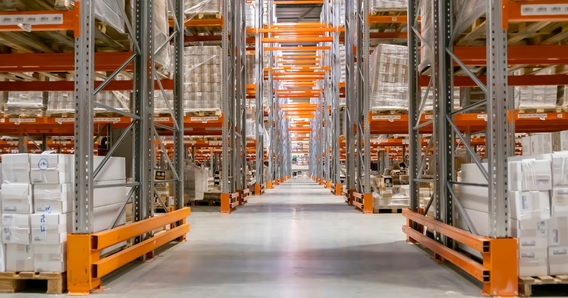
It is a grain law. The Department of Agriculture, Food and Forestry charters public grain warehouses under that statute, and despite the words in the name, the scope is commodities, not merchandise. A contract, public, or fulfillment warehouse holding pallets of consumer goods, oilfield tooling, or aerospace parts is not chartered under it and never was.
So the honest and slightly uncomfortable summary is this: your state has a statute with public warehouse in the title, and it will not help you price this building. What prices this building is the bailment — and the paperwork you wrote yourself.
What Oklahoma actually does reach into
Two registrations matter here, and neither is a general warehouse license. Both are worth knowing, because they tell you which side of a line your building is on.
Meat and poultry. The Department of Agriculture, Food and Forestry’s Food Safety Division registers distributors, meat brokers, and public warehousemen who handle meat and poultry, and that registration brings compliance reviews with it. So a protein warehouse in Oklahoma is a registered premises. A general warehouse across the road is not.
Prescription drugs — and this one is genuinely interesting. The Oklahoma State Board of Pharmacy licenses wholesale distributors, repackagers, and third-party logistics providers. Which means a contract warehouse that merely stores and ships drugs for a manufacturer, without ever owning a pill, is nonetheless a licensed drug facility in its own right. The state has written the bailee/owner distinction straight into its licensing scheme: you do not have to own the goods to be regulated for holding them.
Grain elevators are chartered and bonded. The general contract warehouse, though, holds no state license at all, and its liability for a customer’s goods is fixed by its warehouse receipt and storage agreement.
That absence is a cost driver, not a footnote. Whether your customer accepted a limitation-of-liability or released-value clause, negotiated it away to win the account, or signed something that quietly assumed you carry more than a bare legal-liability form provides — all of it changes the exposure the policy is being asked to size. An underwriter reads those documents, because in the general lane the storage contract is the regulation.
What is on the racks, and what it weighs
The warehouse legal liability limit is sized by the value and the nature of the goods in your care, and it is the figure operators most reliably understate — because that inventory never appears in their own accounts.
Value is the maximum amount of customer-owned freight under your roof on the worst possible day, not on an average one.
Nature, in Oklahoma, deserves more room than it gets in most states. The bailee here is usually a crossroads operator — a third-party warehouse holding another company’s inventory in the middle of the country because the middle of the country is where the truck cycle works. And the mix that pulls in is not retail cartons. It is oilfield and industrial equipment, agricultural inputs, aerospace parts, and consumer freight — and the heavy items on that list are exactly the goods whose damage claims are hardest to argue about.
High value per piece. Rigging involved. Damage that is not always visible and not always obviously anyone’s fault. A pallet of cartons and a crate of oilfield tooling can occupy the same rack position and produce claims that are nothing alike.
Hail is the frequent loss. Tornado is the severe one
Oklahoma is a wind and hail state before it is anything else, and a distribution center is an unfortunate shape for both.
Hail is the more frequent loss and it is the sneaky one: a supercell bruises an entire membrane roof at once, and the resulting water damage reaches the racking and the stored goods long before anyone gets a repair crew on the roof. Straight-line wind events do comparable damage without the headline.
Tornado exposure is genuine and severe across the state, and a large-footprint building cannot be sited out of it. Winter brings ice loading and hard freezes that stress sprinkler piping — the quiet claim where a wet line lets go and soaks a customer’s stored goods without a fire ever starting.
Flood is a localized, riverine problem rather than a statewide one, and belongs in its own placement where it applies.
Your structure, racking, material-handling systems, and the business income lost while a site is down sit on the commercial property side. But observe the pattern: in each of those perils, the building gets damaged and then somebody else’s goods get destroyed.
Bonded, a long way from a dock
Oklahoma’s foreign-trade zones are inland zones, which is the point of them. The Tulsa zone is held by the City of Tulsa–Rogers County Port Authority and sits with the Tulsa Port of Catoosa; the Oklahoma City zone is held by the Oklahoma City Port Authority and serves a wide multi-county region around the capital.
Catoosa is the head of navigation on the McClellan–Kerr Arkansas River Navigation System, so barge cargo reaches Oklahoma from the Mississippi without ever touching a seaport. Bonded and duty-deferred storage here therefore serves manufacturers and distributors staging goods well inland rather than a port throughput trade.
For a bailee the pricing consequence is the same as it is anywhere: when you admit duty-deferred goods, you take on customs obligations on top of your ordinary duty of care to the owner. Two masters, one pallet, and an underwriter pricing the accumulation of both.
The crew, and freight that does not behave
Workers compensation is a private-market line here, administered through the state’s workers’ compensation commission — no state monopoly, and no Texas-style opt-out across the river. It scales with your material-handling payroll and the classifications you actually run.
The warehouse claim profile is the standard one and none the milder for it: powered industrial truck strikes and tip-overs, falls from racking and mezzanines, loads coming down during putaway, dock-plate and trailer-creep injuries, and the repetitive lifting strain that quietly produces the most lost time in any distribution center.
But Oklahoma’s agricultural, energy, and manufacturing supply chains push more awkward, dense freight through its warehouses than a purely retail state would — and dense freight injures people differently than cartons do. The lift is different, the rigging is different, and the consequences of getting it wrong are different. That is a real underwriting distinction, not a rhetorical one.
Claims history, and the retention a heavy-freight operator should actually want
Two levers remain, and one of them is genuinely yours to pull.
Claims history moves pricing more than almost anything else on this list — and not simply whether you have had losses, but what they say about how the building runs. Three small handling-damage claims tell an underwriter something quite different from one large one, and in an Oklahoma warehouse those two patterns really do describe different businesses.
Limits and retention are a real choice, and heavy freight sharpens it. An operator whose losses are infrequent but expensive per piece is in a different position from a fulfillment house absorbing constant small damage. The honest framing is that you are deciding how much of the routine you want to fund yourself in exchange for a better price on the part you genuinely cannot afford — and for a crossroads warehouse holding oilfield tooling or aerospace parts for somebody else, the part you cannot afford is the customer’s cargo, not your own steel.
A warehouse that can comfortably absorb its own routine handling damage, and that buys a serious warehouse legal liability limit for the fire, the hail breach, and the rack failure, is usually buying its insurance in the right order.
One name. Two very different destinations
<text x="350" y="30" text-anchor="middle" font-family="Inter, sans-serif" font-size="15" font-weight="600" fill="#0F4C5C">Read the title, take the wrong turn</text>

<rect x="130" y="48" width="440" height="66" rx="9" fill="#C8935A" stroke="#0F4C5C"/>
<text x="350" y="74" text-anchor="middle" font-family="Inter, sans-serif" font-size="15" font-weight="600" fill="#1A1A1A">A statute with “public warehouse” in its name</text>
<text x="350" y="98" text-anchor="middle" font-family="Inter, sans-serif" font-size="13" font-weight="600" fill="#1A1A1A">Every warehouse owner in the state assumes it means them</text>

<path d="M280 116 L280 140 L180 140 L180 166" stroke="#0F4C5C" stroke-width="2" fill="none"/>
<path d="M420 116 L420 140 L520 140 L520 166" stroke="#0F4C5C" stroke-width="2" fill="none"/>

<rect x="40" y="168" width="280" height="48" rx="9" fill="#ffffff" stroke="#0F4C5C"/>
<text x="180" y="188" text-anchor="middle" font-family="Inter, sans-serif" font-size="13" font-weight="600" fill="#0F4C5C">Where it actually goes</text>
<text x="180" y="207" text-anchor="middle" font-family="Inter, sans-serif" font-size="12" fill="#3F5B64">Grain. Chartered and bonded elevators.</text>

<rect x="380" y="168" width="280" height="48" rx="9" fill="#ffffff" stroke="#0F4C5C"/>
<text x="520" y="188" text-anchor="middle" font-family="Inter, sans-serif" font-size="13" font-weight="600" fill="#0F4C5C">Where your building is</text>
<text x="520" y="207" text-anchor="middle" font-family="Inter, sans-serif" font-size="12" fill="#3F5B64">Merchandise, contract, fulfillment.</text>

<rect x="40" y="228" width="280" height="60" rx="9" fill="#ffffff" stroke="#C3DEDE"/>
<text x="180" y="252" text-anchor="middle" font-family="Inter, sans-serif" font-size="12" fill="#3F5B64">Licensed, audited, and backed by</text>
<text x="180" y="272" text-anchor="middle" font-family="Inter, sans-serif" font-size="12" fill="#3F5B64">a commodity indemnity scheme</text>

<rect x="380" y="228" width="280" height="60" rx="9" fill="#ffffff" stroke="#C3DEDE"/>
<text x="520" y="252" text-anchor="middle" font-family="Inter, sans-serif" font-size="12" fill="#3F5B64">Not chartered. Not licensed. Not reached.</text>
<text x="520" y="272" text-anchor="middle" font-family="Inter, sans-serif" font-size="12" fill="#3F5B64">Only the receipt and the agreement.</text>

<text x="350" y="330" text-anchor="middle" font-family="Inter, sans-serif" font-size="12" font-style="italic" fill="#3F5B64">Which is why the contract, not the statute, is what an underwriter reads.</text>
The honest summary
Nothing in Oklahoma is a gateway. Everything in Oklahoma is a crossroads — I-35 and I-40 meeting, barge navigation reaching all the way inland to Catoosa, and a distribution building filling up because of drive time rather than because of anybody who lives nearby.
So the price is built on the freight that crossroads brings you: heavy, technical, expensive per piece, and belonging to somebody else. On a roof that hail will find. And on a storage contract that has to do the whole job, because the statute that sounds like it protects you is talking about grain.
To see how the coverage itself works rather than what it costs, start with warehouse legal liability, or read the full Oklahoma warehouse insurance page. Our warehouse businesses practice explains how we approach the class. And if you own the goods you hold — an oilfield-supply house, an aerospace parts distributor, a beverage wholesaler — none of the above is your program: read the distributor cost guide instead.