

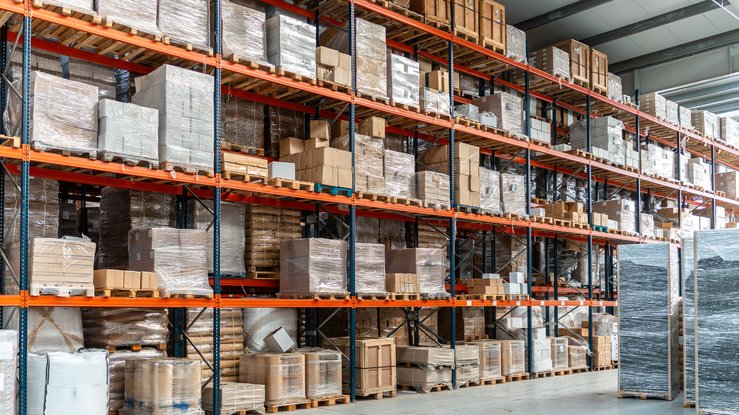
There is no published price for distributor or wholesaler insurance in Oregon, and any figure quoted before an underwriter has seen your building is a guess. An insurer builds the cost from your operation — and in Oregon the operation has a shape that shows up nowhere else on the coast. This state holds more owned inventory than its population has any business explaining.
Oregon is a consolidation state, and consolidation is accumulation
Two facts push in the same direction here. The first is geography: the Willamette Valley is the I-5 pass-through between the Seattle metro and California, so a company can serve the entire coast from one building instead of three. The second is tax posture: Oregon has no general sales tax, a genuine national outlier, and it makes the state attractive for consolidation, cross-dock, and direct-to-consumer fulfillment in ways that reach far beyond Oregon’s own consumers.
Both are sound business decisions. Both of them do the same thing to your risk profile: they put more owned value under a single roof, pointed at more destinations, than a distributor in a state of comparable size would ever carry.
That is the accumulation problem, and it is the thing an underwriter is actually pricing. The number that sizes a stock throughput limit is not what you typically hold — it is the maximum value of owned product concentrated in one place on one day. Owners answer with an annual average almost every time, and it is the most expensive routine mistake in this trade, because a loss does not wait for a convenient month. It arrives in the season you built up for, when the consolidation building is doing exactly the job you built it to do.
<text x="350" y="32" text-anchor="middle" font-family="Inter, sans-serif" font-size="15" font-weight="600" fill="#0F4C5C">Why one building is the efficient answer — and the expensive one</text>

<rect x="272" y="106" width="156" height="86" rx="8" fill="#E2F4F3" stroke="#0F4C5C"/>
<text x="350" y="140" text-anchor="middle" font-family="Inter, sans-serif" font-size="13" font-weight="600" fill="#0F4C5C">one building</text>
<text x="350" y="162" text-anchor="middle" font-family="Inter, sans-serif" font-size="12" fill="#3F5B64">all of the owned stock</text>
<text x="350" y="180" text-anchor="middle" font-family="Inter, sans-serif" font-size="12" fill="#3F5B64">all of the value</text>

<path d="M272 128 L146 84" stroke="#0F4C5C" stroke-width="2" fill="none"/>
<path d="M272 172 L146 214" stroke="#0F4C5C" stroke-width="2" fill="none"/>
<path d="M428 128 L556 84" stroke="#0F4C5C" stroke-width="2" fill="none"/>
<path d="M428 172 L556 214" stroke="#0F4C5C" stroke-width="2" fill="none"/>
<path d="M350 106 L350 68" stroke="#0F4C5C" stroke-width="2" fill="none"/>
<path d="M350 192 L350 232" stroke="#0F4C5C" stroke-width="2" fill="none"/>

<text x="104" y="80" text-anchor="middle" font-family="Inter, sans-serif" font-size="12" fill="#3F5B64">a market</text>
<text x="104" y="222" text-anchor="middle" font-family="Inter, sans-serif" font-size="12" fill="#3F5B64">a market</text>
<text x="596" y="80" text-anchor="middle" font-family="Inter, sans-serif" font-size="12" fill="#3F5B64">a market</text>
<text x="596" y="222" text-anchor="middle" font-family="Inter, sans-serif" font-size="12" fill="#3F5B64">a market</text>
<text x="350" y="62" text-anchor="middle" font-family="Inter, sans-serif" font-size="12" fill="#3F5B64">a market</text>
<text x="350" y="250" text-anchor="middle" font-family="Inter, sans-serif" font-size="12" fill="#3F5B64">a market</text>

<rect x="40" y="272" width="620" height="56" rx="9" fill="#C8935A" stroke="#0F4C5C"/>
<text x="350" y="298" text-anchor="middle" font-family="Inter, sans-serif" font-size="14" font-weight="600" fill="#1A1A1A">Consolidation concentrates the loss, not just the freight.</text>
<text x="350" y="318" text-anchor="middle" font-family="Inter, sans-serif" font-size="12" font-weight="600" fill="#1A1A1A">The limit has to answer for everything gathered in that one place.</text>
The perils that punish concentrated stock
Once the accumulation is honest, the peril conversation follows from it, and Oregon’s peril set is specific. It is not the hail-and-tornado story of the interior and it should never be dressed up as one.
Cascadia. The subduction zone runs offshore, and for a warehouse the seismic exposure is not an abstraction about the building code — it is the rack. Racking that is unanchored, overloaded, or not braced for a long-duration shake will fail before the shell does, and the goods on it end up in the aisle. Earthquake is a separate placement from the standard property form, and it is the placement a Willamette Valley operator most often gets wrong by default — not by decision.
Wildfire, and the part of it owners dismiss. Oregon’s fire seasons have reached the valley margins, and the smoke reaches much farther than the flame. Stored goods — food, packaging, textiles, anything absorbent or consumable — can be contaminated to the point of being unsellable in a building the fire never touched. That is a stock loss with no structural damage attached to it, and whether your program responds to it is a wording question rather than a limit question.
Flood is its own placement again, and it concentrates along the Willamette and Columbia floodplains — which is precisely where a great deal of Oregon’s industrial land happens to sit. Coastal windstorm rounds it out.
Which is why commercial property has a bounded job here and should be understood that way: it covers the building, the racking, and the owned inventory while it sits in a scheduled location, plus the income lost when the location goes down. It stops at the walls, and two of Oregon’s three signature perils walk right through them.
The spirits the state warehouses for itself
If beverages are your book, Oregon is a control state — and, as always, that phrase means nothing until you say which tier.
The tier Oregon occupies is the distilled-spirits wholesale tier. The Oregon Liquor and Cannabis Commission itself buys, warehouses, and distributes distilled spirits out of a central warehouse in the Portland area to retail liquor stores. Those stores are run by independent agents under contract with the commission rather than by state employees — so the state’s hand is on the wholesale tier and on the product, not on the store payroll. Beer and wine are a different world entirely: those move through privately licensed wholesalers.
The practical consequence for an owner of inventory is simple and material. A beverage distributor in Oregon may own and warehouse beer and wine, while the spirits it might otherwise have handled never enter its building at all. That is a genuinely different balance sheet than a license state next door, and it changes what there is to insure. In the tiers you can occupy, the stock is yours at every step — which is exactly why it is a stock-throughput exposure rather than somebody else’s goods in your care.
The same ownership logic runs through Oregon’s other licensed distribution classes. The Department of Agriculture licenses food warehousing directly, and the Board of Pharmacy registers wholesalers by class. In each case the state is regulating you on the goods you own.
What you sell, and where your risk actually began
The driver distributors are most surprised by is the product itself, because it has nothing to do with the building or the trucks.
You sit in the chain of distribution, and a products-liability claim over something that injures a person or damages property can follow that chain to a seller — not only to the maker. Oregon’s owned-goods economy runs to valley produce and packaged food, dairy, wine and craft beverage, wood products, and the imported components and equipment feeding Portland’s west-side technology cluster. Those are not one conversation. A consumable with an ingestion profile carries a different severity picture than a hard good, and an importer of a component that ends up inside somebody else’s finished machine carries the first U.S. seller position for it. General liability answers this through the products-completed-operations hazard, and sizing it against what you truly move is most of the work.
Which brings the import leg. The Port of Portland runs marine terminals on the Columbia and Willamette, and the metro’s foreign-trade zone is a real but focused footprint — one grantee, one metro. A component distributor bringing stock in through the port or on an airfreight lane into a Washington County warehouse has owned that stock for a long time before it landed:
When does the risk of loss actually pass to you?
If it passes at the supplier’s dock and your coverage starts at your dock, there is a stretch of ocean and highway where your own goods are traveling uninsured by you. That gap is invisible until it is a claim. A marine-family stock throughput form is written to close it — one policy following the goods through ocean cargo and inland transit into the building and out to the customer, instead of a property-plus-cargo patchwork with seams in it.
The fleet, the crew, and the wet season
Commercial auto prices unit count, radius, what is hauled, and above all who drives — and an Oregon fleet runs the I-5 corridor and the Gorge, which are two different driving jobs. A note on language this trade cannot avoid: your insurance carrier is the company that writes your policy, an entirely different thing from a motor carrier or freight carrier hauling goods for hire.
On workers compensation, Oregon is a private-market state and you buy comp in the open market. A distributor carries two injury exposures rather than one: the warehouse crew on powered industrial trucks, order-pickers, and the pick line, and the route drivers loading and unloading all day. Oregon adds a plain, practical wrinkle the drier states do not carry to the same degree — slick dock plates and truck-court surfaces through a long wet stretch, which is a slip-and-fall driver that shows up in the loss runs whether or not anyone plans for it.
Reading the claims, choosing the limits
Claims history is read for shape, not count: cargo in transit, shrinkage in the building, and at-fault fleet losses are three different stories about three different parts of the operation. Limits and retention are the lever entirely in your hands — fund the routine handling damage yourself, and put the money into a stock throughput limit sized to the peak, a products limit sized to what you actually sell, and an umbrella sitting over the tail rather than the noise.
An Oregon distributor is priced on how much it has gathered into one place, what that product is, how far it traveled while it was already yours, and what a shake or a smoke season would do to it. If you want the coverage mechanics rather than the cost drivers, stock throughput is the line this whole guide orbits, the wholesaling businesses pillar covers how these programs are assembled, and the Oregon distributor and wholesaler insurance page goes deeper. If the goods in your building belong to your customers rather than to you, this is the wrong guide — read the warehouse cost guide, or ask us for a quote and we will rate the operation you actually run.