

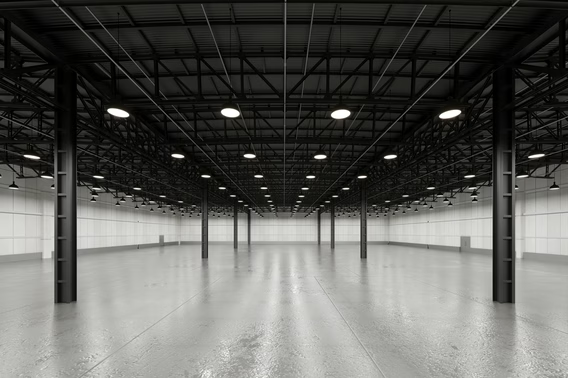
Shippers choose Oregon for a specific reason: they want one Northwest building instead of a Seattle building and a California building. The I-5 corridor makes that work, and the tax posture helps, and so a distribution operator here ends up holding rather more of somebody else’s inventory under a single roof than the square footage would suggest.
Concentration is the beginning of the cost story. It is also the beginning of the risk.
Everything under that roof belongs to somebody else
The corridor is legible — the port district and Rivergate, Gresham, Wilsonville, Tualatin, Woodburn, then down the valley to Salem, Albany, Eugene. The buildings along it hold freight for shippers who wanted one Northwest location, and the operators running them will never own a pallet of it.
The value and the nature of the customers’ goods in your care is what sizes a warehouse legal liability limit, and it is the figure operators most often understate — because that inventory never appears in their own accounts.
Value is the peak: the fullest week, not an average one, and in a consolidation building the peak is high by design. Nature is what the goods actually are, and Oregon’s range is genuinely varied — packaged consumer product moving down the corridor, imported components and equipment feeding the technology manufacturing cluster on Portland’s west side, and a grower’s or packer’s frozen product in the valley’s coolers. Same footprint, entirely different amounts at risk per pallet position, entirely different routes to a total loss.
The quake does not come for your building. It comes for your racking.
This is the sentence that makes Oregon different from every state east of the mountains, and it is the one most often skipped.
The Cascadia subduction zone runs offshore. For a warehouse, the seismic exposure is not an abstraction about the building code — it is the rack. Storage racking that is not properly anchored, that is overloaded, or that is unbraced for a long-duration shake will fail before the shell does. The anchorage pulls out of the slab. The beams deflect. The pallets come off. And what ends up in the aisle belongs to a customer.
Two consequences follow, and both reach the price.
Earthquake is a separate placement. It is not a peril the standard commercial property form carries, and it is the placement decision a Willamette Valley operator most often gets wrong by default — by never actively making it.
Rack discipline is your cheapest control. Anchorage, load ratings, bracing, and inspection records are a seismic control and a workplace-safety control in the same breath, and an underwriter reads them as evidence about how the whole building is run.
The perils that ruin their goods, not yours
Once you look at Oregon through a bailee’s eyes, an uncomfortable pattern appears: the perils most likely to destroy your customers’ goods are the ones your property policy was never carrying.
Wildfire smoke. Oregon’s fire seasons have reached the valley margins, and the smoke reaches far beyond the flame. Smoke and ash contamination can total stored inventory in a building that never saw fire — no burning, no structural damage, and a customer’s goods ruined all the same.
Flood. Its own placement again, concentrating along the Willamette and Columbia floodplains, which is exactly where a great deal of industrial land happens to sit.
Temperature. A refrigeration failure destroys a customer’s frozen product with the racking untouched. It is a total loss with nothing to photograph.
Windstorm off the coast rounds it out. Hail and tornado are not the Oregon story and it would be dishonest to dress them up as one.
Where Oregon actually does put a license on holding someone else’s goods
Two places, and they are worth being precise about.
The food warehouse is licensed directly. The Department of Agriculture’s food-safety licensing covers processing and warehousing — a facility that stores and distributes food for others holds a food-storage-warehouse license, while a processor warehousing its own finished product at the same site does not need a separate one. That distinction is, in effect, the whose-goods line written into a licensing rule. Cold storage is a genuine bailee concentration in this state, because the valley’s food processors, berry and vegetable packers, and the Columbia River’s frozen-goods trade all put other people’s product into freezers that somebody else runs.
The grain warehouse is licensed separately. Chapter 586 requires a warehouse license and a bond for grain storage, with federally licensed grain warehouses able to substitute their federal license. That is a grain regime, and reading it as a general public-warehouse license would be a mistake — the kind of mistake that leads an operator to believe the state has given it a standard of care when it has not.
There is one more, and it is quietly the sharpest: the Board of Pharmacy registers a facility providing third-party logistics services for drugs as a drug distribution agent. Both that and the food rule reach a warehouse that never owns what it stores.
For everything else — the pallets of consumer goods in Portland or Salem — Oregon licenses nobody. Your obligations come from the bailment: the storage contract, the warehouse receipt, and the care standard that attaches to holding another party’s goods. And because no statute writes you a standard of care, the contract is the entire perimeter around a claim, which is why an underwriter reads it before quoting anything.
Fire protection, and the system that has to survive the shake
Two engineering conversations run in parallel in an Oregon warehouse, and they are usually held in separate rooms by people who should be talking to each other.
The first is the ordinary one. Sprinkler protection is engineered against a commodity and a storage arrangement — what the goods are, how they are packaged, how high they are stacked. A system designed for one commodity class in a building that has since filled with another is a genuine and common gap, and in a consolidation building it is especially likely, because the commodity mix changes when the customer mix changes and nobody consults the fire-protection drawings on the way in.
The second is the Oregon one. That same system is piping, hanging overhead, in a place where the ground is expected to move for a long time. Bracing and support are part of the seismic conversation, not separate from it — and the practical consequence for a bailee is unpleasant to think about: a sprinkler system that is compromised in a shake can put water onto a customer’s inventory and be unavailable to protect it from the fire that follows. Racking, sprinkler, and stock are one system in an earthquake, whatever the drawings say.
An underwriter that sees anchorage records, load ratings, and a sprinkler design that has been revisited since the building filled up is looking at a different risk from one that sees a lease and a hope.
The crew, on a wet dock
Workers compensation is a private-market line in Oregon and scales with material-handling payroll. The loss picture is the familiar one — forklift and pallet-jack contact injuries on a congested dock, lifting and repetitive-motion strain on a pick line, falls from order-pickers and ladders at rack height, struck-by injuries from material shifting off a beam.
Oregon adds a plain, practical wrinkle. Slick dock plates and truck-court surfaces through a long rainy stretch are a slip-and-fall exposure the drier states do not carry to the same degree, and drainage, surfacing, and housekeeping discipline are the controls that answer it.
Which policy is actually holding your customer’s goods?
<text x="350" y="30" text-anchor="middle" font-family="Inter, sans-serif" font-size="15" font-weight="600" fill="#0F4C5C">Every peril lands somewhere. Not always on your policy.</text>

<text x="120" y="60" text-anchor="middle" font-family="Inter, sans-serif" font-size="12" font-weight="600" fill="#0F4C5C">THE PERIL</text>
<text x="350" y="60" text-anchor="middle" font-family="Inter, sans-serif" font-size="12" font-weight="600" fill="#0F4C5C">IN THE PROPERTY FORM?</text>
<text x="580" y="60" text-anchor="middle" font-family="Inter, sans-serif" font-size="12" font-weight="600" fill="#0F4C5C">WHOSE GOODS IT TAKES</text>

<rect x="24" y="72" width="652" height="42" rx="8" fill="#ffffff" stroke="#C3DEDE"/>
<text x="120" y="98" text-anchor="middle" font-family="Inter, sans-serif" font-size="12" font-weight="600" fill="#0F4C5C">Fire</text>
<text x="350" y="98" text-anchor="middle" font-family="Inter, sans-serif" font-size="12" fill="#3F5B64">Yes</text>
<text x="580" y="98" text-anchor="middle" font-family="Inter, sans-serif" font-size="12" fill="#3F5B64">Yours, and theirs</text>

<rect x="24" y="120" width="652" height="42" rx="8" fill="#ffffff" stroke="#C3DEDE"/>
<text x="120" y="146" text-anchor="middle" font-family="Inter, sans-serif" font-size="12" font-weight="600" fill="#0F4C5C">Earthquake</text>
<text x="350" y="146" text-anchor="middle" font-family="Inter, sans-serif" font-size="12" fill="#3F5B64">No — a separate placement</text>
<text x="580" y="146" text-anchor="middle" font-family="Inter, sans-serif" font-size="12" fill="#3F5B64">Theirs. It finds the rack first.</text>

<rect x="24" y="168" width="652" height="42" rx="8" fill="#ffffff" stroke="#C3DEDE"/>
<text x="120" y="194" text-anchor="middle" font-family="Inter, sans-serif" font-size="12" font-weight="600" fill="#0F4C5C">Wildfire smoke</text>
<text x="350" y="194" text-anchor="middle" font-family="Inter, sans-serif" font-size="12" fill="#3F5B64">No fire in the building at all</text>
<text x="580" y="194" text-anchor="middle" font-family="Inter, sans-serif" font-size="12" fill="#3F5B64">Theirs. Contaminated, not burned.</text>

<rect x="24" y="216" width="652" height="42" rx="8" fill="#ffffff" stroke="#C3DEDE"/>
<text x="120" y="242" text-anchor="middle" font-family="Inter, sans-serif" font-size="12" font-weight="600" fill="#0F4C5C">Flood</text>
<text x="350" y="242" text-anchor="middle" font-family="Inter, sans-serif" font-size="12" fill="#3F5B64">No — a separate placement</text>
<text x="580" y="242" text-anchor="middle" font-family="Inter, sans-serif" font-size="12" fill="#3F5B64">Yours, and theirs</text>

<rect x="24" y="264" width="652" height="42" rx="8" fill="#ffffff" stroke="#C3DEDE"/>
<text x="120" y="290" text-anchor="middle" font-family="Inter, sans-serif" font-size="12" font-weight="600" fill="#0F4C5C">Refrigeration failure</text>
<text x="350" y="290" text-anchor="middle" font-family="Inter, sans-serif" font-size="12" fill="#3F5B64">The building is undamaged</text>
<text x="580" y="290" text-anchor="middle" font-family="Inter, sans-serif" font-size="12" fill="#3F5B64">Theirs, entirely</text>

<rect x="24" y="314" width="652" height="46" rx="9" fill="#C8935A" stroke="#0F4C5C"/>
<text x="350" y="336" text-anchor="middle" font-family="Inter, sans-serif" font-size="13" font-weight="600" fill="#1A1A1A">The perils most likely to destroy their goods are the ones your property policy never carried</text>
<text x="350" y="353" text-anchor="middle" font-family="Inter, sans-serif" font-size="12" font-weight="600" fill="#1A1A1A">Which is why warehouse legal liability and the separate placements are the whole conversation</text>The honest summary
Oregon concentrates freight by design. One building on the I-5 corridor holds what two buildings would hold elsewhere, and I-84 brings the interior into it through the gorge. The insurance cost of that building is set by the value of goods you will never own, by whether the steel holding them is bolted down like the ground here moves, by whether the freezer keeps running, and by a storage contract doing the work the state declined to do.
If you want the coverage rather than the price, start with warehouse legal liability, see how a program is assembled on our warehouse business insurance page, or read the Oregon warehouse insurance page. And if the goods in that building are yours — a food, beverage, or component wholesaler holding owned stock — the distributor cost guide is the one written for you.